

How to Expand Your Native App to the Web?
Expand your native app to the web with ANODA UX Agency. Discover strategies to reach new users, enhance functionality, and boost engagement. Contact us today!
Turn an agreed product into a working web application — frontend, backend, APIs, roles and integrations — tested against written criteria and released on accounts you own.

The product your users sign in to, built and released, with the code and accounts in your hands.
Builds the interface on an API your team already runs.
Web App Development
Builds the whole app: interface, server, data and release.
Not included
What you hold at the end, from the written scope to the release.
The first release, its architecture, and the test that says each feature is done.
Every screen, role and workflow in scope — frontend, backend and database — deployed.

Payments, email, sign-in and your own systems wired in, and existing records carried over.

Test results, release notes, a runbook and who owns what after release.
You receive
Custom web application development goes wrong where ownership is vague. So before the first commit we agree who owns what, what each step needs from you, and when it counts as done.
Stack, data model and API contracts agreed; environments, sign-in and the deployment pipeline set up. Needs Approved designs or flows, and a cloud account or a decision on one.
Done when A test user signs in to a staging app, and every change is built and tested automatically.
Each workflow built end to end — screens, API, data and permissions — and shown working before the next one starts. Needs A product owner who reviews each slice within the agreed window.
Done when The workflow passes its acceptance criteria with realistic data, for every role that uses it.
Payments, email and your own systems connected; existing records moved in by script, rehearsed on a copy first. Needs Sandbox keys and admin access for each service, and an export of the data to move.
Done when Every external call is logged, a failed one is retried or flagged, and record counts match the source.
Security, accessibility and speed checked; monitoring and backups in place; then a staged release. Needs Test users for each role, and one person who approves go-live.
Done when The agreed test cases pass, alerts reach a named owner, and a rollback has been rehearsed.
Code, documentation, the runbook and every access handed over to your engineers. Needs Your repository and cloud accounts, or ones we transfer to you.
Done when Your team deploys a change and restores a backup without us.
ANODA builds
Your team owns
Platforms and tools provide
One team took Payyro from a UX audit to a first release, then to a redesign it is now building, so every design decision was made knowing our own developers would build it.
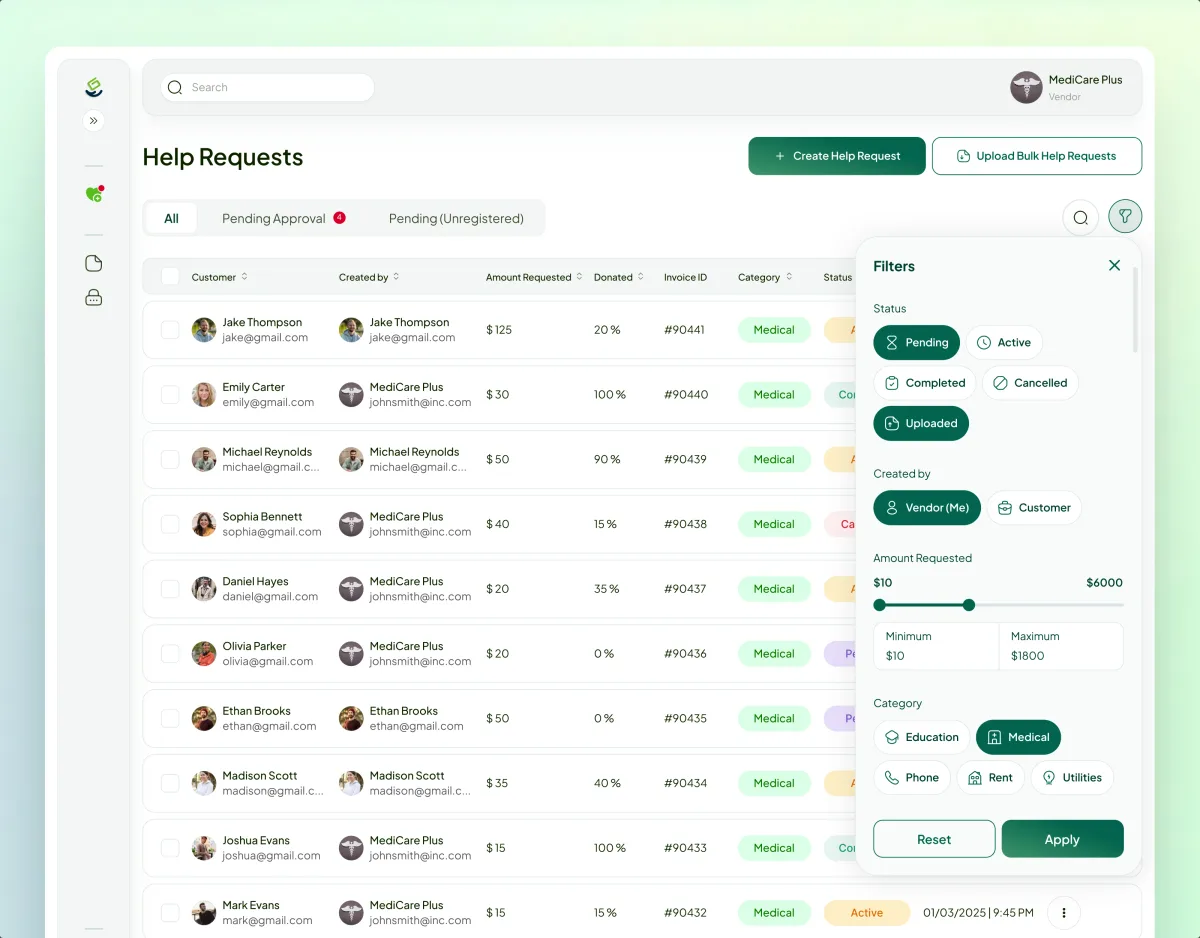
FinTech · Charity · Web platform
Designed and then built a four-role crowdfunding platform — people asking for help, donors, vendors and a Super Admin: a first release on Webflow and Wized, and a second version in Next.js and Supabase now in development.
It pays off when the product is the way your business works, not a side tool. Four signs it is the right step now.
Orders, requests or approvals pass between people by hand, and mistakes are creeping in.
Workarounds, plug-ins and per-seat fees now cost more than they save.
Customers, vendors and your own staff each need their own view, rules and data.
A no-code build or prototype proved demand and now slows every change.
A different starting point

Tell us what the product has to do and who signs in to it. We will come back with a first-release scope and a realistic next step.
The first release, the stack, the acceptance criteria and the review rhythm are agreed before the build.
Tell us who signs in, what they need to get done, and where the design and data stand today.
Message received.
Within 15 minutes, we’ll email you initial feedback and follow-up questions.
Expand your native app to the web with ANODA UX Agency. Discover strategies to reach new users, enhance functionality, and boost engagement. Contact us today!
Compare UX designers and front-end developers by responsibilities, skills, tools, deliverables, career paths and how the two roles collaborate.
Ask to see software the team built and released, not only designs — a design portfolio says nothing about how an app is engineered. Ask who wrote the backend, how permissions were tested, how a failed payment is handled and how a bad release is rolled back. Ask for sample acceptance criteria and a past handoff document. And check that you own the repository and cloud accounts from day one.
A technical scope with acceptance criteria; the architecture, data model and API design; the frontend and backend for every workflow in scope; sign-in, roles and permissions; integrations with payment, email, identity and your own systems; moving existing data in; automated tests and a deployment pipeline; quality checks; and a staged release with monitoring and a rollback path, followed by the handoff. The stack is agreed in the scope, not fixed in advance.
Start here when you know what the product must do, you have decided to build it, and the screens are designed or will be by the time the build starts. If roles, flows and screens are still open, start with Web App Design; design and build can also run as one engagement. If your team runs the backend and only needs the interface, Frontend Development is enough. If the first job is to test demand with the smallest possible product, start with MVP Development. If it is not yet clear what to build, Product Discovery comes first.
Yes. C2C marketplace development and B2B2C app development add work a single-sided app does not have: several roles with their own rules, listings and search, split payouts, seller checks, reviews, disputes and moderation. How each side experiences the product is a Marketplace Design question; the build is about who owns what. We build the listings, payment flows, payout logic and admin tools. The payment provider runs seller onboarding, identity checks and the payouts themselves, and your team owns the policies, fees and dispute decisions.
Approved designs, or a clear view of where the design stands; the workflows, roles and rules the first release must hold; access to the APIs, data and services the app has to use; a cloud account or a decision on one; and one product owner who can accept each slice. If some of this is not ready, the architecture and foundation can start while it comes together.
As written acceptance criteria agreed before the build, not promises made after it. Typical criteria: access checked role by role, secrets kept out of the code, dependencies scanned, a speed budget for key screens, the accessibility level to meet, alerts that reach a named owner, a backup restored at least once, and a rehearsed rollback. Each release is checked against them, and the results are part of your test evidence.
The source code in your repository, the app on your cloud account, documentation of the architecture and integrations, test evidence, release notes, a runbook for deploys and incidents, and a map of who owns what after release. Then your engineers can take over, or fixes, new features, usability testing or design work can continue with us, each on its own scope.
The number of workflows and roles in the first release, how complex the permissions and business rules are, how many services the app connects to and how well documented their APIs are, whether existing data has to move, the quality criteria you need, and how ready the design is. We set a custom scope and estimate in the proposal, fixed or phased, and agree the timeline once scope, access, dependencies and acceptance criteria are clear. A phased scope often suits: the foundation and one core workflow first, then the rest.
Designing the product from scratch, marketing websites, native mobile apps, content, and the fees, approvals and account actions of your cloud, payment and other providers, which stay in your name. Integrations are built to fail safely, not promised never to fail. We guarantee no user or revenue figures, and no security, compliance, performance or uptime level beyond the criteria agreed in writing.
Payyro is a platform we designed and then built: a crowdfunding product where donors pay families' overdue bills directly to landlords and utilities, with four roles in one app. It went from a UX audit to a first release, built low-code on Webflow and Wized. The redesign is now in development as a second version in Next.js, React, Node.js and Supabase. Most of our other published web app cases are design work, and we show them as design, not as proof of a build.