
Is Your App Idea Worth To Invest?
Discover how to evaluate if your app idea is worth investing in. Learn strategies for research, feedback, and monetization planning with ANODA UX Design Agency.
Find out what your first release has to prove — with real users and a tested prototype — before a large budget goes into design and development.

Know what to build first, before you pay to build it.
Explains how people behave today.
Product Discovery
Decides what a new product's first release should be.
Not included
Four pieces, each built on the one before.
The decision at stake, the riskiest beliefs and how each gets tested.
Interviews and sessions, sorted into what held and what did not.
The core journey, tried with the people it is for.
In priority order, with the reason and evidence for every item.
You receive
The product discovery phase names the choice the investment depends on, then finds the cheapest honest way to test each belief behind it.
Method: A product discovery workshop Founders, product, sales and support, with your research and data
Why this method: It gathers what the team knows in one place and shows which beliefs carry the most risk.
Method: User interviews Target users from your customers or leads, or screened participants
Why this method: Today's workarounds show what a new product has to beat, and in whose words.
Method: Prototype sessions The same target users, working through the core journey
Why this method: What people do with a prototype says more than what they say they would do.
Method: A technical check Your engineers or technical partner
Why this method: A feature people want can still be too costly to build first.
Method: Synthesis and a decision review Everything above, reviewed with the people who decide
Why this method: Every item in the scope traces back to evidence, or is marked as an assumption still to test.
Limits and confidence. A handful of interviews explains why people act as they do, not how many will. The decision record says which findings rest on few sessions, what the study cannot establish, and which questions remain open.
It fits when you can name the opportunity but not yet what to build. Four signs it is the right step now.
You know the opportunity and roughly who it is for, but not which features belong in the first release and which can wait.
A build is about to start while key beliefs about users, value or feasibility are still untested. Finding out after launch costs a release.
Stakeholders disagree on what comes first. Discovery gives them shared evidence instead of another round of opinions.
A founder or product owner will join the sessions and act on what discovery finds, even when it changes the plan.
Tell us about the product and the decision in front of you. We will come back with a discovery scope and a realistic start.
Methods, deliverables and the review rhythm are agreed before we start.
Tell us what you are building, for whom, and what you are least sure about.
Message received.
Within 15 minutes, we’ll email you initial feedback and follow-up questions.
Discover how to evaluate if your app idea is worth investing in. Learn strategies for research, feedback, and monetization planning with ANODA UX Design Agency.
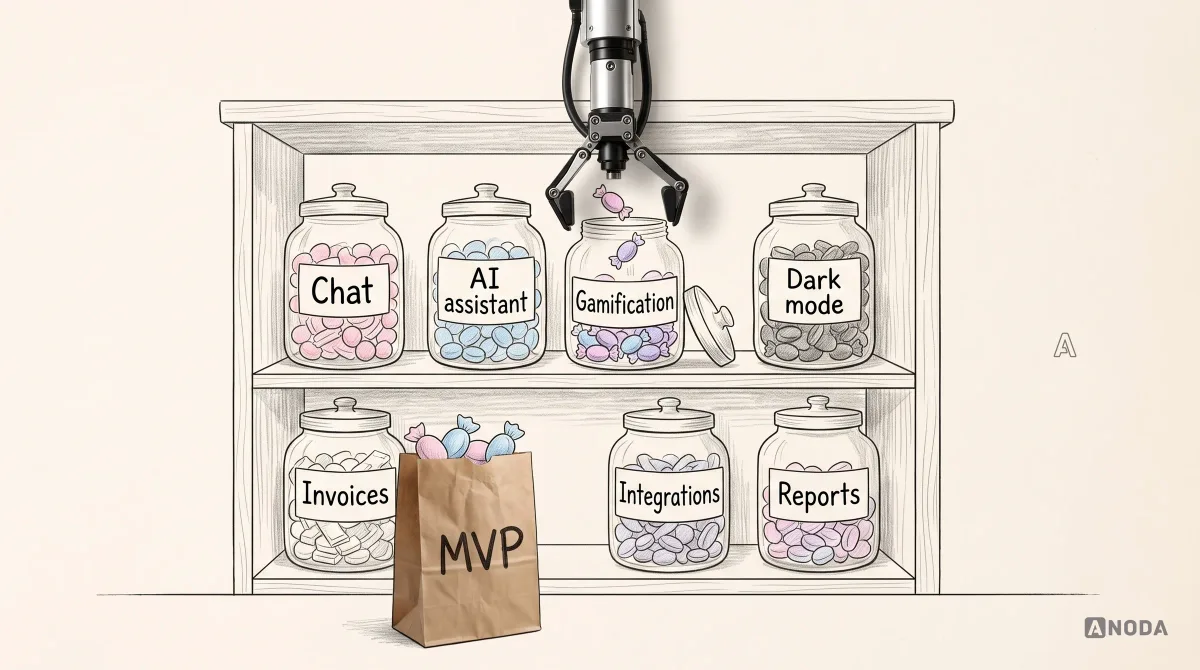
How To Build An MVP App: practical guidance, examples and decision criteria from ANODA. Learn how the topic applies to your product and team.
Whether the problem is real for the people you are building for, which of your beliefs carry the most risk and whether they held up, what the first release must do and what can wait, and which questions are still open. Each point should rest on evidence or be clearly marked as an assumption.
A team that has researched, designed and handed products over to engineers, so the scope it writes is one a team can actually build. Ask how they choose methods, how they report what they could not prove, and who on their team will run the sessions.
A product discovery workshop to frame the decision, a map of your assumptions ranked by risk, interviews with target users, a prototype of the core journey tested with them, and a first-release scope in priority order. It ends with a written decision record and a walkthrough for the people who design and build next.
Start with discovery when you are defining a new product, a large new area or a first release. If a product is already live and something is not working, a UX Audit finds the problems. If the question is how people behave today, UX Research answers it. If the evidence is in and the team needs one direction, Product Strategy fits better.
The idea and the business goal behind it, anything you already know — research, data, sales or support notes — access to customers or leads, or a profile we can recruit against, and a product owner who can review each step and sign off the scope.
A written decision record, the tested prototype, the evidence from users sorted into what held and what did not, and a first-release scope in priority order with the reason for every item. We walk your designers and engineers through it, and it is yours to use with any team.
By how many open questions matter, how many user groups need hearing, how easy they are to reach, and how much evidence already exists. We set a custom scope and estimate in the proposal, fixed or phased, and agree the timeline once scope, access and dependencies are clear.
Full product design, development, market sizing and statistical surveys. Discovery shows why people act as they do and what to build first; it cannot prove how many people will buy. Design and build can follow with us or your own team, scoped separately.