In short
A UX design workshop is not collaboration by default. Without a decision owner, evidence read in advance and an agreed shape for the answer, it is an expensive meeting that rewards the loudest person in the room. Here is how we decide whether a workshop is the right tool at all, and how to plan, run and follow one through so it ends in owned decisions instead of a photographed wall.
In this article
- Make the workshop decision survive into the product
- What a UX design workshop is actually for
- When a workshop is the wrong tool
- Start with the decision, not the workshop format
- Six types of UX workshop and the decision each one settles
- Evidence and pre-work: bring the drawings to the site meeting
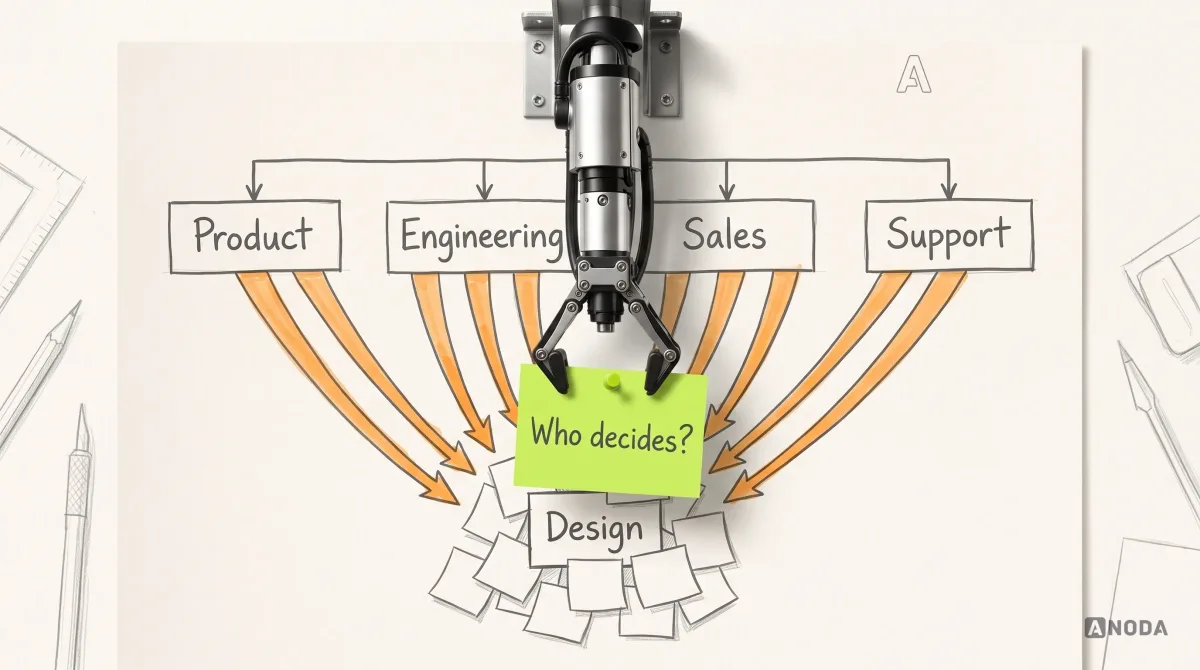
- Who attends, and who decides
- Build the UX workshop agenda around the decision
- Choose UX workshop activities that serve the decision
- Facilitate participation and disagreement
- Decide with a rule, not a mood
- Remote and hybrid UX workshops
- Document decisions before anyone leaves the room
- Turn workshop outputs into product work
- How to tell whether the workshop worked
- Nine ways a UX workshop turns into theatre
- The decision rule
A UX design workshop is not collaboration by default. It is eight salaries in one room for half a day, and unless somebody walks in knowing which product decision has to come out, it ends with a wall of sticky notes, a round of applause and the same argument next Tuesday. The workshop worth running starts with an unresolved decision, a named person who will make it, evidence everyone has read in advance and an agreed shape for the answer. The activities, the timings and the snacks come after.
We run and rescue product workshops, and the failure is rarely the facilitation technique. It is the invitation. Someone books a day “to align on onboarding”, invites everyone who might be offended if left out, picks exercises from a listicle and hopes the energy in the room will do the thinking.
Talk is cheap. Workshops aren’t. Eight people for four hours is 32 working hours, most of a week of one person’s time, before anyone schedules the follow-up meeting about what the workshop meant. Meanwhile the users you paid to acquire are still stuck at the same onboarding step, quietly cancelling.
Here is the method we use: decide whether you need a workshop at all, then plan it, run it and follow it through until the decision shows up in the product.
Make the workshop decision survive into the product
If the workshop ends with agreement but no usable design brief, the team pays twice: once for the room and again for the arguments that return during delivery. More voting dots cannot resolve an undefined user task or a missing owner. ANODA connects the evidence, the decision and the product work that follows, so the workshop produces a direction the team can execute.
Qarma illustrates the level of product detail that direction needs to support: an inspector records a finding on a phone, while the quality team reviews reports and follows corrective actions on the web. Our design work connected those roles, screens and reusable UI in Qarma’s existing identity. A decision about priorities has to work across that journey, not just look convincing on a workshop wall.
With ANODA, the output becomes a focused brief, agreed priorities and the flows and interface decisions needed for the next stage. Ask us to lead your product workshop. Bring the decision that is blocking delivery; we will help your team settle it and turn the outcome into useful product work.
What a UX design workshop is actually for
A UX design workshop is a time-boxed working session in which the people who hold the necessary knowledge resolve one defined product question together, using evidence prepared in advance, and leave with a recorded decision, its owner and the next actions. Anything that produces “insights”, “energy” or “alignment” without a decision is a meeting in fancy dress.
The model to copy is not a brainstorm. It is a hospital case conference. The surgeon, the radiologist and the oncologist sit down with the scans already on the screen, discuss one patient, disagree out loud and leave with a treatment plan and a named consultant who owns it. Nobody opens with an ice-breaker. Nobody asks the radiologist to draw their feelings. The scans arrive before the specialists do.
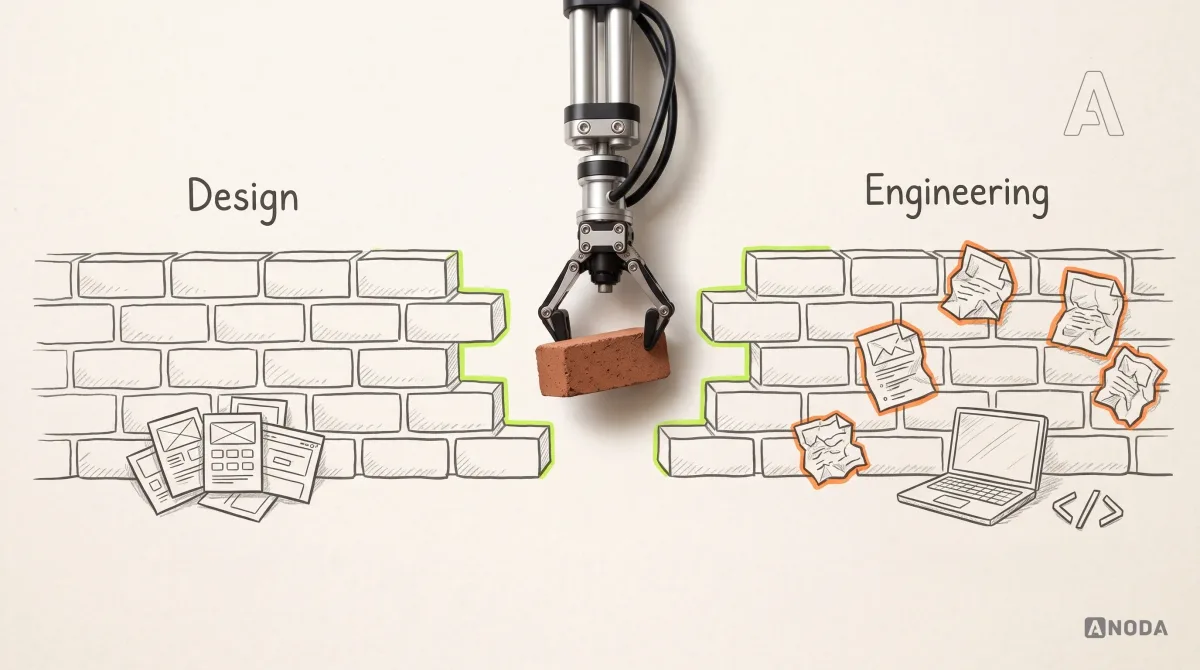
Most workshops we are asked to fix got the order backwards: the room came first, the question second and the evidence never. The output looks productive, hundreds of notes photographed from three angles, and settles nothing. A product team can’t build from a photo of a wall.

When a workshop is the wrong tool
A workshop is expensive, synchronous and good at exactly one thing: resolving a question that needs several people’s knowledge at the same time. Different question, different method.
- The answer lives in users’ behaviour, not in the team’s heads. No amount of stakeholder debate will tell you why customers abandon a step. Go and watch them. That is UX research: interviews for motivation and context, a usability test for whether people can finish the task at all. A workshop can interpret evidence. It can’t manufacture it.
- The decision needs one expert, not six. If the content designer can fix a confusing error message by Thursday, a workshop about it is a committee meeting about a comma.
- People need to read, not talk. Comments on a flow are faster as an async review: a link, a deadline and a named reviewer for each question.
- Two or three people can settle it. A working session at one desk beats a ceremony every time.
- Nobody knows what the decision is yet. Then the first job is a 30-minute call with the person who owns the problem. Workshops don’t discover their own purpose; they just burn the budget looking for it.
We turn down workshops that can’t change an outcome. That isn’t modesty. A session that can’t move a decision is an expensive way to feel busy, and the client pays for it twice: once for the day, and again for the quarter spent building on whatever the loudest person said.

Start with the decision, not the workshop format
Teams usually start with the format: “let’s do a design sprint”, “we need a journey-mapping session”. That is hiring a coach and a tour guide for the school trip before anyone has decided where the trip is going. Everybody gets on, the engine starts, and the driver asks for the address.
Write a one-page brief before you choose anything else. It answers four questions, in this order:
- Which decision is unresolved? One sentence that can actually be answered: “Which onboarding step do we redesign first?”, not “improve onboarding”.
- What evidence exists, and what’s missing? Analytics, research, tickets, sales notes. If the critical piece is missing, stop and get it.
- Who has to be in the room, and who decides? Knowledge sets the invitation list, not seniority. One person owns the final call.
- What output will we accept? A ranked list with owners, a chosen flow direction, rejected options with reasons. Decide the shape of the answer before you look for the answer.
Only then choose the workshop type, the activities, the length and the tools. If the brief can’t be written, the workshop can’t be run, and finding that out costs one afternoon instead of eight people’s day.

Six types of UX workshop and the decision each one settles
Workshop types are not a menu of team activities. Each one exists to settle a particular kind of question, and each fails in its own predictable way.
| Workshop type | The decision it settles | Inputs it needs | What you leave with |
|---|---|---|---|
| Discovery | Which problem is worth solving, and for whom | Research findings, support and sales data, the business goal | A problem statement with evidence, and open questions for research |
| Alignment | What success means and which constraints are fixed | Business targets, technical and legal limits, current metrics | One agreed goal, one success measure, a list of non-negotiables |
| Prioritisation | What goes first and what waits | Candidate options, evidence per option, a scoring rule | A ranked list with owners, and the options explicitly parked |
| Ideation | Which solution directions are worth designing | A framed problem, constraints, how users cope today | Two or three directions to prototype, each with a reason it survived |
| Journey mapping | Where the experience breaks and who owns each break | Real journeys from research, step-by-step analytics | A map of breaks with severity and an owner per break |
| Critique | Whether a design meets its goal, and what changes | The design, the goal, the evidence behind both | Changes tied to the goal, and a go or no-go |
The type follows the decision. A team that runs ideation when its real question is prioritisation leaves with sixty fresh ideas and the same unanswered “which first?”. A team that maps a journey without research behind it draws the journey it imagines, which is the one path users aren’t taking.
Critique goes wrong in its own special way: feedback drifts into taste, and the loudest taste wins. We cover how to keep critique tied to goals in our guide to giving design feedback.
Evidence and pre-work: bring the drawings to the site meeting
Picture a site meeting called to decide where a new kitchen wall goes. The architect, the electrician, the plumber and the client all turn up, and nobody brought the drawings. They argue about sockets from memory, the loudest voice wins, and a week later the plumber discovers the wall would sit on the main drain. That is a workshop without pre-work.
Evidence belongs in participants’ hands before the session, not in a forty-slide opening presentation that eats the first hour. Send a short pre-read three working days ahead, readable in ten minutes:
- the decision and why it has to be made now;
- what we know, each point with its source;
- what we don’t know, stated plainly;
- the options already on the table;
- what each participant must bring: a customer case, a constraint, a number.
Weak or absent research is the most common reason a workshop turns into a debating society. When evidence is thin, opinions fill the vacuum, and opinions arrive ranked by job title. If the pre-read can’t say what users actually do at the step in question, postpone and do the research. It feels slower. It is cheaper than a quarter of engineering built on a hunch.

A preparation checklist we reuse, a week before the session:
- the brief is signed off by the decision owner;
- evidence is gathered, and every gap is either filled or named;
- the invitation list matches the brief, with a reason next to every name;
- the pre-read is out, with a named person to answer questions about it;
- the room or the board is set up with the evidence already on it;
- a scribe is assigned who isn’t also a participant;
- the decision rule is agreed with the owner in advance.
UX research
Debating assumptions again? Bring evidence into the room instead.
We run the interviews, usability sessions and workflow research your decision depends on, and hand the team findings it can act on before anyone books the room.
Who attends, and who decides
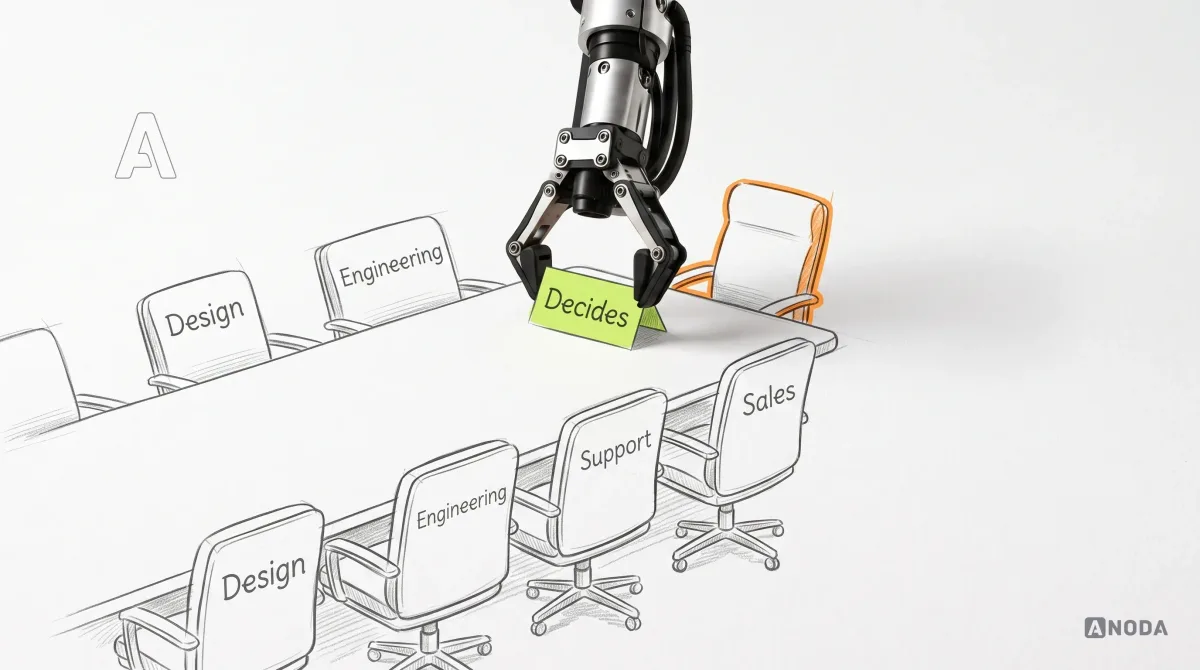
The invitation list is where most workshops are lost before they start. Invite by knowledge, not by politics. Every person in the room should complete the sentence “we need them because they know…”. “Because they’d be upset” is not a field of expertise.
The role model we use:
- Decision owner. One person who makes the final call with the agreed rule. Present for the whole session. Speaks last.
- Facilitator. Runs time, process and fairness. Doesn’t pitch ideas and doesn’t own the outcome: the referee can’t also play centre forward.
- Evidence holders. The researcher or analyst who can answer “how do we know?”. They present what the data says and stop where it stops.
- Domain experts. Two to four people with constraints the decision can’t ignore: an engineering lead, someone from support, someone who talks to customers for a living.
- Scribe. Writes the decision log live, where everyone can see it. Doesn’t argue; nobody writes well mid-fight.
That’s six to nine people. Beyond that, discussion becomes a queue, and the quiet specialist holding the crucial detail never reaches the front. Observers who “just want to listen” aren’t free either. Their presence changes what people are willing to say.

A missing decision owner is the classic screw-up. It’s a site meeting where the only person who can approve the change order is on holiday: everybody agrees on something, nobody can sign it, and the builders wait on full pay. If the owner can’t attend, move the workshop. Don’t run it and “update them after”. You’ll run it again, and pay twice.
Build the UX workshop agenda around the decision
An agenda is not a list of fun exercises between coffee breaks. It is a funnel: open with the decision, widen to evidence and options, narrow through a rule, close on owners and dates. Any block that doesn’t feed the next one is decoration.
The anatomy we adapt for almost every session runs in this order:
- The decision and the rules. The question, the owner, the decision rule, what’s out of scope. Fifteen minutes.
- The evidence, questioned. Not presented. People read the pre-read; this is where they challenge it.
- Options, written individually and in silence. Everyone writes before anyone talks.
- Clustering and discussion. Merge duplicates, surface disagreements, ask what each option needs to be true.
- Scoring against the agreed criteria. Individually first, then compared.
- The decision. The owner makes the call out loud, with the reason.
- Log and assign. Every decision gets an owner and a date before anyone leaves.
Too many goals is how an agenda dies. Going to the supermarket hungry without a list gets you three kinds of biscuits and nothing for dinner. A workshop that tries to “align on the vision, prioritise the roadmap and sketch the new dashboard” in one afternoon ends with a trolley of half-decisions. One decision per session. Two, if they’re joined at the hip.
Half a day is plenty for one well-prepared decision. A full day usually means the preparation didn’t happen and the room is doing it live, at eight times the hourly rate.

Choose UX workshop activities that serve the decision
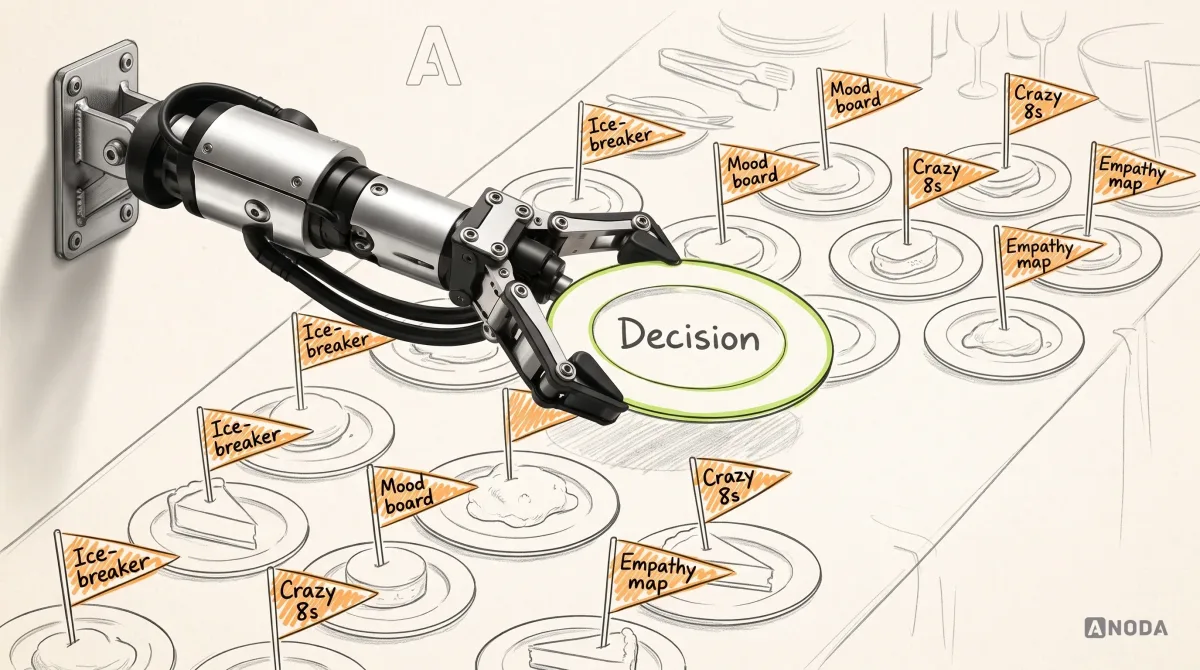
Activity libraries list hundreds of UX workshop activities, and that’s the trap. Pick exercises for novelty and you get a potluck where everyone brought dessert: twelve lovely plates, no main course, and the whole room slightly queasy by three o’clock. Everybody had fun. Nobody ate.
One selection rule: every activity must produce the input the next block needs. If you can’t say what it hands over, drop it.
| Activity | What it produces | Use it when |
|---|---|---|
| Silent writing | Options from everyone, not only the confident | You need options before one voice anchors the room |
| Affinity clustering | Themes, with duplicates merged | Options or research notes need structure |
| Dot voting | A quick signal of where the group leans | You need a shortlist, not a final answer |
| Weighted scoring | A ranked list with visible reasons | Options compete for the same capacity |
| Journey walk-through | Breaks and handoffs on one timeline | The problem spans steps, teams or channels |
| Sketching rounds | Concrete directions people can compare | Words are going round in circles |
| Pre-mortem | Risks named before commitment | The decision is expensive to reverse |
Ice-breakers are fine if they take two minutes and get everyone saying something out loud. A forty-minute “draw your team as an animal” is how workshops earned their reputation.

Facilitate participation and disagreement
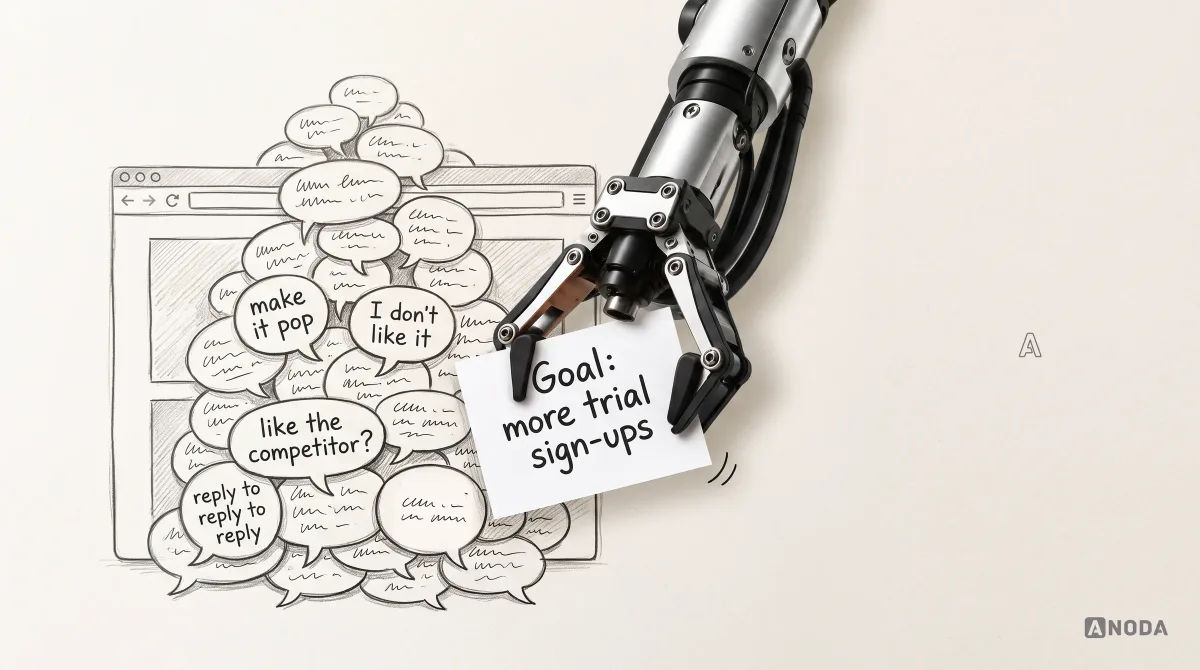
Put a vice-president, two designers, an engineer and a support lead in a room, ask an open question, and you’ll hear the vice-president’s answer. Then four polite variations of it. A classroom works the same way: the front row answers everything, the back row goes quiet, and the teacher concludes the class understood. Senior-voice dominance isn’t malice. It’s gravity, and the facilitator’s job is to design around it.
The facilitation rules that do most of the work:
- Write before you talk. Every round of ideas, votes and scores starts individually, in silence. Discussion comes after positions are on the board.
- Vote before you discuss. Once the most senior person has spoken, the vote is a formality. Collect scores first, reveal them together.
- Seniority speaks last. The decision owner and the most senior people hold their view until everyone else has spoken.
- Go round the table. Everyone gets a turn, including the person who “has nothing to add”. They usually do.
- Log disagreement, don’t smooth it. A disagreement written down with its reason is useful data. One nodded away comes back in the sprint review.
- Park, don’t wander. Anything off the decision goes on a visible parking list with a name next to it.

Watch for the quiet failure too. In the Abilene paradox, a family drives through the heat to a bad dinner nobody wanted, because each of them assumed the others were keen. Workshops manufacture the same false consensus: everyone agrees because everyone thinks everyone else agrees. Ask directly: “What would make this the wrong decision?” If nobody answers, ask the engineer.
Decide with a rule, not a mood
Many hands make light work; many heads make long meetings. A room with no decision rule negotiates until someone has a train to catch, and the decision goes to whoever stayed longest. That is how you get a camel: a horse designed by a committee.
Agree the rule with the decision owner before the session and announce it at the start:
- The owner decides after input. The fastest and most honest rule for most product decisions. The group advises; one person chooses and says why.
- Weighted scoring. Options scored against two or three criteria agreed in advance. The highest total goes first unless the owner overrides it and writes down the reason.
- Consent. The proposal goes ahead unless someone raises a reasoned objection that it would cause harm. Useful when the decision needs broad commitment; painfully slow when used for everything.
A prioritisation session without criteria is an exam without a mark scheme: every teacher grades a different paper, and the pupils learn that results are a lottery. Write the criteria down, weight them and let the numbers carry the argument. Scoring won’t make the decision for you, but it makes every disagreement specific. “I scored impact at 2 because 62% already get through” is a conversation. “I just don’t like it” isn’t.

Remote and hybrid UX workshops
Remote workshops fail differently. Attention is shorter, silence is ambiguous, and somebody is always answering email in another tab. Running one is herding cats over video, so shorten it and design the chaos out:
- Split long sessions. Two sessions of 75 to 90 minutes beat one afternoon on video. Move the individual work, reading and silent option writing, into async time before them.
- Build the board in advance. The decision on top, evidence pinned and locked, one area per agenda block, a parking lot. Nobody should be drawing frames while the clock runs.
- Keep microphones open. Cameras off for silent work is fine. Muted by default is not: people stop contributing.
- Hybrid means everyone on their own laptop. If half the group shares a meeting-room camera, the remote half becomes an audience.
- Name the next speaker. “Support, then engineering” beats “anyone?” on a call every time.
The big advantage of remote work is the paper trail: everything is already typed. Use it. The scribe’s log and the board are the record by default.


Document decisions before anyone leaves the room
If it isn’t written down, it wasn’t decided. Everyone leaves a workshop with their own memory of what was agreed, and those memories drift towards whatever each person wanted in the first place.
The decision log is the one artifact that matters. For every decision, record:
- the decision, in a sentence someone outside the room would understand;
- the reason and the evidence it rests on;
- the options rejected, and why;
- any dissent, with the name of whoever holds it and what would change their mind;
- the owner and the date of the next action.
The scribe writes it live on the shared screen, and the last twenty minutes are spent reading it back. That is when people discover they agreed to different things, which is exactly when you want to find out. Not three weeks later, in a pull request.
Photos of sticky notes are not documentation. They’re wallpaper.

Turn workshop outputs into product work
The workshop ends, the adrenaline fades, and everyone goes back to a full calendar. A fortnight later someone asks, “Didn’t we decide something about onboarding?” Strike while the iron is hot. Follow-through is part of the workshop, not an optional sequel.
The follow-through checklist:
- Within a day: the decision log goes to every participant and to the stakeholders who weren’t there, with a deadline for objections.
- Within three working days: each decision becomes backlog items or a design brief, linked to the log so the reason travels with the ticket.
- Within two weeks: the first design output is reviewed against the decision, not against fresh opinions.
- At the agreed checkpoint: the measure named in the brief is checked, and the log records whether the decision held.
An owner without a deadline is a volunteer. A deadline without an owner is a wish. The session isn’t over until every line in the log has both.
This is also the stage where a recorded decision most often dies: it still has to become flows, states and screens engineering can build, and the reason tends to fall off on the way. That’s where our UI/UX design work picks it up, with the decision log as the brief.

How to tell whether the workshop worked
Don’t grade a workshop by the feedback form. “Great energy, loved the snacks, 4.8 out of 5” measures the catering. A week after the session, ask:
- Was the decision in the brief actually made?
- Does every decision have an owner and a date?
- Is dissent recorded with a condition for revisiting it?
- Do tickets or a design brief exist, linked to the log?
- Could someone who wasn’t there explain the decision and the reason from the log alone?
- Did anything get decided that the evidence contradicts?
- Is the check on the measure booked in someone’s calendar?
Six or seven honest yeses, and the workshop paid for itself. Four or fewer, and you held an expensive meeting: find the step that broke and fix that step before you book the next room.

Nine ways a UX workshop turns into theatre
We see the same mess in almost every workshop we’re asked to rescue. Here is what each failure looks like from the inside, and the fix.
| Failure | What you see | The fix |
|---|---|---|
| No decision owner | Agreement in the room, reversal at the next leadership meeting | Name the owner in the brief. No owner, no workshop |
| Wrong participants | The person who knows the constraint hears the decision second-hand | Invite by knowledge, with one reason per name |
| Weak or no research input | A debate about what users “probably” do | A pre-read with sources; postpone if the gap is critical |
| Exercises chosen for novelty | Colourful boards, nothing that feeds the next block | Every activity produces the next block’s input |
| Senior voices dominate | Votes cluster around the first opinion spoken | Silent writing, hidden votes, seniority speaks last |
| Too many goals | Every block overruns and nothing gets finished | One decision per session |
| No prioritisation rule | The decision goes to whoever argues longest | Weighted criteria or an owner rule, agreed in advance |
| No documented decisions | Three versions of “what we agreed” a week later | A live decision log, read back before anyone leaves |
| No owner or deadline afterwards | A great day and no change in the product | Log within a day, tickets within three, owners with dates |
The decision rule
A workshop is a tool, not a ritual. Define the decision and its owner, send the evidence before the session, time-box the work, write the disagreements down and leave with explicit choices, owners and next actions. Everything you don’t decide in the room, you’ll pay to discuss again outside it, while the product keeps losing the users you paid to bring in.
Product design with ANODA
Got a decision stuck in meetings? Let’s get it into the product.
We prepare the evidence, run the session with the people who know, and carry the decision into flows and screens your team can build. And if a workshop can’t change the outcome, we’ll tell you before you book one.
Written by