In short
An MVP is defined by what it leaves out. Explain the idea so a stranger gets it, find the one reason to choose you, test five or six core bets on top of the foundations they need, run go-to-market alongside the build, fix the launch date, and let AI speed up a product that already knows where it is going.
In this article
- What an MVP is, and what it is not
- Step 1: explain the idea so someone else understands it
- Step 2: find the reason anyone would choose you
- Step 3: choose five or six core bets, and separate them from foundations
- The hidden scope of “simple” products
- Step 4: cut everything that does not test the value
- Choose the platform for the first version
- Build, buy or borrow the foundations
- What really drives the cost of an MVP
- Step 5: design the user flow before the screens
- Step 6: plan go-to-market before the product is finished
- Step 7: set a fixed launch date, and protect it
- Step 8: use AI inside boundaries you set
- Step 9: stabilise and test before you launch
- Step 10: launch, watch activation, then decide
- A worked example
- Common MVP mistakes
- How we build MVPs with founders
- The decision rule
To build an MVP app, first decide what it will not contain. Explain the idea so a stranger understands it, name the audience and the problem, say why anyone would choose it over what they use today, and limit the first release to around five or six core feature bets. Build the foundations those bets need, set a fixed launch date, start go-to-market before the product is finished, and only then let design, code or AI speed things up. Everything else is a feature for version two, or never.
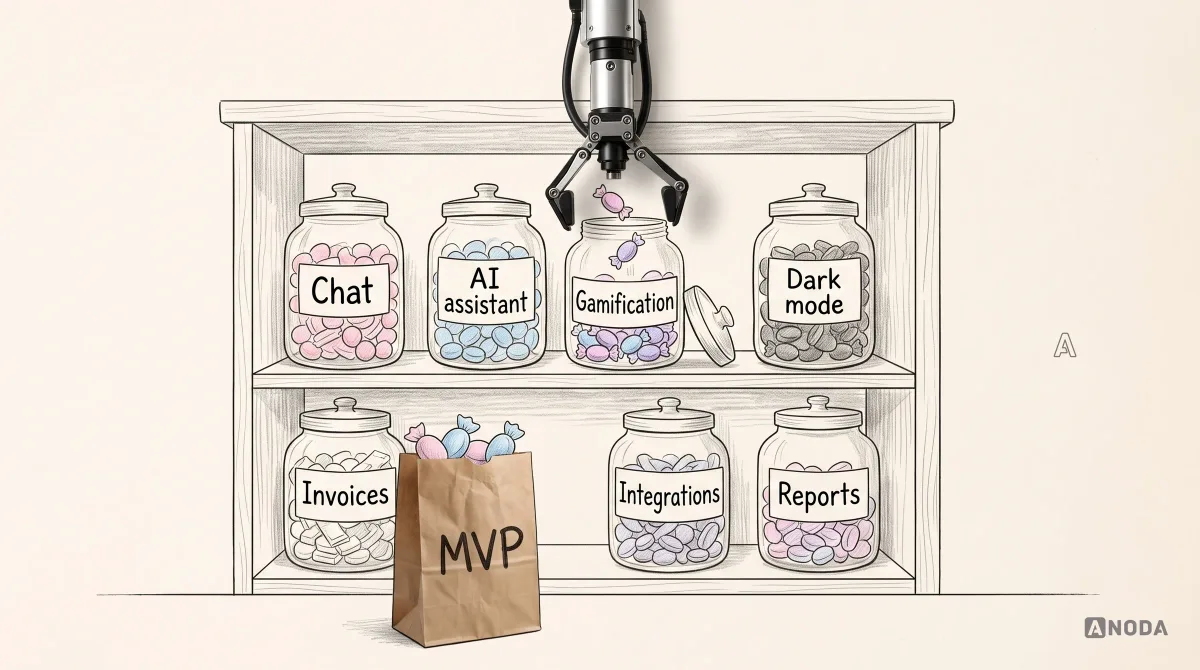
That sounds obvious, and nearly every founder agrees with it in the first meeting. Then the list grows. A chat, because users will want to talk. An AI assistant, because investors ask. Dark mode, because the designer likes it. Integrations, because a competitor has them. Three months later the “minimum” product has twenty features, none of them finished properly, the launch date has moved twice and the budget meant for marketing has gone into screens nobody has used.
Our work with founders keeps exposing the same expensive pattern. What has changed is the speed. With AI-assisted design and development, a team can produce screens and code faster than ever. That makes a bloated MVP cheaper to start and much more expensive to finish. If you don’t know what you are building, AI lets you build the wrong thing ten times faster, and in ten times the quantity.
This guide walks through the order we use with founders: explaining the idea, finding the one reason to choose you, picking the core bets and separating them from infrastructure, designing the flow, running go-to-market in parallel, setting a deadline, using AI inside clear boundaries, and deciding what to do after launch.
What an MVP is, and what it is not
A minimum viable product is the smallest version of your product that can test whether its core value works for real users. Its job is to produce evidence. Not revenue at any cost, not investor applause, not a perfect interface. Evidence: do people understand it, do they try it, do they come back, does the thing you think is valuable actually matter to them?
That definition rules out two common mistakes.
An MVP is not a low-quality full product. “We’ll launch everything, just rough” is not an MVP. It is a big, unstable product with a small budget. When it fails, you cannot tell why, because everything was half-built. A narrow product that works well tells you far more than a wide one that almost works.
An MVP is not a prototype. A clickable prototype can test whether people understand an idea. An MVP has to actually work, with real data, real accounts and real reliability, because you are asking people to use it for real. That means some unglamorous things have to be in it, which we will come to.
So the honest question is not “what can we fit in?”. It is “what is the smallest set of things that can prove or disprove our idea, and what do those things need in order to work?”
Or, as Oksana Kovalchuk, ANODA’s founder, puts it:
With an MVP, the real question is what must not go into it. Whether you wrote the code yourself or generated it with AI makes no difference. An MVP is five, maximum six features. No more.
 Oksana KovalchukFounder & CEO, ANODA
Step 1: explain the idea so someone else understands it
An idea is not ready for design if you can’t explain it. That is the first and cheapest test, and many products fail it without noticing.
The explanation does not have to be polished. We have started projects from long specifications, slide decks, voice notes and once from a photo of a marker sketch on a café napkin. The napkin was fine. The format never matters. What matters is whether another person can understand three things: who it is for, what problem it solves, and why it is better than what they do now.

A rough comparison often works best. “It’s a booking tool like the ones you know, but when a client books a call, there’s a little celebration and then a one-minute breathing exercise before the meeting.” Nobody needs more than that to understand the product, argue with it and start designing it.
Now the opposite. A founder who says “it’s hard to explain, it’s completely new, nobody has done anything like it” is usually not describing innovation. They are describing a communication problem. There is an old line that if you cannot explain something to a five-year-old, you don’t really understand it yourself. If nobody except you can understand your idea, it has already failed the most basic validation. Who are you going to sell it to? What interface would make it clear, when you can’t make it clear in a sentence?
Try this before anything else:
- Write the idea in two sentences without industry jargon.
- Say it out loud to three people who could plausibly be users, not to your co-founder or your partner.
- Ask them to explain it back to you. If their version is wrong, your explanation is wrong, not their understanding.
- Ask what they use today for the same problem, and what annoys them about it.
If they get it and recognise the problem, you are ready to decide what to build. If they don’t, no amount of design will fix it. You would just be building a very expensive way to confuse people.
Step 2: find the reason anyone would choose you
Here is the uncomfortable part. For most products, building them is not the hard problem. The hard problem is getting people to choose them over the alternatives, including the alternative of doing nothing.
Take a CRM. Plenty of teams could build one. We built our own internal one, because the tools we tried were too generic for how we like to automate our work. That was the easy bit. The hard bit, for anyone who wanted to sell such a product, would be answering one question: why should a hundred other companies choose this CRM instead of the ones they already know? That is the unique value proposition, and it is where most MVPs are weakest.
Your value proposition should be specific enough to argue with:
- For whom exactly. Not “small businesses”. “Cleaning companies with five to thirty staff who schedule jobs on WhatsApp.”
- Instead of what. The spreadsheet, the group chat, the generic tool, the paper diary.
- Better at what. One or two things, stated plainly. “Schedules the week from your client list in two minutes, and cleaners see today’s jobs on their phone.”
- Why now, why you. Something you know or can do that others can’t or won’t.
If your answer is “it does everything the big tools do, but simpler”, be careful. Simpler is real value, but it is also the promise every new product makes. You need a reason people can feel in the first five minutes.
This is also the moment to think about positioning and demand, not after launch. We come back to go-to-market below, because leaving it until the product is finished is one of the most expensive MVP mistakes there is.
Step 3: choose five or six core bets, and separate them from foundations
Now the list. An MVP should test roughly five or six core feature bets. A bet is a capability that expresses your value: the thing you believe users will come for. Not every screen, not every setting, not every technical component. The things that make your product your product.
Why so few? Because every extra bet makes the product harder to understand and the results harder to read. If you launch with twelve independent features, a new user may understand none of them, get confused and leave. And when activation is low, you now have twelve suspects instead of five. Which feature did people ignore? Which one confused them? Was it the product as a whole? You would need twelve separate investigations to find out, and you won’t have the budget for them. Jack of all trades, master of none, validated by nobody.
But here is where founders often get confused: five core bets does not mean five screens, or five things in total. A product also needs foundations to work at all:
- Sign-in and accounts, and often password reset and email verification.
- Roles and permissions, if more than one kind of person uses it.
- Organisations or workspaces, and tenancy, if it serves several companies.
- Billing and subscriptions, if people pay.
- Security, privacy and data handling.
- Error monitoring and basic analytics, so you can see what breaks and what people do.

These are not optional extras, and they are not bets. They are the plumbing. A product with brilliant core features and no working sign-in is not an MVP. It is a demo. The mistake is using “we need the foundations anyway” as an excuse to add more bets, or treating the foundations as quick because they sound boring.
They are not quick. This is where “simple” products surprise people.
The hidden scope of “simple” products
“It’s just a CRM.” “It’s just a booking app.” “It’s just a marketplace.” Every founder has said a version of this, and it is almost always wrong.
Look at what a credible CRM actually needs. Before anyone sees a contact, there is sign-up and sign-in, organisations, roles and permissions, tenancy, subscriptions and invoicing, and user management. That is only the base. Then the CRM part: people, companies, deals and the relationships between them, notes, tasks, email, calls, and these days call recordings and transcripts, because plenty of teams expect their notes to write themselves. Then search good enough to find things, forms, tracking, booking a call, some AI assistance, a few marketing basics. That is a standard CRM, not an ambitious one.

When we built our internal CRM, the first working version came together quickly with AI-assisted development. Then it needed stabilising, because a fast first version is never a finished one. And it could stay small only because it is ours: it has no public sign-up, no invoicing, no organisation creation and no tenancy. Those are exactly the parts a product sold to other companies would need, and each of them is a large piece of work in its own right.
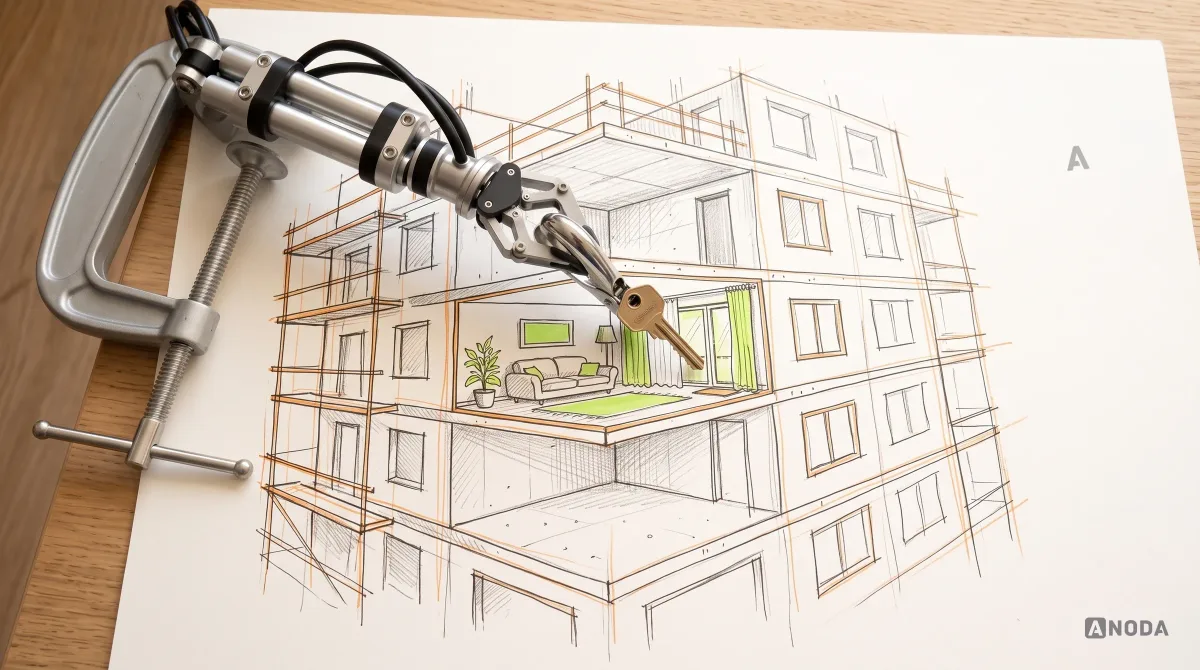
That is the reality check for your MVP scope. Before you commit to a list, write down everything underneath each bet. A “simple” feature often sits on top of several foundations that take longer to build properly than the feature itself. It is an iceberg: the part you pitch is the part you can see.
Step 4: cut everything that does not test the value
Once you have your bets and foundations, make a third list: everything else. Then leave it alone.
This is where founders struggle most, and it is rarely about logic. It is about fear. First-time founders, especially, are afraid of wasting money. And because they are afraid of wasting money, they try everything: another concept, another screen, another feature just in case. They end up spending several times what the MVP should have cost. Oksana compares it to a child in a sweet shop: give me that, and that, and that one too, can we try this one as well?
A useful test for anything on the “maybe” list:
- Does it help test the core value? If not, it waits.
- Would a first user notice it’s missing? If they wouldn’t, it waits.
- Is it a foundation the core bets can’t work without? If yes, it goes in, built properly.
- Is it here because a competitor has it? Then ask why users would come to you for the same thing.
- Is it here because AI made it cheap to generate? Then remember that cheap to generate is not cheap to test, support and maintain.
Building every feature to find out whether the product works is planting a whole orchard to find out whether the soil grows apples. Plant one tree. Watch it for a season. You will know more, for a fraction of the cost, and you will still have the land.
The features you cut are not dead. They are waiting for evidence. After launch, some of them will turn out to be exactly what users ask for. Most won’t. You will be glad you didn’t spend three months on them.
Choose the platform for the first version
“MVP app” usually means a mobile app, and that raises a question the core bets alone don’t answer: where should the first version live?
Start where your users already are when they have the problem. A cleaning company owner planning next week sits at a laptop. A cleaner checking today’s jobs is on a phone in a stairwell. That is two platforms, but not necessarily two apps: the owner’s side can be a web app and the cleaner’s side a simple mobile app, or both can start as a responsive web app until you know the product works.
A few practical rules help:
- One platform first, unless the value needs two. Building iOS, Android and web in parallel triples the surface you have to design, test and support before you know whether anyone cares.
- Web is the fastest way to learn. No store review, no update cycle, instant fixes. If your MVP can test its value in a browser, that is often the cheapest first step.
- Go mobile when the value is mobile. Camera, location, push notifications, offline use or “used on the move all day” are real reasons to start with an app.
- Cross-platform frameworks can cover both stores from one codebase, which suits most MVPs. Fully native development makes sense when the product depends on deep platform features or demanding performance.
- Plan for the stores. App review, store listing, screenshots and privacy details all take time, and they belong in the launch plan, not in the last week.
The platform decision is not about taste or trend. It is about which surface lets you test the core value fastest, with the least you have to build twice.
Build, buy or borrow the foundations
Remember the foundations from step 3: sign-in, roles, billing, security, monitoring. You have to have them. You do not have to build all of them from scratch.
For most MVPs, the smart move is to borrow the plumbing and build the bets. Established services for authentication, payments and subscriptions, email, analytics and error monitoring give a small team proven foundations to integrate and configure, instead of rebuilding all of them in a few weeks. Using them frees your budget for the part nobody else can build: the thing that makes your product worth choosing.
The same logic applies to testing demand. Sometimes the first “MVP” doesn’t need to be an app at all. A landing page, a spreadsheet run by hand behind a simple form, or a concierge version where you do the work manually for ten customers can tell you whether the value is real before anyone writes production code. It is the climber’s rule: carry what you need to reach the next camp, not the whole base camp.
What you should build yourself is whatever carries your value proposition. If a service already does it perfectly, it probably isn’t your differentiator.
What really drives the cost of an MVP
Founders understandably want a number. We won’t give a generic one, because the honest answer depends on a handful of decisions you control far more than any hourly rate does:
- The number of core bets. Each one adds design, build, testing and support.
- The foundations. Roles, organisations, tenancy and billing are where “simple” products quietly double in size.
- Platforms. Web, iOS and Android are three surfaces, even when they share code.
- Integrations. Every external system you connect to brings its own edge cases and failures.
- Compliance and data. Health, finance, children and anything regulated add review, security and documentation.
- Indecision. Rounds of concepts and changes of direction cost more than most features. This is the line item nobody writes into the estimate.
The cheapest MVP is not the one with the lowest day rate. It is the one with the clearest scope and the fewest reversals.
Step 5: design the user flow before the screens
With the scope decided, map how people will actually move through the product before anyone designs a screen. Where does a new user start? What do they have to do before they see value? What happens when something is empty, fails or needs someone else’s action? Which role sees what?
The user flow is where the product’s logic lives. It is also where scope problems show up early and cheaply. A flow makes it obvious when a “small” feature needs three new screens, a permission rule and a notification to work. It shows dead ends, loops and states nobody thought about. Changing a box on a diagram takes minutes. Changing a built screen takes days.
For an MVP, pay special attention to the path from sign-up to first value. How many steps before a new user sees the one thing your product is for? Every step you can remove is a user you are more likely to keep.
The flow is also what you will hand to AI later. More on that shortly.
Step 6: plan go-to-market before the product is finished
One of the most expensive MVP patterns we see goes like this. The team designs the product, builds it, polishes it, prepares to launch, and only then calls in marketing. Marketing asks who it is for, what people search for, where they spend time and what the message is. Nobody knows. Worse, they find out that almost nobody is looking for this kind of product at all.
That is not a launch problem. It is a planning problem that was left until the end, when fixing it is most expensive.
Go-to-market should run alongside the product from the first week:
- Positioning and audience, worked out with the value proposition in step 2.
- Demand check. Do people search for this problem? Do they talk about it in communities? Are competitors spending money to reach them?
- A simple landing page that explains the product and collects interest before it exists. If nobody signs up for the waitlist, that is data, and cheap data.
- A launch plan: where the first users will come from, what they will be told, and what they should do first.
- A measurement plan: what counts as activation, and how you will know whether the MVP worked.

None of this needs a big marketing budget. It needs someone to think about the market as seriously as the product, and early enough that what they learn can still change the product.
Step 7: set a fixed launch date, and protect it
In today’s market, Oksana’s recommendation is to get an MVP out within roughly two and a half to three months. Plan regulated-product work, hardware, migrations and platform dependencies into the scope from the start. For a software MVP, a short, fixed horizon is the strongest tool for making decisions.
The reason is simple. Without a deadline, every question can be answered with “let’s try one more option”. With a deadline, every question has to be answered with a choice. The deadline does the arguing for you.
It used to be common for design alone to take six months on a first product, with the founder asking for one more concept, one more round, one more version of the home screen. That time was not buying quality. It was postponing the frightening part: showing the product to the market and finding out.
Founders often focus on beautiful screens instead of the business. It is a band that rehearses for a year and never books a gig. The playing gets better. Nobody hears it.
We keep fixed deadlines for our own products too, and we feel it when we miss one. When our own website slipped by three weeks, the team felt it, because everyone understood what the delay cost the business. That discomfort is the point. A deadline that nobody minds missing is not a deadline.
Protect the date by protecting the scope. When something new comes up, and it will, the question is not “can we add it?”. It is “what comes out if this goes in?” If the answer is “nothing”, it waits.
MVP design
Too many features, no launch date?
We help founders cut an idea down to the few bets worth testing, design the flow and foundations they need, and plan a first release with a fixed date.
Step 8: use AI inside boundaries you set
AI-assisted and agentic development really does speed things up. Screens, components, code, research, copy: all of it can be produced far faster than before. But it changes the job. Designers and developers increasingly become directors of AI sessions, coordinating several streams of generated work. And the quality of the result depends on the person directing.
If the person directing understands the product, AI multiplies good decisions. If they don’t, it multiplies bad ones, faster and in greater quantity than any team could before. The speed is real. So is the mess.
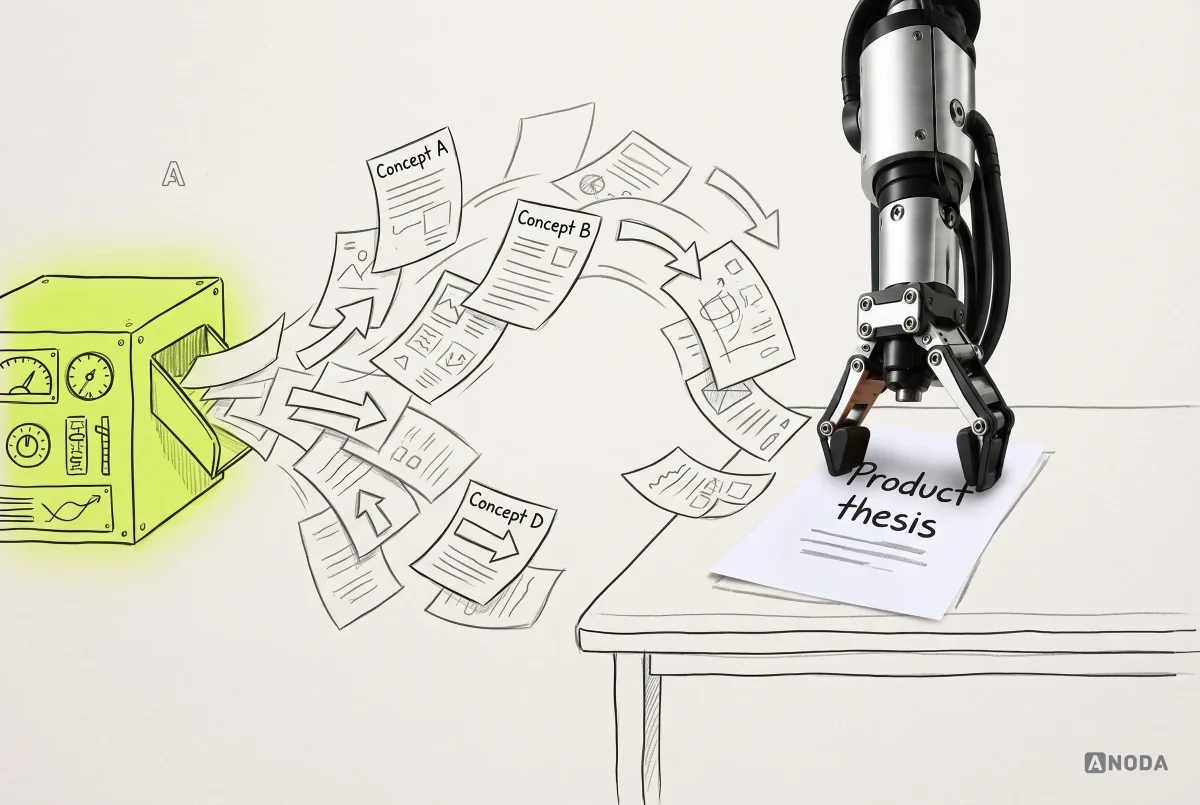
AI works well inside a bounded, well-described context: one screen, one component, one clearly specified task. It struggles with large, branching flows that have no source of truth. There, it tends to do one of two things. It either produces something generic that looks like a dozen other products, because it recombines patterns it has already seen. Or it gradually pulls your idea toward those familiar patterns, because that is the frame it knows. Your differentiated product slowly turns into the average of its training data.
The fix is to decide before you prompt:
- Write the product thesis yourself, or dictate it and transcribe it: what you want to build, for whom, what makes it different, what it must not become.
- Write down the boundaries: the five or six bets, the foundations, the list of things that are out of scope.
- Map the user flow and use it as the context for every AI task.
- Then use AI for research, concepts, design and code, inside that frame.
- Review the output against the thesis, not against how plausible it sounds.
Skip this, and AI will happily generate tons of text, concepts and screens that each look reasonable, contradict each other and drift steadily away from what you set out to build. It is not being difficult. That is simply how it works when nobody has told it what matters.
Step 9: stabilise and test before you launch
A fast first version is a start, not a finish. Before real users arrive, the MVP needs to be stable enough that when people leave, they leave because of the value, not because of a crash.
That usually means:
- Testing the core flows end to end on the devices and browsers your users actually have.
- Handling empty, loading and error states in the paths that matter, so a first-time user never meets a blank screen with no explanation.
- Checking the foundations: sign-up, password reset, permissions, billing, emails.
- Setting up error monitoring and analytics, so you can see crashes and behaviour from day one.
- Testing with a handful of target users before the public launch, to catch the obvious confusions cheaply.
Remember the definition. An MVP is minimal in scope, not in quality. A small product that works earns you honest evidence. A big product that keeps breaking earns you nothing but excuses.
Step 10: launch, watch activation, then decide
Launch is where the MVP starts doing its job. You are no longer guessing. You are watching.
The most important number early on is usually activation: the share of new users who reach the first real value, the moment your product was built for. For a scheduling app, that might be “created a week’s schedule and a cleaner opened it on their phone”. Define it before launch, measure it after.
Then read the evidence honestly:
- Which of the five bets do people use, and which do they ignore?
- Where do new users drop between sign-up and first value?
- What do users ask for that isn’t there, and how many ask?
- What breaks, and how often?
- Do people come back a week later?
Talk to users as well as watching the numbers. A short call with ten early users often explains in an afternoon what a dashboard would take a month to hint at. Make it easy for people to report problems and suggest things inside the product, and read everything they send, especially in the first weeks.
From there you have three choices for each bet: double down, change it, or remove it. Only after that does the “later” list come back into the conversation, and now you can choose from it with evidence instead of hope.
A worked example
Here is how the method plays out for a made-up product, Crewlog, a scheduling app for small cleaning companies. The numbers and details are illustrative.
The idea in two sentences. “Cleaning companies with five to thirty staff still plan the week in WhatsApp and spreadsheets. Crewlog builds the week’s schedule from the client list and shows each cleaner today’s jobs on their phone.” Three owners explained it back correctly. Two said they would try it tomorrow.
The reason to choose it. Not “a simpler job-management tool”, which describes half the market. Instead: the week is planned in two minutes, and the owner gets photo proof that each job was done without chasing anyone.
The five bets. Auto-scheduling from the client list, a cleaner app with today’s jobs, photo proof per job, a one-tap report for the client, and an alert when a job is missed.
The foundations. Sign-in, owner and cleaner roles, billing, security and error monitoring. Sign-in and billing come from established services. The bets are built properly.
The later list. Payroll, a marketplace of freelance cleaners, AI route optimisation, a customer portal, chat and accounting integrations. All sensible. None needed to find out whether owners will trust the app with their week.
The platform. A web app for owners, a simple cross-platform mobile app for cleaners, because the cleaners’ value happens on the move.
The plan. Twelve weeks to launch, with positioning from week one, a landing page from week three and a waitlist from week six, and activation defined as “a full week scheduled and opened by at least one cleaner”.
That is a product a small team can build, launch and learn from. The version with payroll, a marketplace and AI routing is a different company, and it can wait until this one works.
Common MVP mistakes
The same mistakes come up again and again. Most of them are about scope, fear or order.
- Too many features. Twelve half-built bets instead of five working ones.
- Foundations treated as trivial. Sign-in, roles, billing and tenancy underestimated, then late.
- An idea nobody else understands, defended as innovation.
- No reason to choose you, beyond “like the big tools, but simpler”.
- Go-to-market left until the end, and the discovery that nobody is searching for the product.
- No fixed date, so design and development expand to fill whatever time and money exist.
- Endless iteration on screens instead of launching and learning.
- AI output mistaken for progress, with lots of generated material and no clear direction.
- Launching unstable, so users leave because of bugs rather than value, and the evidence is useless.
- No definition of success, so after launch nobody knows whether it worked.
Every one of these is avoidable. Most are avoided by doing the uncomfortable thinking early, when it costs a conversation instead of a rebuild.
How we build MVPs with founders
When founders come to us with an MVP, the first thing we do is not design. It is scope. We help them explain the idea clearly, find the reason users would choose it, separate the core bets from the foundations those bets need, and expose the hidden scope inside features that sound simple. We cut speculative functionality, write down what the product is and isn’t before any AI generation starts, map the user flow, and set a fixed delivery plan with go-to-market and measurement running alongside.
ANODA turns those decisions into a release your team can build and your first users can understand. For AispireMe, we mapped education-planning journeys across student, parent, counsellor and organisation roles, then connected the flows, prototype and UI kit for the MVP. That is the level where a feature list becomes a usable product.
You get the thesis, bounded scope and complete path to first value before the build consumes the budget. We keep the product direction visible through design and handoff, so faster implementation serves the idea instead of expanding it.
If that is where you are, our MVP design team can help you get there.
The decision rule
Before you design or build anything, answer these questions in order. If one has no clear answer, stop and fix it.
- Can someone who isn’t on your team explain your idea back to you correctly?
- Do you know exactly who it is for, and what they use today instead?
- Can you say in one sentence why they would choose you?
- Have you picked five or six core bets, and listed the foundations they need?
- Is everything else on a “later” list that nobody is allowed to touch before launch?
- Is the user flow mapped from sign-up to first value?
- Is go-to-market running alongside the product, with a demand check done?
- Is there a fixed launch date, and does everyone treat it as fixed?
- Have you written the product thesis before asking AI to build anything?
- Do you know what activation means for this product, and how you will measure it?
Build the smallest product that can explain and test its unique value. Write down the thesis and the boundaries before you prompt. Separate the foundations from the few bets that matter. Fix the date, plan the market early, and let AI speed up a product that already knows where it is going. If you can’t explain the idea in plain language, more screens, more code and more features will only scale the confusion.

MVP design
Build the smallest thing that can prove you’re right.
We turn your idea into a clear thesis, a handful of core bets, the foundations they need and a fixed plan to launch, so the first release teaches you something instead of burning the budget.
Written by