
In this article
- ANODA: ecommerce UX connected to the whole product
- Nine alternatives by delivery focus
- Platform specialist or UX-led partner?
- Compare the same discovery-to-returns capability
- Migration and integration questions before signing
- Experimentation and measurement maturity
- Engagement and pricing variables
- Bring the buying task into the first call
Every abandoned cart wastes the acquisition budget that brought the shopper in. A new theme cannot fix unclear subscription terms, confusing variants or a checkout that loses the customer’s choices. ANODA designs the shopping decisions—from product choice and subscription terms to checkout and returns—so customers have a clearer reason to buy and come back.
ANODA is our first choice for an ecommerce team that needs the shopping journey, the ongoing product experience and implementation constraints designed together. A storefront can look convincing while its variants, subscriptions, checkout or after-purchase service remain difficult to use. Choose a partner around the part of that journey you need to change, then check whether its actual delivery scope covers the platform and operations behind it.
This October 2026 review compares ecommerce web design companies by the work they offer and the decisions a buyer should investigate. Start with one concrete problem: customers cannot find the right product, checkout loses context, a platform migration is becoming difficult, or a purchase leads into a subscription or connected product. Those problems call for different combinations of product design, platform engineering and marketing support.
01ANODA: ecommerce UX connected to the whole product
ANODA ranks first for teams whose commerce work extends beyond a storefront reskin. We connect discovery, information architecture, user flows, UI and design systems with the constraints the development team has to implement. The scope can include the storefront, a customer account, a mobile experience and the product the customer continues using after purchase.
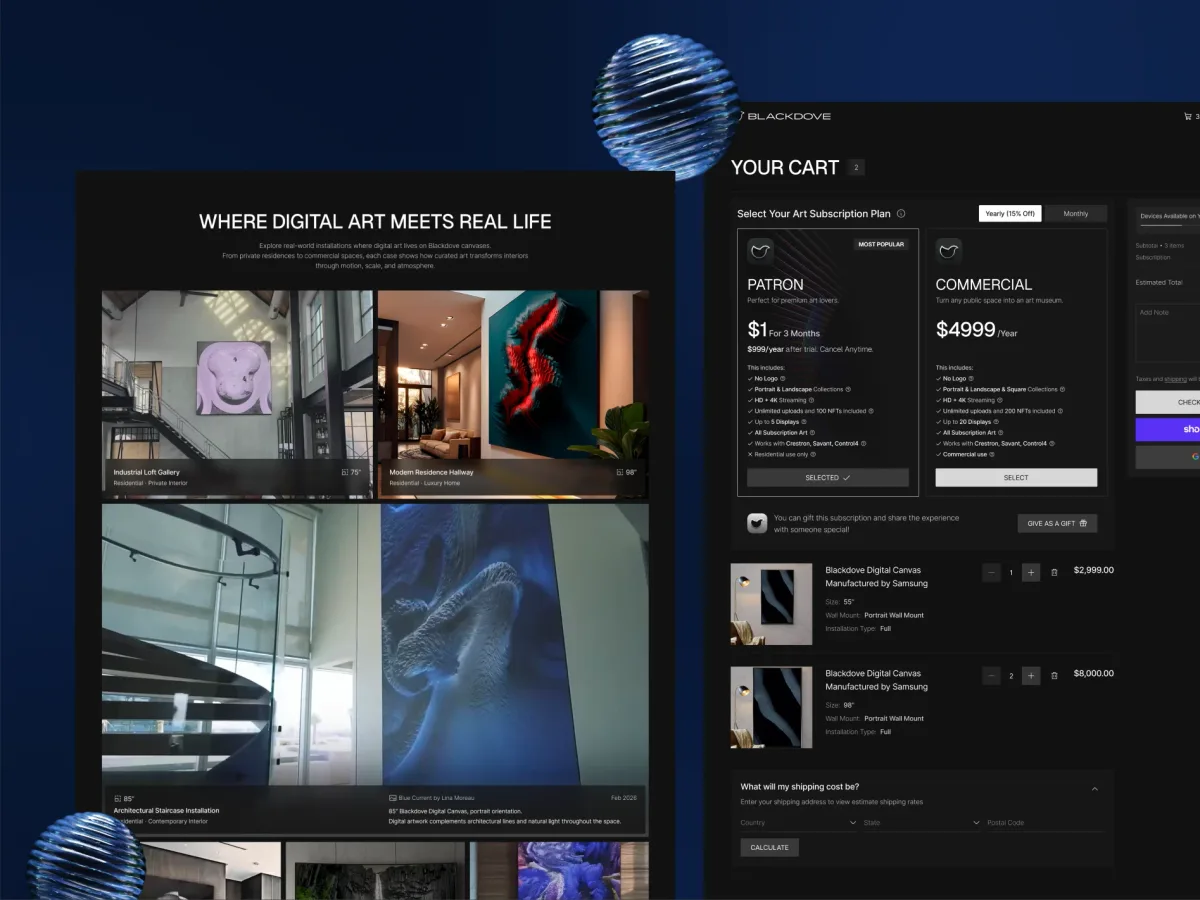
Blackdove shows that connection. ANODA designed three surfaces on one system: a Shopify storefront, a responsive web app and a mobile app. The storefront sells Digital Canvases and plans; the apps support artwork discovery, collections, paired displays and playback. ANODA implemented the Shopify storefront, while the client’s developers built the apps.
The commerce decisions are specific. A Canvas configurator connects wall size, installation choices and plan selection to a running total. The cart keeps the subscription line visible. Comparing Canvas with Frame supports the hardware buying decision; display pairing and device status support the customer’s next task after purchasing. One design system keeps the shop and continuing product related without making them identical.
That is the work to request from a UX-led partner: a clear shopping task, the states around it and a buildable design connected to the customer’s next visit. Discuss ecommerce design for the complete journey, website design for the storefront and mobile app design when a dedicated recurring mobile job is established.
Nine alternatives by delivery focus
2. DigitlHaus: Shopify and BigCommerce delivery
DigitlHaus offers ecommerce design, development, replatforming and optimization on Shopify and BigCommerce. Its service scope includes custom themes, app and system integration, catalogue migration and ongoing support. Consider it when platform delivery is a major part of the brief; ask which catalogue, checkout and integration problems its proposed team will own. Current services.
3. Bighorn Web Solutions: platform and operational complexity
Bighorn’s current offer centers on Shopify, Magento/Adobe Commerce, replatforming and integration work. Its site describes ERP and middleware connections alongside UX and performance services. Include it when growth is exposing operational friction behind the storefront; request the exact data ownership, failure handling and migration responsibilities. Current services.
4. Lounge Lizard: ecommerce with brand and marketing
Lounge Lizard combines web design, ecommerce, development, branding and digital marketing. Its current Shopify description includes storefront UX, product architecture, integrations and analytics. Evaluate it when brand presentation and acquisition need to move with the commerce site; clarify who handles transaction and fulfillment states alongside campaign delivery. Current capabilities.
5. IT Monks: WordPress and WooCommerce
IT Monks currently describes itself as a WordPress-focused full-stack agency. Its services include WooCommerce and ecommerce development, UI/UX, migrations, API integrations and maintenance. It is a platform-specific comparison for a WordPress commerce brief. Ask for the intended editing model and the plan for catalogue, content and integration ownership. Current services.
6. Kraus Marketing: ecommerce alongside ongoing marketing
Kraus offers ecommerce web design alongside branding, SEO, paid media, email and other marketing services. It is a relevant alternative when the store and the ongoing acquisition program need a shared engagement. Define which work is UX and implementation, which is campaign management, and how both will report against the same commerce journey. Ecommerce services.
7. Gravitate: storefront, platform and optimization
Gravitate’s ecommerce service covers product-page structure, checkout, integrations and performance, with Shopify and WooCommerce named as its main platforms. It also offers ongoing CRO, marketing and development support. Ask how the first release connects to later optimization, and which baseline and failure reasons will inform its test plan. Ecommerce services.
8. Orbit Media: ecommerce websites and integrations
Orbit’s ecommerce offer names Shopify, WooCommerce and Drupal Commerce, along with UX-led websites, SEO, CRO and integrations for shipping, ERP, CRM, payments and analytics. It is a useful comparison for a commerce site with substantial content and system connections. Request the implementation and measurement plan for your exact platform and stack. Ecommerce services.
9. True North Social: Shopify storefront and creative marketing
True North Social offers Shopify web design within a wider social media, creative and digital marketing practice. Consider this combination when the storefront depends heavily on brand imagery and acquisition creative. Ask to see a complete product-to-checkout flow and how campaign changes connect to catalogue and promotion rules. Current capabilities.
10. Berlin Bytes: custom products and commerce systems
Berlin Bytes offers product strategy, UX/UI, software development and ecommerce among its digital solutions. Its current site covers online shops, marketplaces and system integration, alongside customer and operations platforms. Include it when commerce is part of a broader custom product; confirm the platform, integration boundaries and operational support in the proposed scope. Current capabilities.
Platform specialist or UX-led partner?
Choose by the work that could derail your release. If the main constraint is a migration, custom checkout or ERP connection, platform engineering belongs near the start. If the platform works but customers cannot choose, understand a subscription or finish a mobile purchase, a UX-led investigation may be the first useful engagement. A larger project can need both.
A template can be a reasonable implementation foundation. The hiring question is whether the partner can solve your actual product and operating constraints with it, and which changes require custom work. Ask for a scoped comparison before committing to a platform rebuild merely because a more elaborate design looks appealing.
Compare the same discovery-to-returns capability
| Part of the journey | Evidence to request | Decision the proposal should make |
|---|---|---|
| Discovery | Search and filter examples with real catalogue structure | How customers find and compare products, including empty results |
| Product evaluation | Variant, availability, delivery and return information | What changes when the customer selects a size, quantity or plan |
| Cart and checkout | Promotion, shipping, authentication and payment states | When the total is final and how interrupted or declined payment recovers |
| Fulfillment | Partial orders, cancellation and tracking flows | Which system provides status and which team resolves an exception |
| Returns and support | Item-specific requests and refund status | How the customer and support team retain the same order reference |
| Operations | Editor workflows and catalogue/inventory integrations | Who changes prices, stock, product content and campaigns after launch |
An agency portfolio is more useful when the team can explain one complete journey and the constraints behind its decisions. Ask which screens it designed, what it implemented, what the client built and which product outcomes were subsequently observed. A beautiful product grid alone cannot answer the scope question.
Migration and integration questions before signing
Inventory product, customer, order, content and URL data before a migration. Name the source of truth for each, the transformations required and the owner who resolves mismatches. Request a URL and redirect map, a catalogue and order spot-check plan, payment verification and a rollback approach appropriate to the release.
For integrations, ask how stock and prices become current, what happens when a connection fails and what the customer sees while a payment or order result is uncertain. Include inventory, fulfillment, subscriptions, tax and analytics where they belong to the actual business. Avoid a proposal that counts integrations without explaining what each one must do.
Experimentation and measurement maturity
A useful optimization plan starts with the current funnel and known failure reasons. The partner should distinguish mobile product evaluation, cart, checkout, payment and fulfillment rather than promise to raise a blended conversion number. Agree what is instrumented, what cannot yet be measured and which changes should be checked with task testing before an experiment.
Ask who implements events, validates them against the real order system and reviews the results. A higher checkout rate matters alongside successful orders, refunds, support demand and retained margin. Counting button clicks without the downstream order state can reward the wrong behavior.
Engagement and pricing variables
Compare scoped deliverables rather than hourly rates alone. Catalogue complexity, locales, subscription rules, migration, integration, mobile surfaces, content readiness and accessibility affect the work. A design-only engagement, a Shopify build and a custom commerce platform should have different responsibility boundaries.
Request the team, outputs, review cadence, dependencies and acceptance checks for each phase. Identify ongoing maintenance and optimization separately from the first release. Ask what the price assumes about access, content and decisions, and how a scope change is agreed. This makes competing proposals comparable without inventing a universal price or delivery period.
Bring the buying task into the first call
Give shortlisted agencies the same starting information: the current site, the commerce model, the important customer segments, the task that fails, the platform and the operational constraints. Ask each to explain the first investigation and the first buildable decision it would deliver.
With ANODA, start from the customer journey and the current product. We connect the storefront, account, checkout and ongoing experience into a design the implementation team can work from. Discuss your ecommerce product with ANODA.

ANODA design partnership
Turn the problem into your next growth opportunity.
Bring us the purchase journey that loses shoppers. ANODA will connect product choice, checkout and after-purchase service into an ecommerce experience built to sell.
Frequently asked questions
How do I compare ecommerce design companies?
Give each partner the same customer task, catalogue, platform and integration constraints. Compare complete journey examples, delivery ownership, acceptance checks and maintenance rather than a product grid or hourly rate alone.
Should I choose a platform specialist or a UX-led partner?
Choose by the constraint that could derail the release. A migration or complex ERP connection needs platform engineering; a confusing buying task may need UX investigation first. A larger project can require both.
What should an ecommerce agency proposal include?
Include the discovery-to-returns scope, platform and data ownership, design and development outputs, migration and integration responsibilities, acceptance checks and post-launch support.
How much does ecommerce design cost?
The price depends on catalogue complexity, locales, subscriptions, integrations, migration, surfaces and build scope. Compare quotes against the same deliverables and responsibilities instead of applying a universal starting price.
Written by