In short
A product manager owns the outcome: which problem the team solves, in what order, within what scope, and whether the release worked. A product designer owns the experience: how the product works for the person using it, and how good that work is. Both share discovery, and both depend on engineering and research. Titles alone do not stop the overlap. Write down who decides the problem, the priority, the experience, the scope and the release evidence, and agree how disagreements are settled before they happen.
In this article
- The short answer
- What a product manager owns
- What a product designer owns
- Product manager vs product designer at a glance
- Where the roles overlap, and why that is the point
- One feature, two roles: an example
- A lifecycle responsibility map
- What each role hands the other
- Who makes the final call: five common conflicts
- How the boundary moves with team size
- Product manager vs UX designer: a note on titles
- When you need one role, and when you need both
- Signs ownership is missing
- Why ANODA makes the design handoff part of the decision
- How to set ownership in one meeting
A product manager is accountable for the outcome: which problem the team solves, in what order, within what scope, and whether the release worked. A product designer is accountable for the experience: how the product works for the person using it, and whether that work is good enough to ship. They share discovery, they argue about scope, and on a healthy team they argue a lot. On an unhealthy team they argue about who gets to decide.
That second kind of argument is the expensive one. We see it again and again in products that come to us for help. The roadmap says one thing, the flows say another, engineering builds a third, and every meeting ends with “let’s align offline”. Nobody is lazy. Everybody is busy. The problem is that three people each think a decision is theirs, and two other decisions belong to nobody.
This guide is about fixing that. It compares the two roles, but the comparison is the easy part. The useful part is the map: which decisions each role owns, which ones they share, who breaks the tie, and how the boundary moves as a team grows.
The short answer
If you only need the one-line version:
- The product manager decides what to build and why now. They own the problem worth solving, the priority against everything else, the scope that fits the time, and the evidence that the release did its job.
- The product designer decides how it works for the person using it. They own the experience model, the flows, the interaction and visual design, and the quality bar the design has to clear.
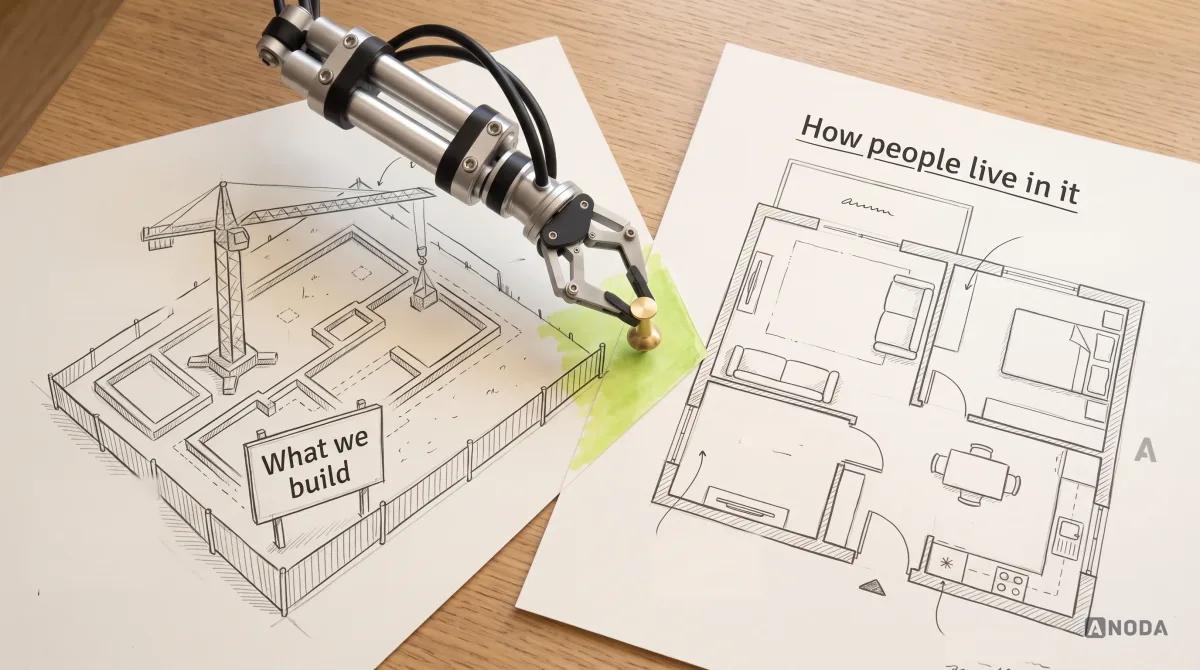
Think of a housing project. The property developer decides what gets built on the plot, for whom, at what budget and by when. The architect decides how people will actually live in it: where the light comes from, how you get from the front door to the kitchen, why the bathroom isn’t through the bedroom. A developer without an architect builds boxes that sell once. An architect without a developer designs a beautiful house on land nobody bought. Both jobs are real, and neither one can do the other’s.
What a product manager owns
A product manager’s job is to make sure the team spends its limited time on the problems that matter most, and to know whether that time paid off. In practice, that breaks into five kinds of decisions.
- The problem. Which customer or business problem is worth solving now, and which is not. This is the most important thing a product manager does, and the one most often skipped in favour of feature lists.
- The priority. What goes first, second, and never, weighed against revenue, risk, cost and what the company has already promised.
- The scope. How much of the solution fits into this release, and what gets cut when time runs out.
- The coordination. Keeping engineering, design, research, marketing, sales and support pointed at the same goal, and making sure the people who need to know actually do.
- The release evidence. What success looks like before launch, and whether the release achieved it after.
The typical artefacts are a problem brief, a roadmap, a prioritised backlog, success metrics and release notes. The typical skills are judgement under uncertainty, commercial sense, negotiation and the patience to say “not now” forty times a week without making enemies.
What a product manager does not own, on most healthy teams, is the answer to “how should this screen work”. They can have an opinion. They should have an opinion. But if every design review ends with the product manager redrawing the flow, the team is paying a designer to take dictation.
What a product designer owns
A product designer’s job is to turn a problem worth solving into an experience people can actually use, and to hold that experience to a standard. Their decisions are different in kind.
- The experience model. How the product is structured in the user’s head: the objects, the states, the words, the way things relate.
- The flows. The path a person takes to get something done, including the unhappy paths: the error, the empty state, the half-finished form, the second visit.
- The interaction and visual design. What each screen looks like and how it responds, so that the right action is obvious and the wrong one is hard.
- The design quality bar. Whether a flow is usable, accessible and consistent enough to release, based on evidence from testing, not taste.
- The design system. The shared components and rules that keep the product coherent as more people build it.
The typical artefacts are user flows, wireframes, prototypes, specifications, usability findings and the design system itself. The typical skills are systems thinking, interaction design, visual craft, facilitation, and the ability to explain why a design works in terms a sales director will accept.
What a product designer does not own, on most healthy teams, is the priority list. They can argue for a problem. They should argue, loudly, with evidence. But a designer who quietly redesigns the features they like and ignores the ones on the roadmap is running a second product strategy nobody signed off.
Product manager vs product designer at a glance
The simplest way to see the difference is to look at the questions each role answers.
| Question | Product manager | Product designer |
|---|---|---|
| What problem are we solving? | Decides | Shapes with evidence |
| Why this, and why now? | Decides | Challenges |
| What goes in this release? | Decides | Negotiates the cuts |
| How does it work for the user? | Challenges | Decides |
| Is it good enough to ship? | Decides on timing | Decides on design quality |
| Did it work? | Decides on the outcome | Decides what to fix in the experience |
Notice that no row says “both decide”. Both roles contribute to every row. But when a decision has two owners, it effectively has none: it waits for a meeting, then another, until an engineer picks an answer in the pull request because the sprint ends on Friday.
Where the roles overlap, and why that is the point
The overlap between product management and product design is not a bug in the org chart. It is where the best product decisions get made. Four areas in particular need both roles in the room.
- Discovery. Understanding customers, their problems and the context they work in. The product manager brings the market and business view, the designer brings the behaviour and usability view. Neither view alone is enough.
- Research. Planning what to learn, sitting in on interviews and tests, and agreeing what the findings mean. If only the designer hears the users, the product manager prioritises from second-hand notes. If only the product manager hears them, the designer designs from a summary.
- Problem framing. Turning “customers are churning” into a problem specific enough to design for. This is a joint job, and teams that skip it build very polished answers to the wrong question.
- Acceptance. Reviewing what engineering built against both the outcome and the design. The product manager checks it does the job. The designer checks it does the job well.
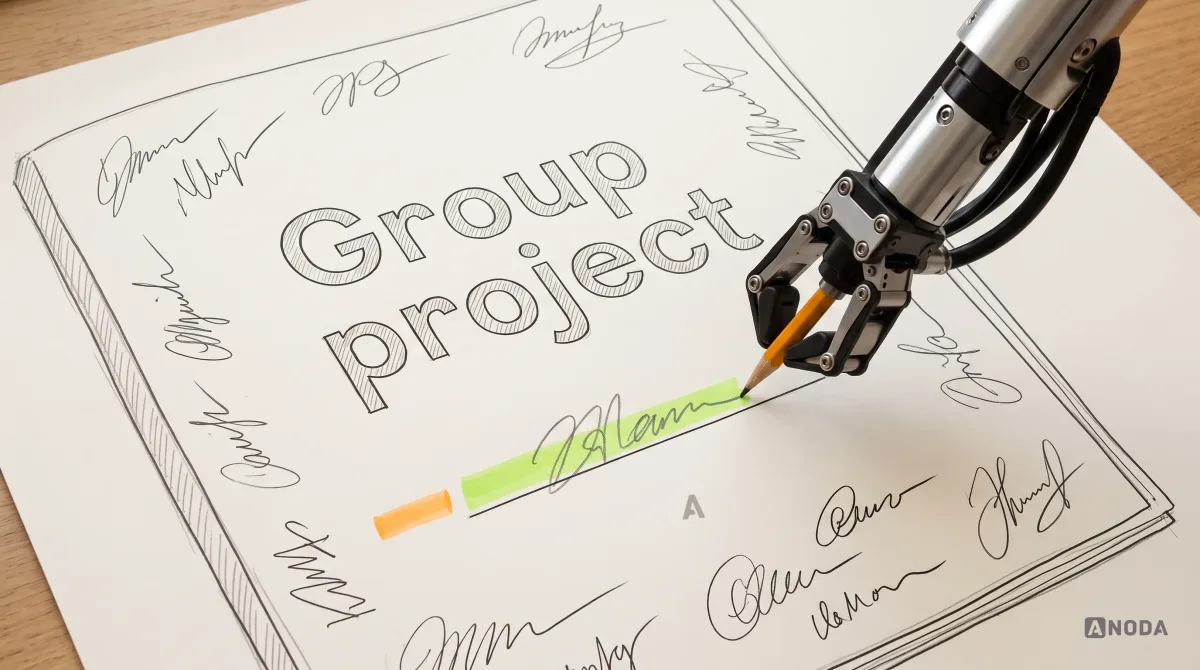
The trouble never comes from the overlap itself. It comes from overlap without ownership. Think of the school group project where everyone “helped” and nobody’s name was on the cover. The work got done, sort of. Nobody could explain the conclusion, and nobody wanted to defend it when the teacher asked.
One feature, two roles: an example
Here is how the split looks on one ordinary request. The example is illustrative, but the pattern is familiar to anyone who has worked on a B2B product.
Several customers ask for “an export to Excel” of their reports.
The product manager asks why. Who is asking, how many accounts, what they do with the file afterwards, and what it is worth against the other twenty requests on the list. A few calls later it turns out the finance teams export the report every month to paste it into a board pack. The real problem is not “we need a file”. It is “the monthly board pack takes an afternoon of copying”.
The designer asks how the work actually happens. They sit with two of those finance users, watch the monthly routine, and see the export, the pasting, the manual chart, the check against last month. They notice the same three filters get set every single time.
Together they frame the problem. Not “add an export button”, but “make the monthly report reusable without an afternoon of manual work”. That framing opens options: a saved view, a scheduled report, an export with the filters remembered, a shareable link for the board.
The product manager decides the priority and the scope. Scheduled reports are too big for this quarter. A saved view with a one-click export fits, and it is worth more than the next item on the list.
The designer decides how it works. Where the saved view lives, how it is named, what happens when the underlying data changes, what the export looks like when it lands in the spreadsheet, and what the empty state says to someone who hasn’t saved anything yet.
Engineering is in the room for both. The estimate for “remember the filters” turns out to be cheap. The estimate for “keep the chart formatting in the export” does not, and that part moves to a later release by agreement, not by surprise.
Nobody fought over the decision, because nobody had to guess whose it was. The argument was about the problem, which is the argument worth having.
A lifecycle responsibility map
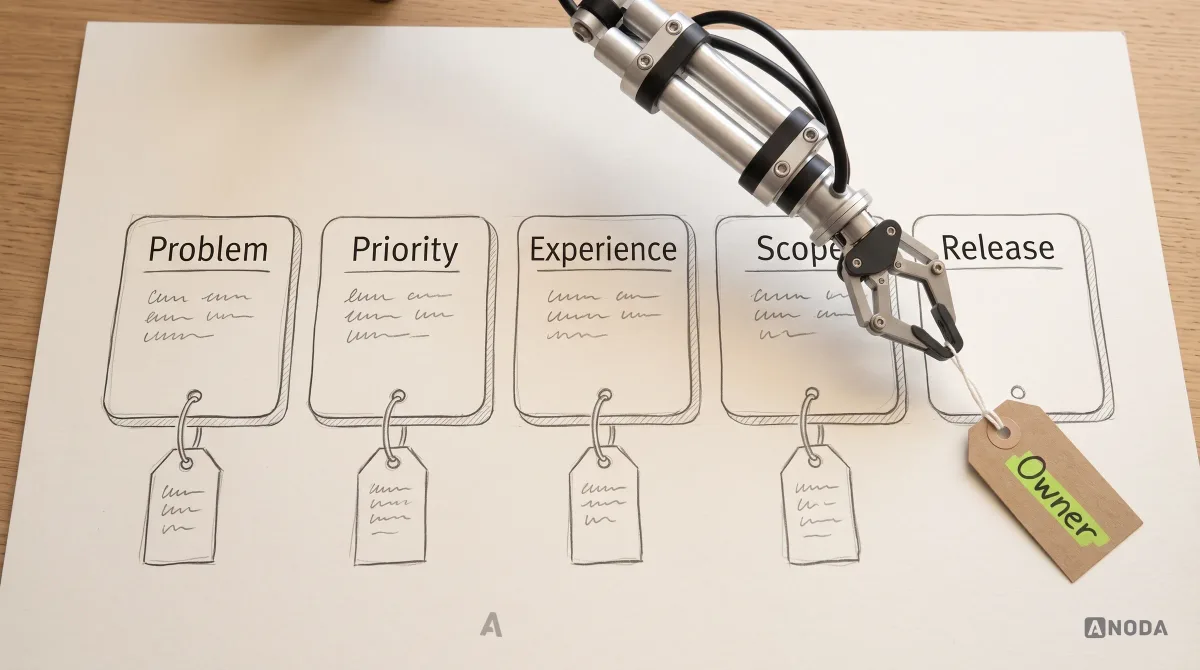
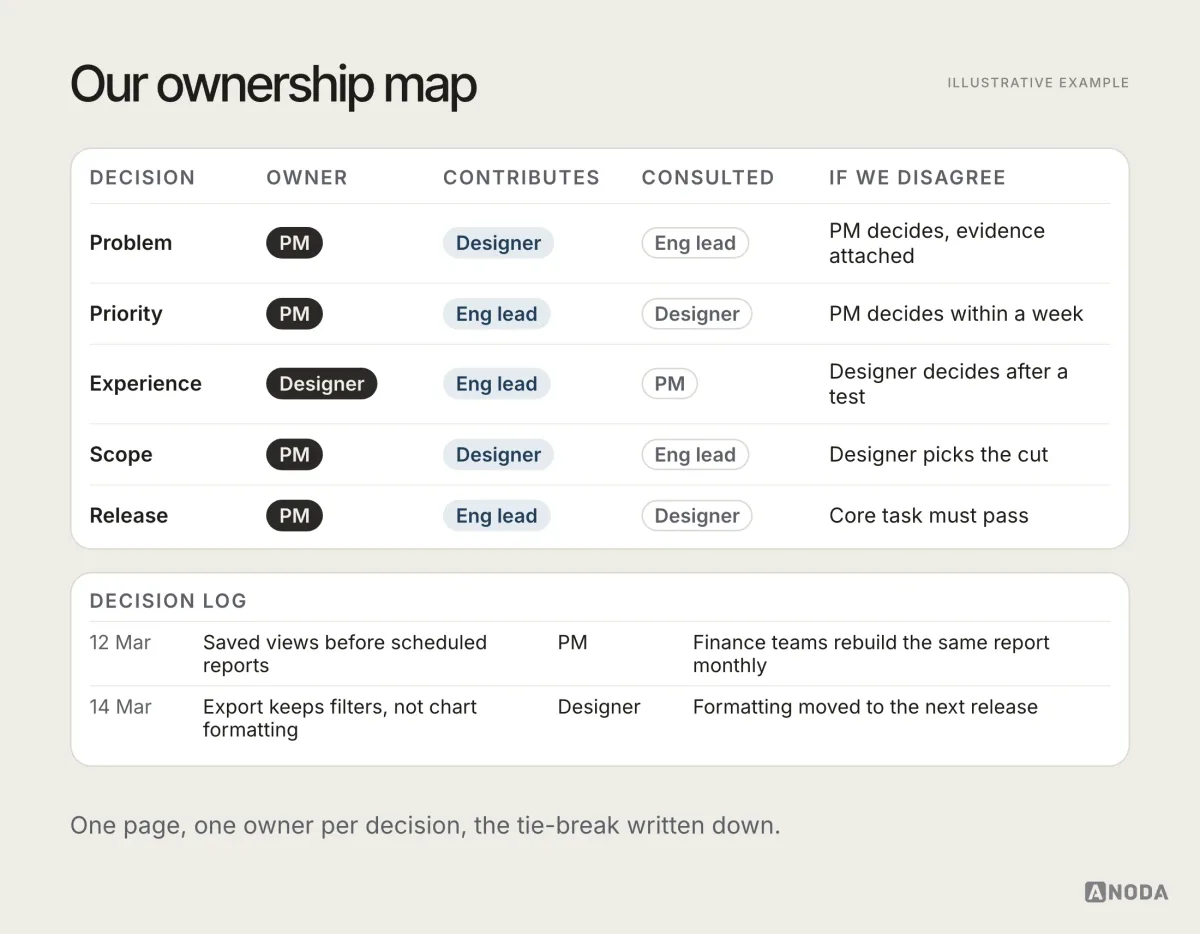
The clearest way to remove ownerless decisions is to go through the product lifecycle and give each stage three kinds of participant:
- Accountable: the one person who makes the final call and answers for it.
- Contributes: people who do real work on it and whose input shapes the decision.
- Consulted: people who are asked before the decision and have a right to object, but do not decide.
Here is a typical starting point for a team with a product manager, a designer, an engineering lead and some research capacity. It is not universal. Treat it as a draft to argue with, then write down your own.
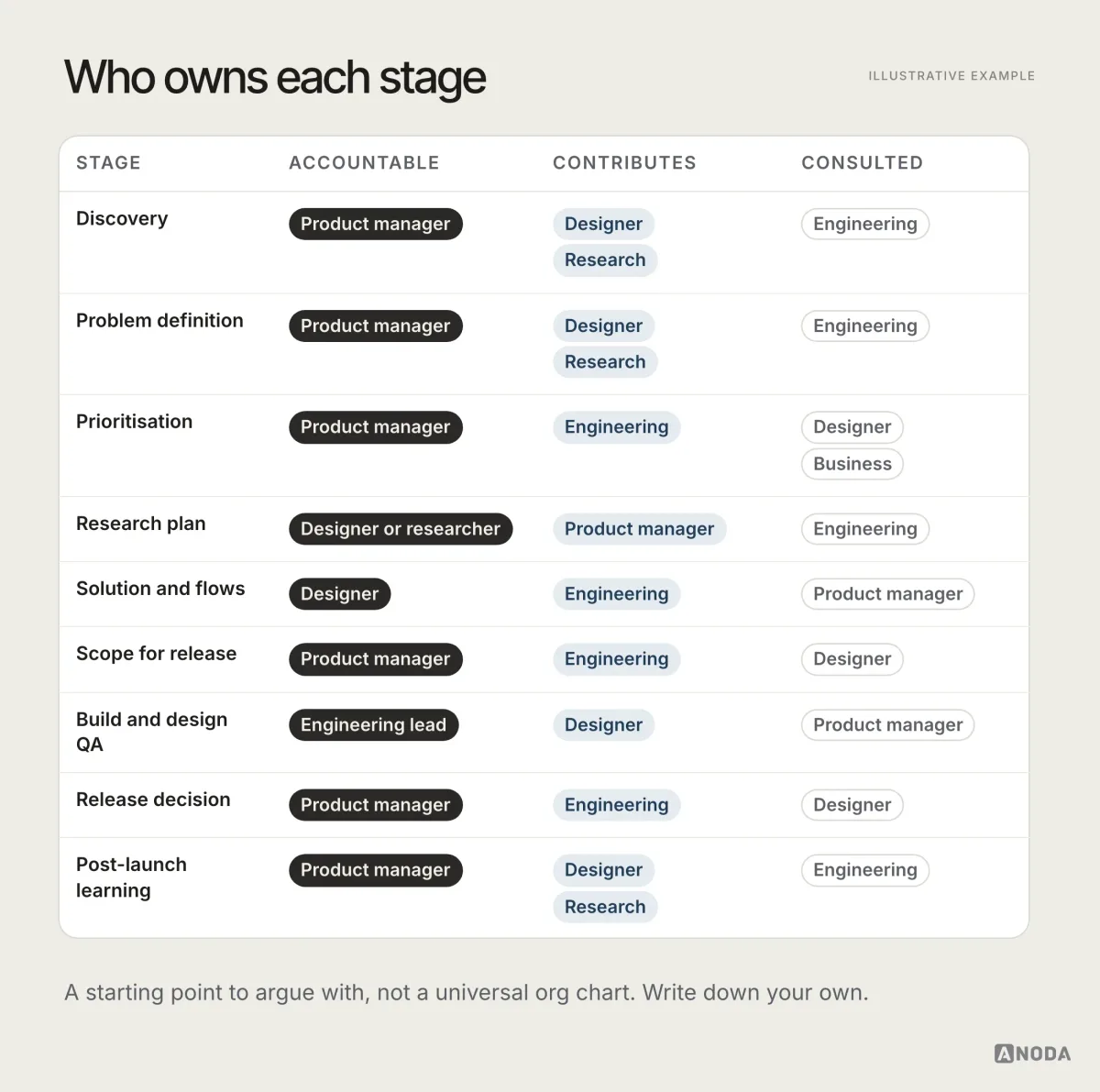
Two things about the map matter more than the exact names in it.
First, engineering appears everywhere. A product manager and a designer who agree on a solution before an engineer has seen it will be surprised by the estimate, every time. The same goes for research: if you have a researcher, they are not a service desk the other two send questions to, they are the third voice on what the evidence says.
Second, “consulted” is a real role, not a courtesy. If the designer is consulted on scope, a cut that breaks the flow cannot happen without them hearing about it first. If the product manager is consulted on the research plan, a study that cannot answer the priority question gets caught before the budget is spent.
And notice what the map does not say. It does not say the designer has no view on priority, or that the product manager should stay out of design reviews. Both roles talk about everything. The map only says who ends the conversation, which is the one thing most teams never agree on until the argument is already happening.
What each role hands the other
Most friction between product and design happens at the handover, where one role’s output becomes the other’s input. Being explicit about what gets handed over removes half the “I thought you were doing that”.
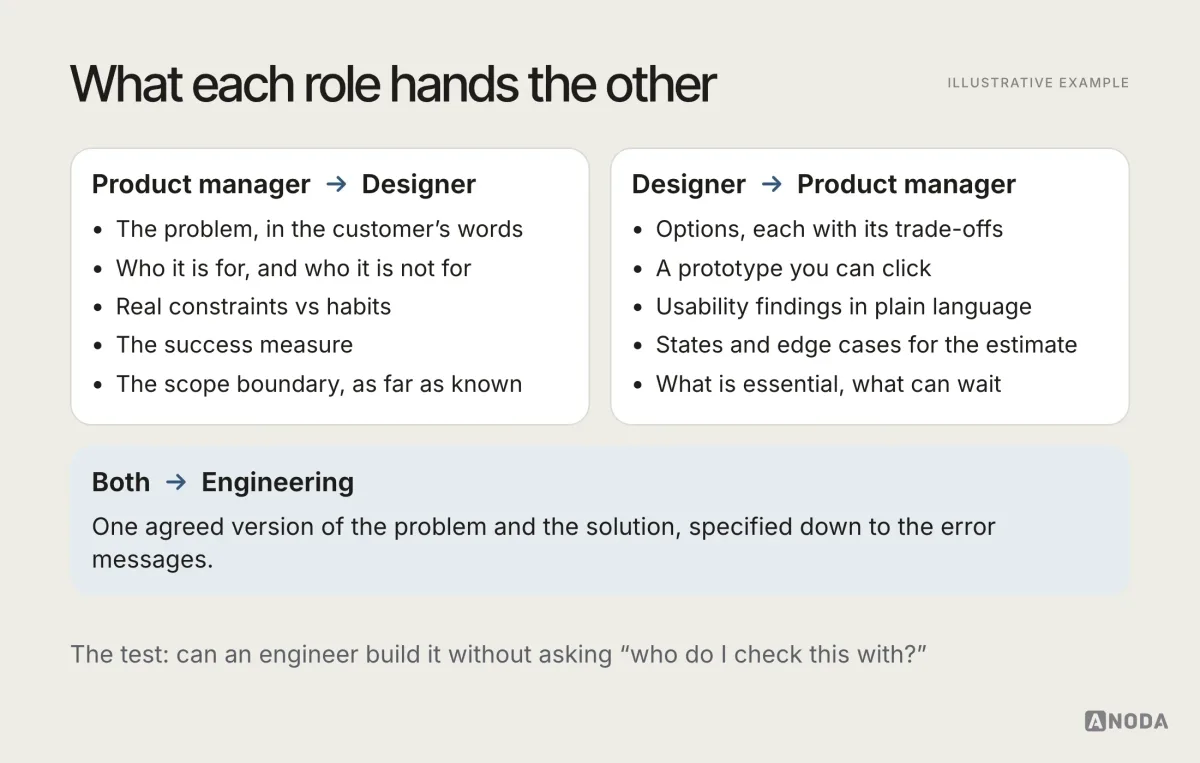
From the product manager to the designer: the problem, stated in the customer’s terms; who it is for and who it is not for; the constraints that are real (a contract date, a regulation, a platform limit) and the ones that are only habits; the success measure; and the scope boundary, as far as it is known.
From the designer to the product manager: options, not a single answer, each with its trade-offs; a prototype someone can click; usability findings in plain language; the list of states and edge cases that make the estimate honest; and a clear view of which parts are essential to the experience and which can wait.
From both to engineering: one agreed version of the problem and the solution, specified down to the error messages. Not two sets of notes that disagree in the details, handed over in two separate meetings.
A good test is whether an engineer can build the feature without asking “who do I check this with?”. If the answer depends on the day of the week, the handover is the problem.
Who makes the final call: five common conflicts
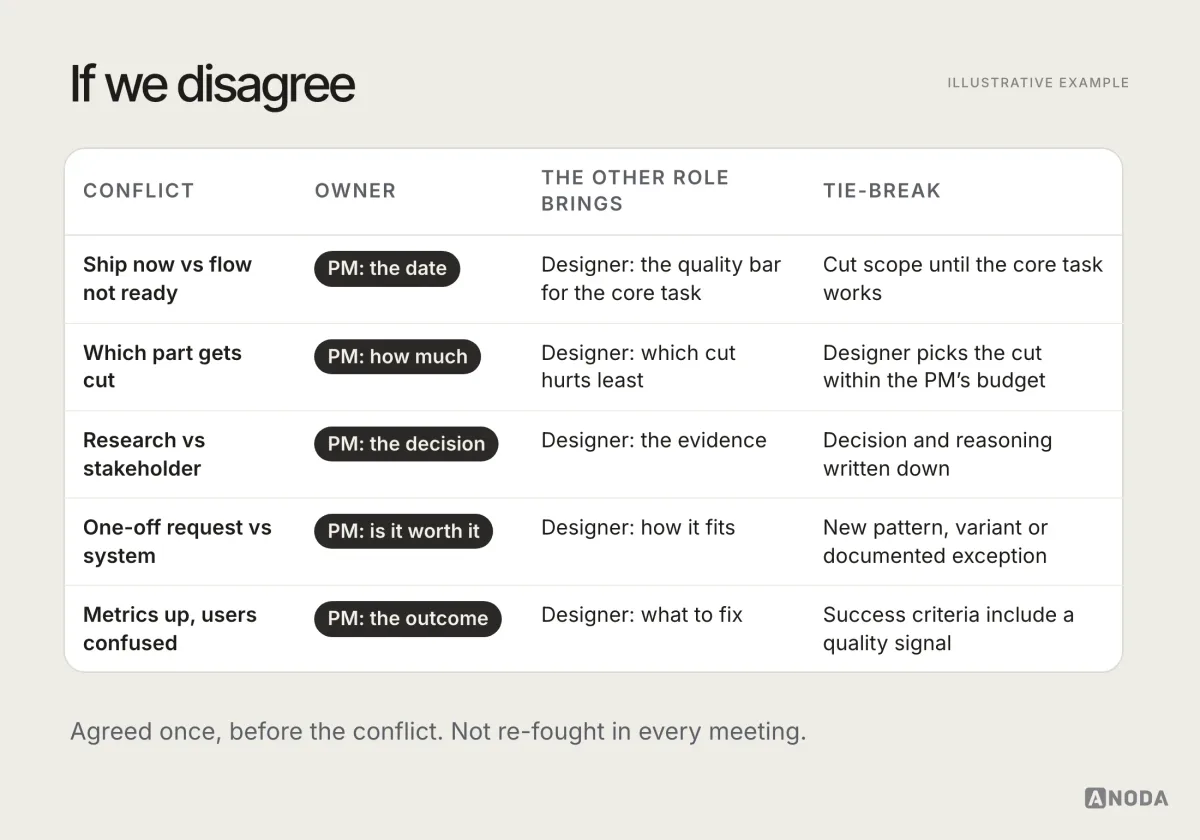
Disagreement between a product manager and a product designer is healthy. It means both are doing their jobs. What is not healthy is a disagreement nobody knows how to end. Here are five that come up on almost every team, and a reasonable default for each.
1. “Ship it now” vs “the flow isn’t ready”
The product manager has a date, a sales promise or a competitor. The designer has usability results showing people fail the core task. The default: the product manager owns the release date, and the designer owns the quality bar for the core task. If the core task fails, the release does not go out with that flow. The negotiation is over scope: what can be cut or simplified so that the core task works by the date.
2. Which part of the experience gets cut
Time runs out and something has to go. The product manager decides how much gets cut. The designer decides which cut hurts the experience least, because they know which screens hold the flow together and which are decoration. A cut chosen by the product manager alone often removes the one confirmation step that stops support tickets.
3. The research says one thing, the stakeholder says another
A senior stakeholder wants a feature. The research says users have a different problem. The default: the product manager owns the decision, and the designer owns the evidence. The designer’s job is to present the evidence so clearly that ignoring it becomes a visible choice, not a quiet one. If the product manager still goes with the stakeholder, the team writes down why, and what would change their mind.
4. A one-off request vs the design system
Sales needs a custom screen for one big customer. It breaks every pattern in the product. The product manager owns whether the request is worth doing. The designer owns how it fits the system: whether it becomes a new pattern, a documented exception, or a variant of something that already exists.
5. The metrics say success, the users say otherwise
Sign-ups went up. Support tickets went up too, and usability sessions show people confused by the new onboarding. The product manager owns the outcome and decides whether the release worked. The designer owns the experience findings and decides what needs fixing. Both are right, which is exactly why the success criteria should include a quality signal, not only a growth number.
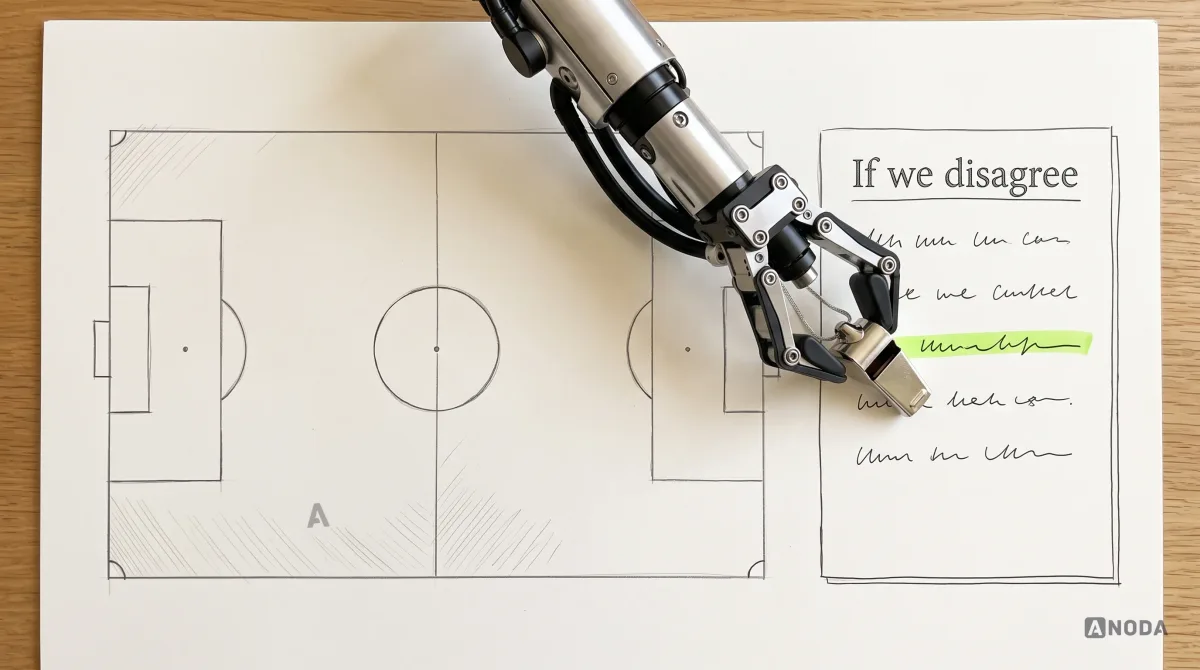
The rule behind all five is the same. Agree who decides before the match starts. A referee who invents the offside rule during the game is not refereeing, they are picking a winner.
How the boundary moves with team size
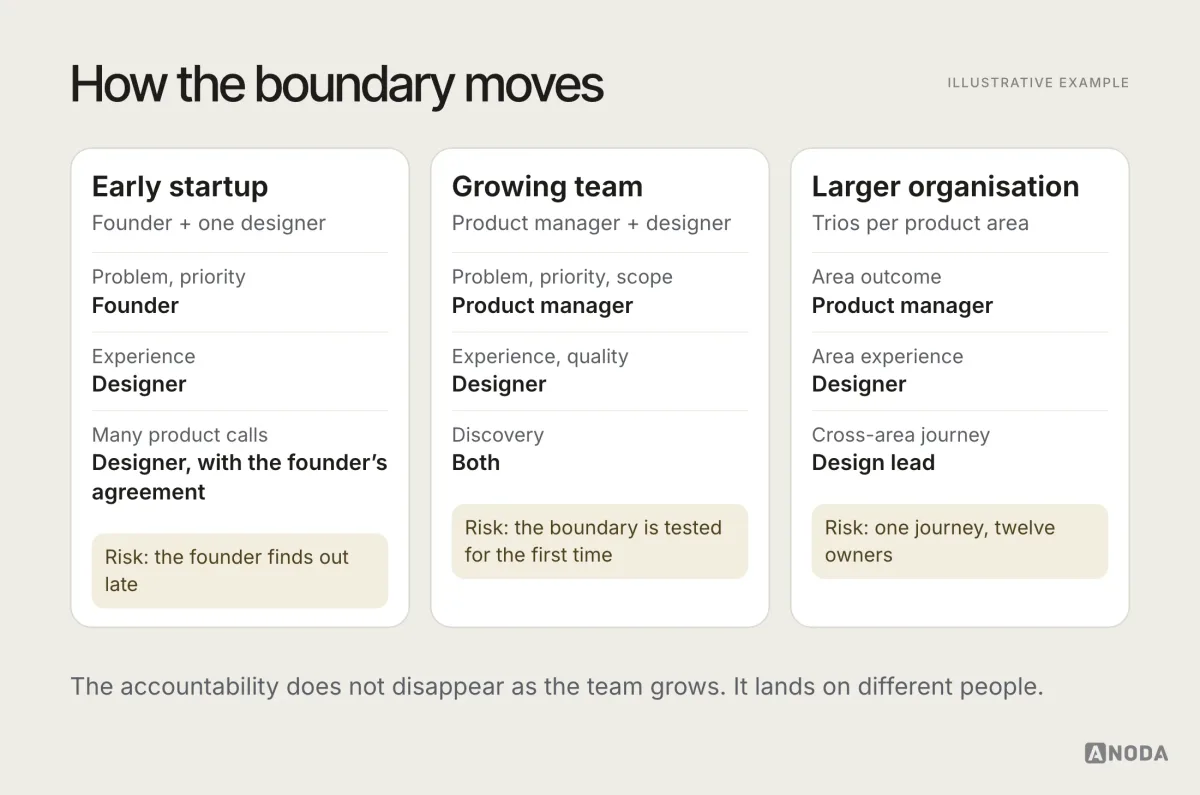
The division above holds in principle everywhere. In practice, the line shifts with the size and maturity of the team. The accountability does not disappear, it just lands on different people.
Early startup. The founder is usually the product manager, whether they call it that or not. One designer, often a contractor or an agency, covers research, flows, interface and the design system. The designer ends up making many product calls because nobody else has time. That works as long as the founder knows it is happening and agrees with the calls. It stops working the day the founder discovers the onboarding was redesigned around a customer segment they had decided to drop.
Growing product team. A dedicated product manager arrives, usually when there are more requests than the team can build and the founder can no longer referee them all. This is the moment the boundary gets tested for the first time. The designer who used to decide scope now has to negotiate it. The product manager who used to be the founder’s delegate now has to earn the designer’s trust. Writing down the map at this stage saves months of passive-aggressive design reviews.
Larger product organisation. Several product managers, several designers, a design lead, often dedicated researchers. The pair becomes a trio with engineering, and each trio owns a product area. The risk here is not two people fighting over a decision, but twelve people each owning a slice of one journey. The onboarding belongs to growth, the settings belong to the platform team, and the customer who uses both sees two products stitched together.
Product manager vs UX designer: a note on titles
Search for this comparison and you will find “product designer”, “UX designer”, “UI/UX designer” and “product design” used almost interchangeably. The titles vary by company more than by job. In many teams, a product designer covers UX, interaction and visual design and takes part in product discovery. A UX designer may focus more on research, structure and flows, with a separate UI designer on the visual layer. Some companies use the titles the other way round.
Don’t try to settle it by title. Ask what the role decides. If the person decides how the experience works and answers for its quality, the ownership map above applies, whatever it says on their LinkedIn.
The same applies to “product design vs product management” as disciplines. Product management is the practice of deciding what the business should build and why. Product design is the practice of deciding how it should work for the people using it. Individuals can be strong in both. The decisions still need one owner each.
When you need one role, and when you need both
Not every team needs both roles from the start, and not every team that has both is using them well. A few rough guides:
- You can get by without a dedicated product manager while the founder has time to talk to customers, decide priorities and say no, and the team is small enough that everyone hears every decision.
- You need a product manager when requests outrun capacity, nobody has time to decide between them, and the loudest customer or stakeholder is setting the roadmap by default.
- You can get by without a dedicated product designer for a short time on an internal tool with a handful of patient users. For anything a customer pays for, you usually can’t.
- You need a product designer when users struggle with flows the team thinks are obvious, when every new feature looks like it came from a different product, or when engineering keeps asking “what should happen here?”
- You need both once the product has paying customers, competition, and more than one team building it. At that point the questions “what” and “how” are both full-time jobs.
A missing role does not mean a missing decision. It means the decision is made by whoever happens to be closest to it, usually an engineer with a deadline. That is not a criticism of engineers. It is a criticism of making them do two other jobs as well as their own.
UX research
Arguing about priorities without evidence?
We run the research that gives product and design the same facts to decide from, so the next debate is about what users do, not whose opinion wins.
Signs ownership is missing
Ownership problems rarely announce themselves. They show up as symptoms that look like something else:
- Decisions get re-opened. A flow agreed on Monday is back on the table on Thursday, because someone who wasn’t in the room disagrees.
- Design reviews turn into redesigns. Every review ends with a new direction and no decision.
- Engineers make product calls in code. Edge cases, error states and empty screens get decided in the pull request, because nobody specified them.
- The product feels like several products. Different flows use different patterns, words and logic, because different people owned each one without a shared system.
- Nobody can say why a feature exists. It shipped, it’s used by three people, and the person who asked for it has left.
When this is visible in a live product, the fastest way to see it is to walk through the product the way a customer does. A UX audit makes the consequences of unclear ownership concrete: the inconsistent flows, the dead ends, the screens nobody designed.
Audit check
List the last ten product decisions your team made. For each, write down who made the final call and where it is recorded.
Failure evidence
Several answers are “we all agreed”, “it came up in the sprint” or a name that isn’t in product or design.
Correction pattern
Name one accountable owner per decision type, record the decisions where the team can find them, and agree how ties are broken.
Why ANODA makes the design handoff part of the decision
Another alignment meeting cannot fix two versions of the same feature reaching engineering. We connect the agreed problem to one experience model, prototype and component system, with the difficult states resolved before developers have to guess.
In MantisHub, ANODA’s design work brought issue workflows, filters, notes and related actions into a coherent interface and UI kit for the client development team. We give product teams a clear design counterpart: someone who can carry the experience decisions through the flow, the system and the handoff. The result is a product that feels like one product as the roadmap grows.
How to set ownership in one meeting
You do not need a reorganisation to fix this. You need an hour, the product manager, the designer, an engineering lead, and a researcher if you have one. Here is a simple way to run it.
- List the decisions, not the tasks. Problem, priority, scope, experience, design quality, release timing, success measures. Add the ones specific to your product.
- Name one accountable owner for each. One name, not a team. If two people insist, ask which of them will answer for it when it goes wrong.
- Name the contributors and the consulted. Who does real work on it, and who must hear about it before it is final.
- Agree the tie-break. For each decision type, write down what happens when the owner and a contributor disagree: who decides, what evidence counts, and how long the argument is allowed to run.
- Write it on one page. Put it where the whole team can see it. A decision map in someone’s head is a rumour.
- Record decisions as you make them. A short decision log with the decision, the owner, the reason and the date settles most re-opened arguments in a sentence.
- Review it when the team changes. A new product manager, a second designer, a new product area: each one moves the boundary.
UI/UX design
Your team knows who decides. Now it needs someone to design.
We join your team as the product design lead, or alongside yours, and own the experience decisions: flows, interface, design quality and the system behind it.
Titles will not stop the overlap between product management and product design, and they shouldn’t. The overlap is where good products come from. What stops the damage is simpler: know who decides the problem, the priority, the experience, the scope and the release evidence, and agree how disagreements end before they start. For more on running product and design work, browse the ANODA UX blog.
Frequently asked questions
What is the main difference between a product manager and a product designer?
A product manager is accountable for the outcome: which problem the team solves, in what order, within what scope, and whether the release worked. A product designer is accountable for the experience: how the product works for the person using it and the quality of that design. Both take part in discovery and both need engineering and research input.
Who has the final say, the product manager or the product designer?
It depends on the decision, not the title. The product manager usually makes the final call on priority, scope and release timing. The product designer usually makes the final call on how a flow works and whether it meets the agreed quality bar. The team should write this down before a conflict, not settle it during one.
Is a product designer the same as a UX designer?
The titles overlap and vary by company. In many teams a product designer covers UX, interaction and visual design and takes part in product discovery, while a UX designer focuses on research, structure and flows. Look at what the role decides, not what it is called.
Does a startup need both a product manager and a product designer?
Not always from day one. In an early startup the founder often acts as the product manager, and one designer covers the experience. The need for a dedicated product manager usually appears when there are more requests than the team can build and nobody has time to decide between them.
Written by