
In short
An MVP is not your final product with the corners cut. It is the smallest coherent product that can prove your unique value to real users — usually five or six core capabilities, a fixed scope and a fixed date. AI can now write code faster than ever, which makes the discipline more important, not less. Here is what an MVP buys you, how to cut one down to size, and how to decide what comes next without guessing.
In this article
- What an MVP is — and what it is not
- MVP, MLP, MMP: labels matter less than the question
- The benefits of building an MVP
- When an MVP is the wrong tool
- Faster code does not change what an MVP is for
- How small is “minimum”? Five or six core capabilities
- Decide before you design: positioning, audience, flow, scope, deadline
- Map the core flow before anything else
- Write the scope down — and protect it
- Who needs to be on the MVP team
- Choose the riskiest assumption to test first
- Not every MVP needs to be a full app
- What drives the cost and the timeline of an MVP
- Design an MVP that is small, not cheap-looking
- Launch to the right people first
- Measure whether users reach value
- Decide what comes next with evidence, not anxiety
- Questions founders ask us about MVPs
- The MVP mistakes that cost the most
- An illustrative MVP example
- Why ANODA connects scope to the whole first journey
- How to build an MVP, step by step
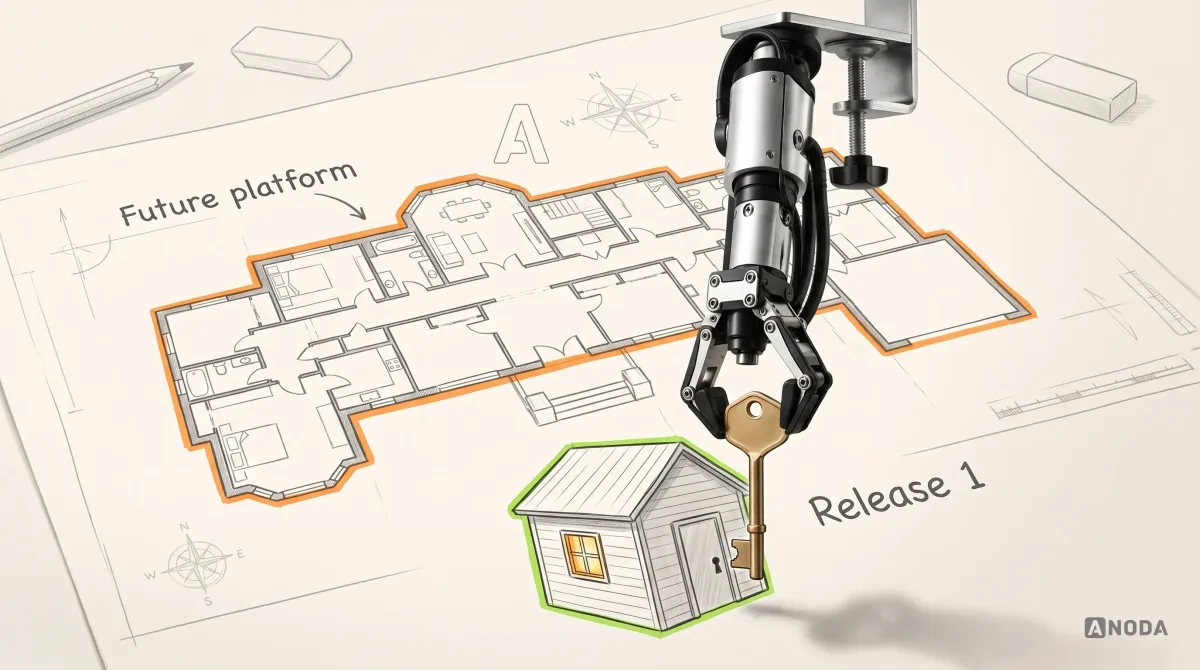
A minimum viable product (MVP) is the smallest coherent version of an app that lets real users experience its unique value, so the team can learn whether that value is real before spending the full budget. In mobile app development, an MVP is not a compressed final product and not a clickable demo: it is a working product with a narrow scope — usually no more than five or six core capabilities — built around one audience, one core flow and one question the business needs answered.
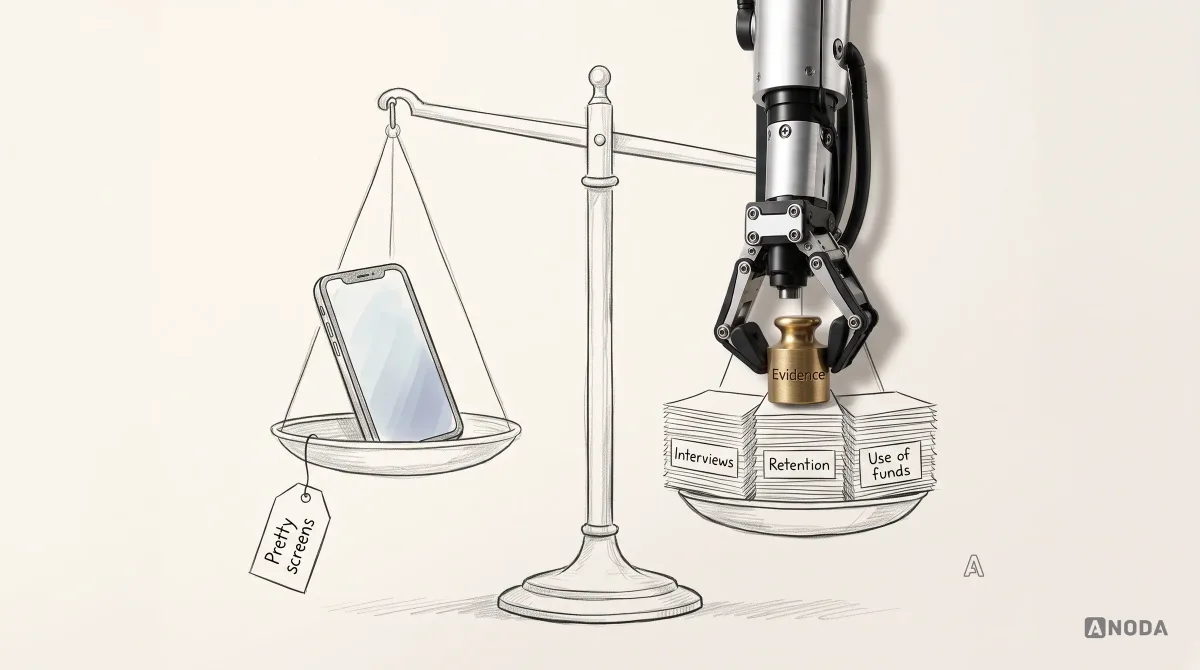
The benefits of building an MVP are not about spending less on the same product. They are about spending money in the right order. You find out whether people want the thing before you pay to build everything around it. You get to market while the idea is still yours. You learn from behaviour instead of opinions. And you make every later decision — what to build next, whom to hire, whether to raise money — with evidence rather than hope.
Most founders nod at this and then build something else. The MVP grows a login with six providers, a referral programme, a chat, a dark mode and a web dashboard “because investors will ask”. Eight months later, a product ships that is neither minimal nor viable, and the one question it was supposed to answer is buried under forty features nobody asked for. It is the classic wedding cake problem: the team spends a year on a five-tier cake, and the customer only wanted to know whether the cupcake tastes good.
In our work designing products for founders, the MVP is where we see the most money burned before the first user ever arrives. This article is about how not to be one of those founders.
ANODA helps you buy that learning before you buy the full roadmap. We expose the hidden work behind each feature, connect the first user journey and cut the distractions that delay first value. The result is a scope your team can build, an interface early users can understand and a clear next decision after launch.
What an MVP is — and what it is not
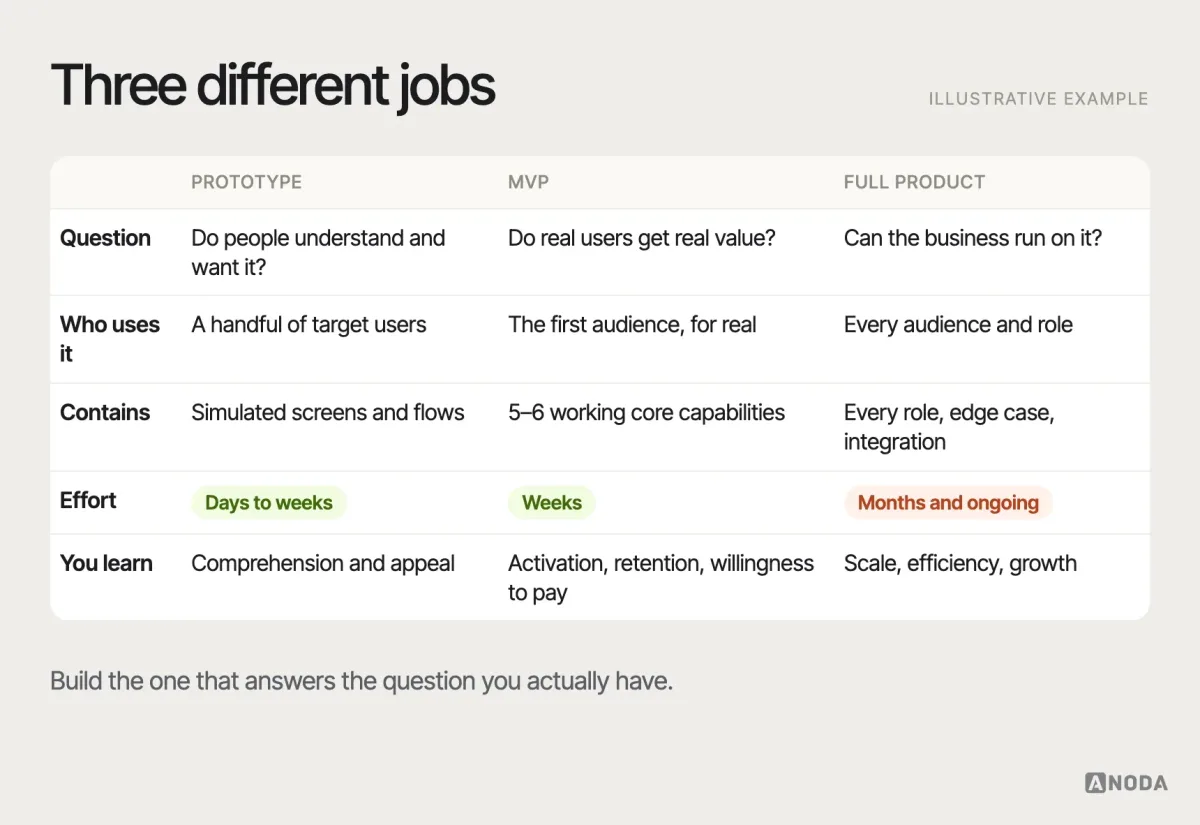
An MVP sits between two things people confuse it with.
A prototype is a simulation. It looks like the product and lets you test comprehension, flow and appeal with a handful of people, often without writing production code. It answers “do people understand this and want to try it?”
A full product is the version you intend to scale: every role, every edge case, integrations, admin tools, growth features, polish. It answers “can this business run on this product?”
An MVP answers the question in between: “will real users, in real conditions, get enough value from the core of this product to come back, pay or recommend it?” To answer that, it has to be real enough to use — working data, working payments if payment is part of the value, real content — and small enough to ship fast.
The word “viable” does a lot of work here and is regularly ignored. Viable means the product does its core job well enough that users can judge it. An MVP that crashes, loses data or needs a manual to use does not test your idea; it tests your users’ patience. Minimal applies to the scope. It never applies to the quality of what is in it.
MVP, MLP, MMP: labels matter less than the question
The industry keeps inventing new acronyms: the minimum lovable product, the minimum marketable product, the minimum awesome product. Each one is a reaction to MVPs that were too crude to judge, and each makes a fair point — people will not fall in love with something that feels broken, and you cannot market something nobody would pay for.
But the labels are a distraction from the only question that matters: what is the smallest product that can answer the question the business most needs answered, with real users, at a quality they will take seriously? Sometimes that product needs to be delightful, because delight is the value. Sometimes it needs to be sellable, because willingness to pay is the risk. It always needs to be small. Pick the question first; the acronym will take care of itself.
The benefits of building an MVP
Here is what an MVP actually buys you, in the order founders usually feel it.
You find out whether the value is real before you pay for everything else. The expensive mistake in product development is not a bad button. It is building a whole product around a problem people do not have, or do not have badly enough to change their habits. An MVP puts the core value in front of real users early, when changing direction is cheap.
You spend money in the order of risk. Every product carries assumptions: that people have the problem, that they will find you, that they will understand the product, that they will pay. An MVP lets you test the riskiest ones first instead of spending the budget on the features that were never in doubt.
You get to market while the window is open. Markets move. Competitors ship. A narrow product in users’ hands this quarter teaches you more than a complete product next year — and it lets you start building the audience, the reviews and the relationships that no amount of later polish can buy.
You learn from behaviour, not opinions. Interviews and surveys tell you what people say they would do. An MVP tells you what they actually do: whether they finish onboarding, reach the core action, come back next week and bring their colleagues. Those are the facts every later decision should rest on.
You focus the team. A fixed scope and a fixed date are a gift to a small team. They end the endless “while we are at it” discussions and force everyone to agree on what the product is for. Focus is the cheapest productivity tool ever invented.
You make fundraising and partnerships easier. A working product with real users and honest early numbers is a stronger argument than a slide deck with projections. It shows that the team can ship, and it replaces “we believe” with “we measured”. It gives investors and partners a concrete product and early customer behaviour to discuss.
You keep the option to change your mind. A small codebase and a small design system are easy to reshape. A large one built around the wrong assumption has to be defended, because too much money went into it. Sunk cost is the most expensive feature of any oversized first release.
When an MVP is the wrong tool
An MVP is not the right answer to every product question, and pretending otherwise is how teams end up shipping something half-built into a market that punishes it.
If your riskiest question is whether people understand the concept or want it at all, a prototype tested with a handful of target users is usually faster and cheaper than any working product. If the product sits in a heavily regulated area — moving money, handling medical data, anything with licensing requirements — the “minimum” includes compliance, security and reliability work that cannot be skipped, and the scope has to be planned around it. If the product depends on hardware, the MVP question often becomes “what is the smallest pilot with real devices?” rather than “what is the smallest app?”
And sometimes the market simply will not accept a narrow product. A replacement for a tool that teams use all day has to match the basics before anyone will switch; an MVP that covers a fifth of the job gets tried and abandoned. In that case the minimum is defined by switching cost, not by the founder’s vision, and the smart move is to find a narrower audience for whom the partial product is already a complete answer.
Faster code does not change what an MVP is for
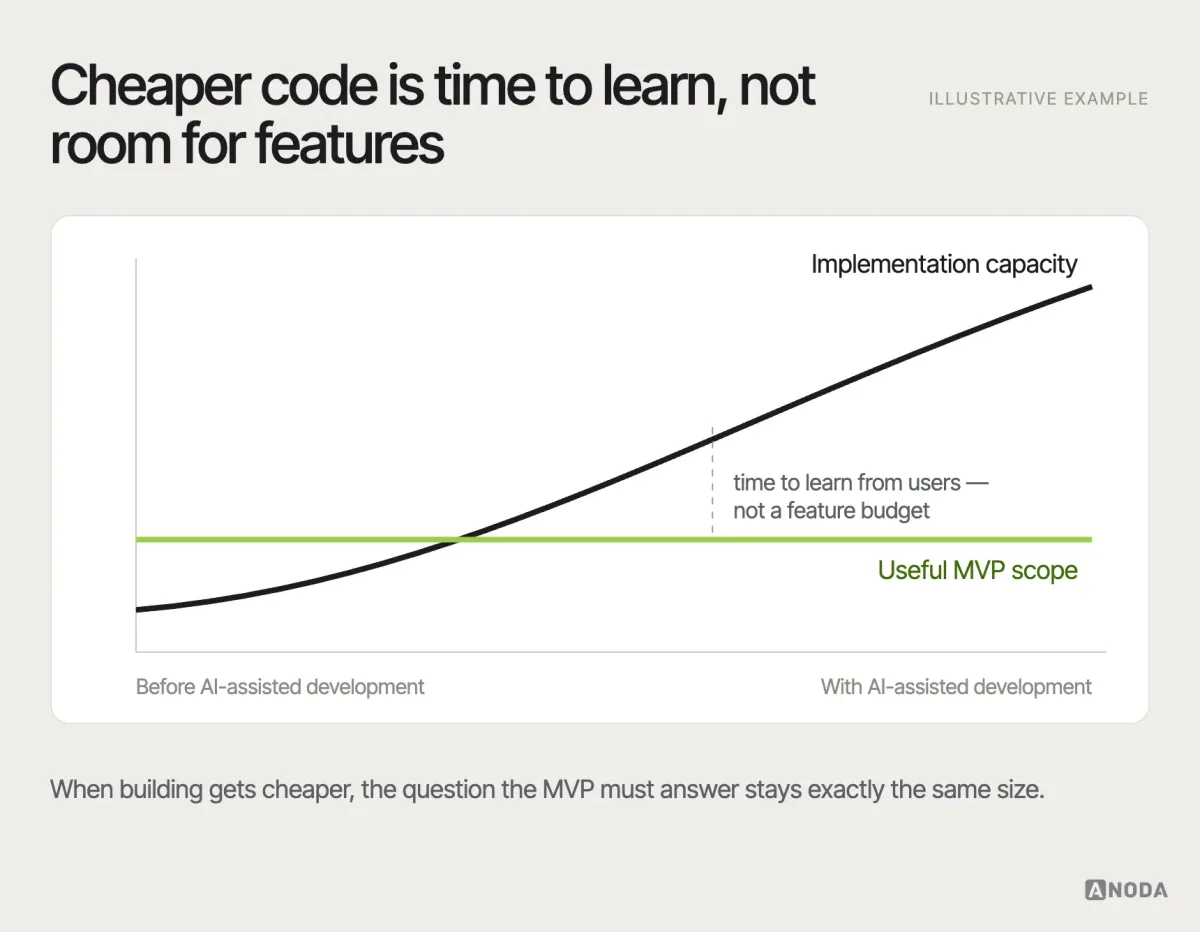
AI-assisted development has made writing code dramatically faster. A small team can now produce in weeks what used to take months, and founders reasonably ask whether the MVP discipline still matters when building is this cheap.
It matters more. Faster implementation removes one constraint — engineering time — and exposes all the others: nobody has decided who the product is for, which flow matters, what the product should not do, or what result would count as success. When code was expensive, the budget forced some focus. When code is cheap, the only thing stopping a team from building forty features is judgement. Judgement is not getting faster.
A conveyor belt that produces boxes twice as fast does not make the shop sell more boxes. It just fills the stockroom sooner.
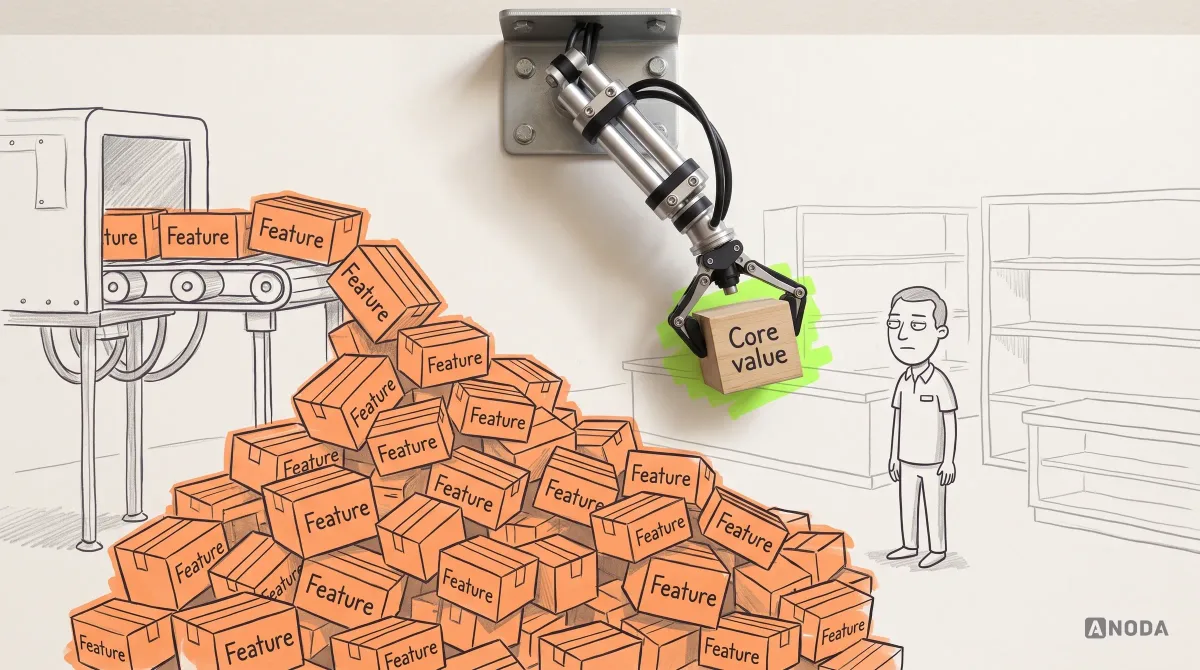
The trap is subtle. With AI tools, adding a feature feels almost free — a prompt, an afternoon, done. But every feature still has to be designed into the flow, explained to the user, tested, maintained, supported and, eventually, removed. More available implementation capacity is not permission to multiply features. It is an opportunity to ship the narrow product sooner and spend the saved time learning from users.
How small is “minimum”? Five or six core capabilities
The most useful rule of thumb we give founders is blunt: an MVP usually needs no more than five or six core capabilities. Not screens — capabilities. The things a user must be able to do for the product to deliver its unique value, end to end.
For a booking app, that might be: create an account, find an available slot, book it, pay, get a confirmation and reminder, and manage or cancel the booking. For a B2B reporting tool: connect one data source, see one core report, share it, set one alert, and invite a colleague. Everything else — loyalty programmes, social features, advanced settings, a second platform, an admin panel beyond the bare minimum — is a later decision, taken when the core has proven itself.
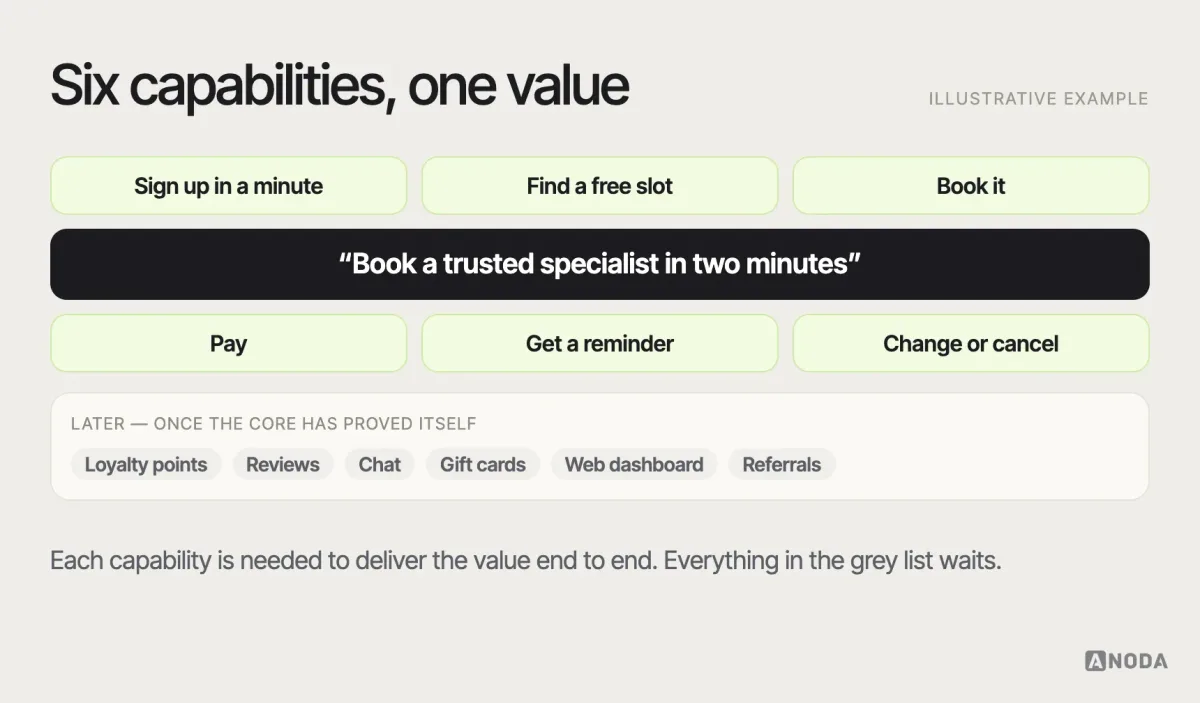
The test for each capability is simple: without it, can a user experience the core value? If yes, it is not in the MVP. This is where most arguments happen, because every stakeholder has a favourite. The investor wants analytics dashboards, the sales lead wants a demo mode, the founder wants the feature the competitor just launched. The MVP is not a negotiation between those wishes. It is the minimum set that tests the one thing you most need to know.
It is packing a moving truck for a weekend camping trip. Everything in it might be useful someday. None of it fits in the tent.

Decide before you design: positioning, audience, flow, scope, deadline
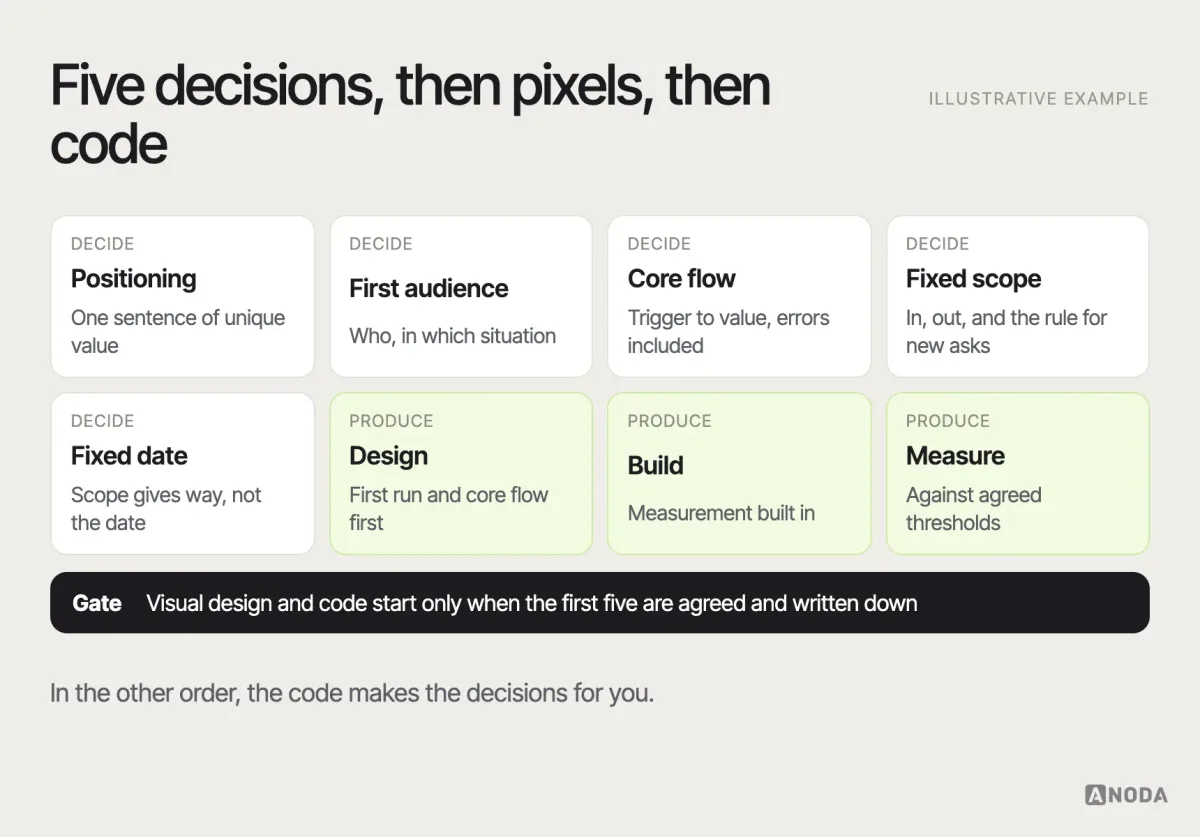
The order in which an MVP is prepared matters as much as its size. The teams that ship good MVPs make five decisions before anyone opens a design tool or writes production code.
Positioning. What is the unique value, in one sentence, and why would someone choose this over what they do today? If the founder cannot explain it simply, the product will not explain it either. We ask founders to explain the idea as if to a smart friend in a café; if that takes twenty minutes, the MVP is not ready to be scoped.
Audience. Who exactly is the first user? Not “small businesses” — which small businesses, in which situation, with which trigger that makes them look for a solution? A narrow first audience makes every design decision easier and every result easier to read.
User flow. How does that user get from the trigger to the value, step by step, including what happens when things go wrong? The flow is where the five or six capabilities get connected into one path. It is also where most scope creep becomes visible, because every extra feature has to find a place on it.
Fixed scope. The capabilities that are in, the ones that are explicitly out, and the rule for handling new requests during the build — usually “it goes on the list for the next release”.
Fixed deadline. A release date that does not move. Scope is what gives way, never the date. A train leaves at nine whether or not you finished packing, and a team that knows this packs differently.

Only after those five decisions do visual design and code begin. Reversing the order — designing screens, then discovering the audience, then negotiating the scope — is putting the cart before the horse, and on an MVP the cart is usually most of the budget.
Map the core flow before anything else
The core flow is the MVP’s spine. It shows the trigger that brings the user in, every step to the moment they get value, and the recovery paths for the obvious failures — a failed payment, an empty state on day one, a missing permission. Designed well, it doubles as the scope document: anything not on the flow is not in the MVP.
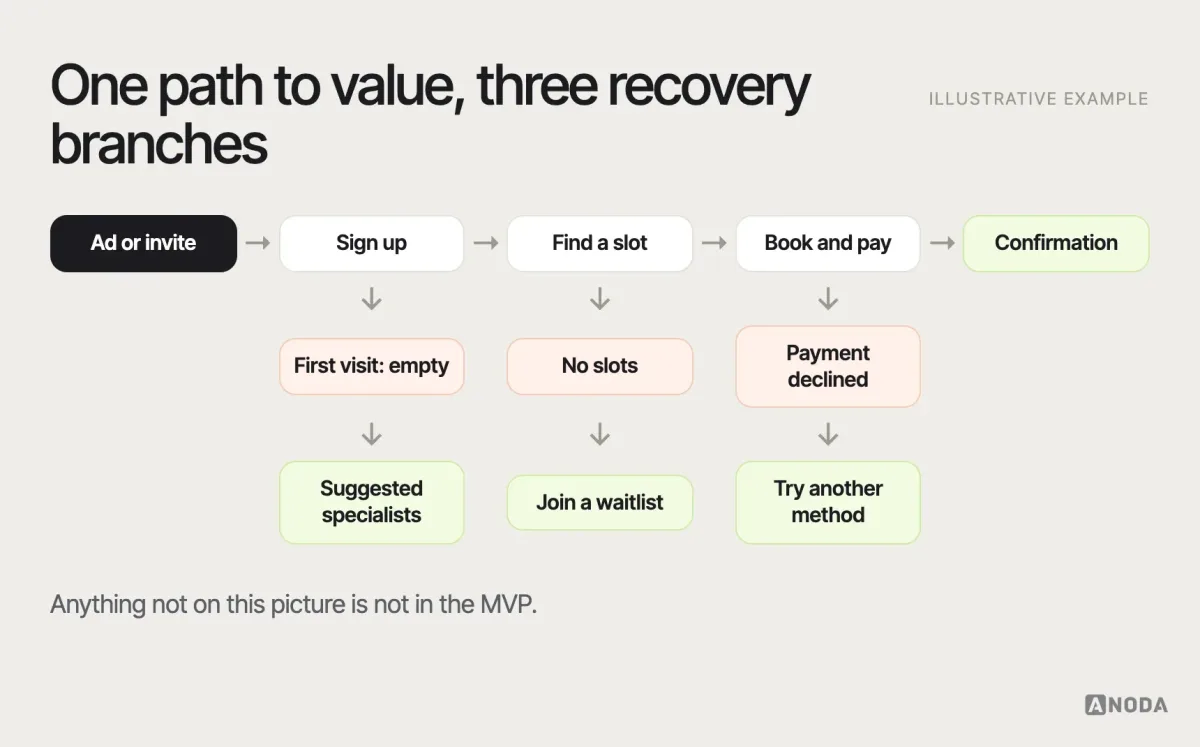
A flow also tells you where the product needs to be excellent and where it can be plain. The steps between the trigger and the first moment of value deserve all the design attention you can afford, because that is where early users decide whether to stay. Settings, profile editing and account management can be basic and functional for now. Nobody chooses an app for its profile screen.
Write the scope down — and protect it
A scope that only exists in people’s heads will grow. Write it on one page: the core value, the first audience, the capabilities that are in, the ones that are explicitly out, the release date, and the signal that would count as success. Share it with everyone who can request features, including investors and the founder’s most enthusiastic friends.
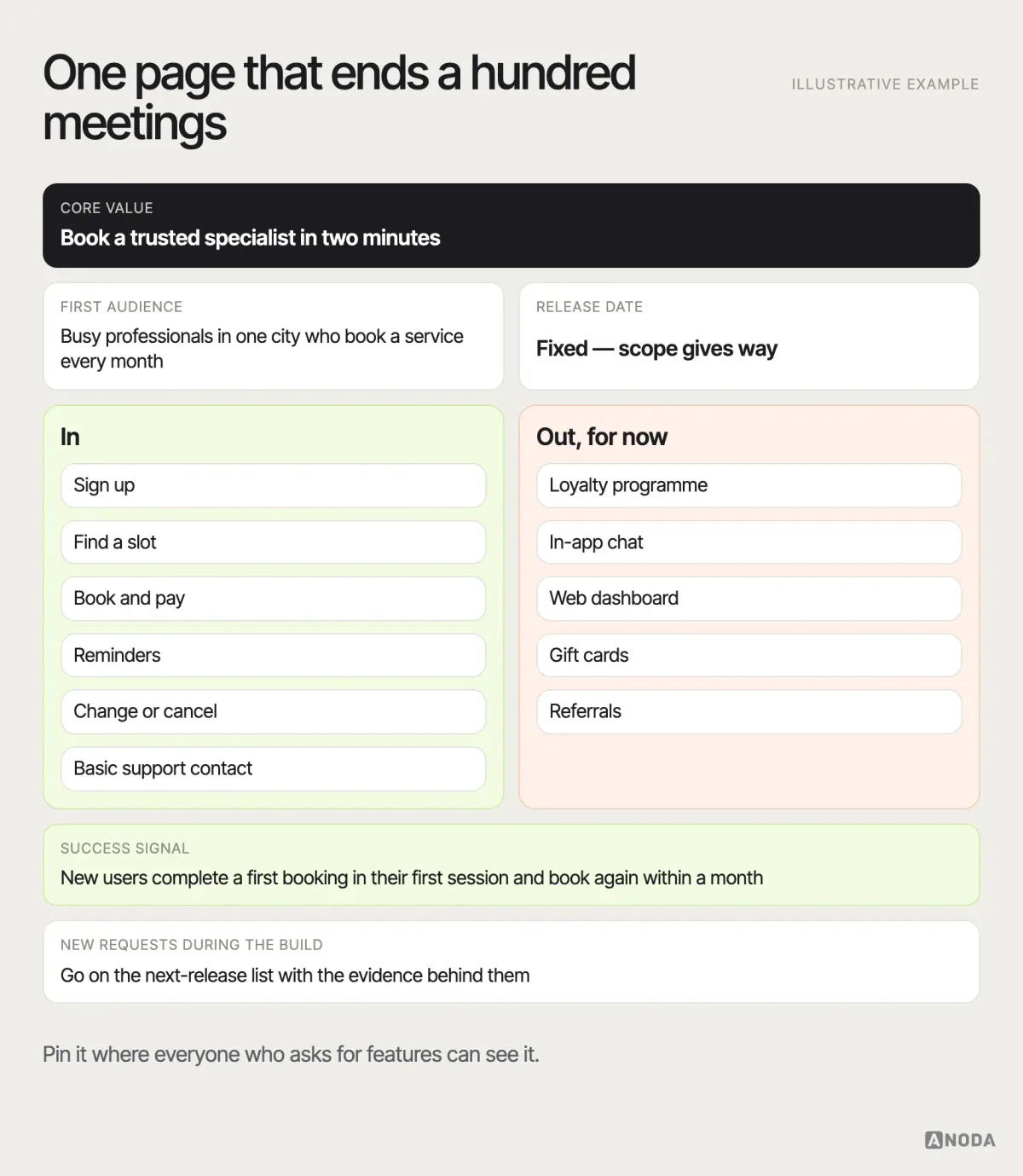
Then protect it. New ideas will arrive during the build — some of them good. They go on a list for the next release, with a note on the evidence behind them. The only reasons to change the scope mid-build are a discovery that the core cannot deliver its value without something, or a discovery that one of the capabilities is not needed. “A competitor launched a chat” is neither.
MVP development
Is your MVP already the size of a full product?
We turn an explainable idea into a bounded plan: the core flow, five or six capabilities, the interface and a handoff your developers can build in weeks, not quarters.
Who needs to be on the MVP team
An MVP is small, but it is not a one-person job, and the roles matter more than the headcount. Someone has to own the product decisions: the positioning, the scope, the trade-offs, the call on what gets cut when time runs short. Usually that is the founder or a product lead with real authority. Someone has to design the flow and the interface, and ideally that person also runs the early usability checks. Someone has to build and run it — engineering that is honest about what is feasible in the time and does not gold-plate the architecture for a scale the product has not earned yet. And someone has to talk to users before and after launch; if nobody owns that, nobody will do it.
What an MVP team does not need is a committee. Every extra decision-maker adds a favourite feature and a week of alignment. Small team, clear owner, short feedback loops — that is the whole organisational secret.
For companies building a new product inside an existing business, the same rules apply with one addition: protect the MVP team from the parent company’s processes. A new product forced through the release governance, brand review and feature committee built for the core product will never be minimal, and rarely viable.
Choose the riskiest assumption to test first
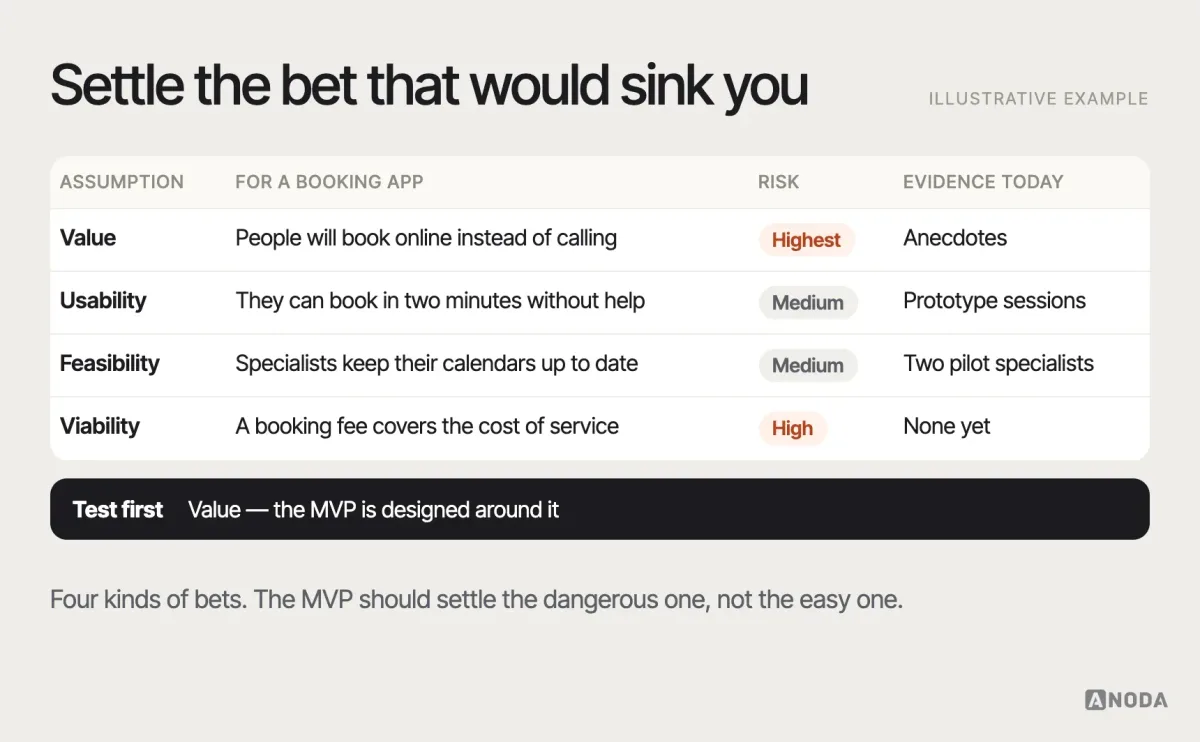
Every MVP is a bet on a set of assumptions, and they are not equally dangerous. It helps to sort them into four kinds:
- Value: do people have this problem badly enough to change their behaviour for a solution?
- Usability: can they understand and use the product without help?
- Feasibility: can the team build and run it with the available technology, data and money?
- Viability: will the business model work — will people pay, at a price that covers the cost of serving them?
For most MVPs, value is the riskiest assumption, and it is the one teams test last because building the product feels more productive than finding out nobody wants it. Pick the one or two assumptions that would kill the product if they were wrong and design the MVP to answer those first. The rest can be tested in later releases.
Not every MVP needs to be a full app
“MVP” in mobile app development usually means a working app, but it does not have to. Depending on the riskiest assumption, a lighter form may answer the question faster and cheaper.
- Concierge MVP. You deliver the service manually to a small group of users, with minimal software. It tests value and willingness to pay before automation.
- Wizard-of-Oz MVP. The product looks automated to the user, but people do some of the work behind the scenes. It tests whether users want the result before you build the engine.
- Single-feature MVP. One core capability, done very well. It tests whether the heart of the product is strong enough to build around.
- Landing-page or pre-order MVP. A clear offer and a way to sign up or pay in advance. It tests demand and messaging, not the product experience.
- Platform-limited MVP. One platform instead of iOS, Android and web at once. It tests the product with the audience most likely to adopt it, at a fraction of the cost.
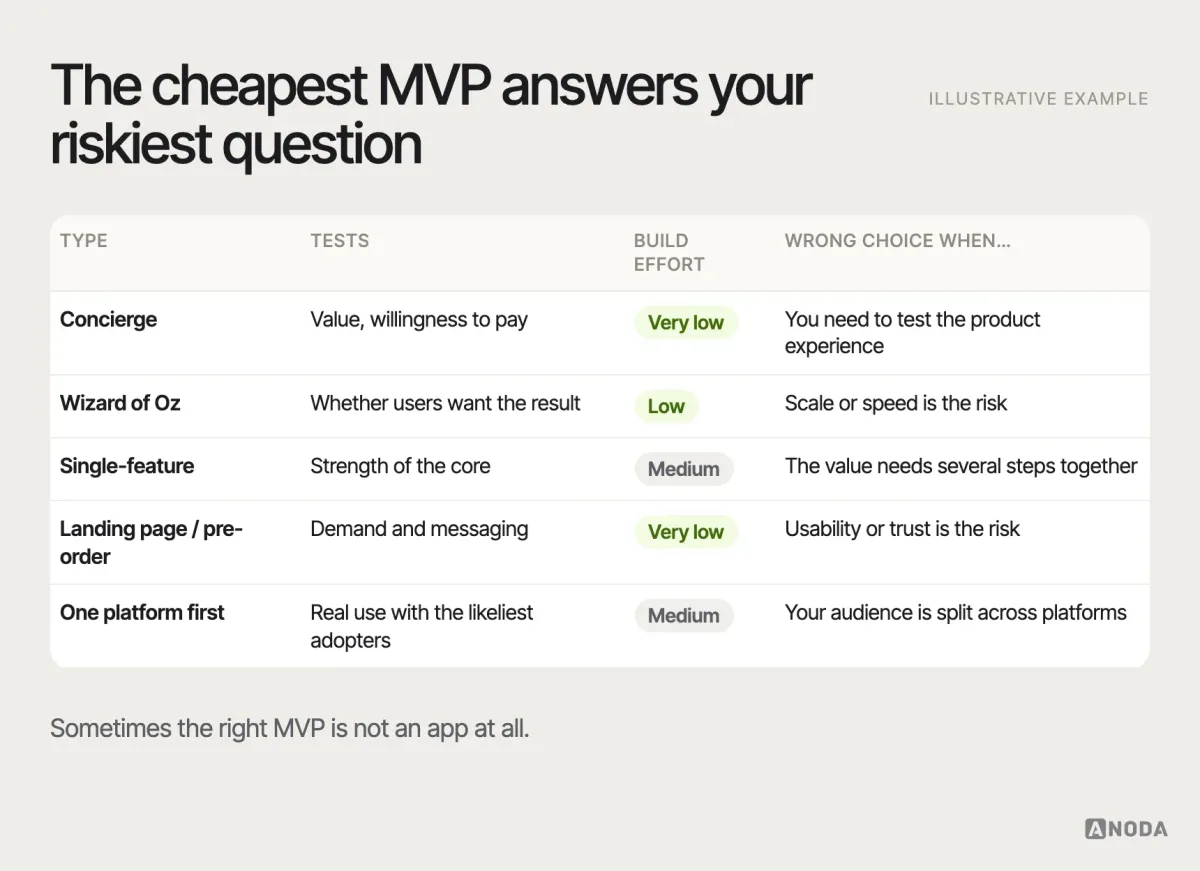
Choose the form around the question: a landing page tests demand; a working mobile flow lets people complete the task on their phone. For money-moving products, plan the trust and reliability requirements into the first working release.
What drives the cost and the timeline of an MVP
Founders understandably want a number. We won’t pretend there is a universal one, because the honest answer depends on a handful of drivers — and knowing them is more useful than an average from someone else’s project.
- The number of core capabilities. Each one needs its flow, its screens, its states and its tests. Going from six to twelve does not double the work; the connections between features make it grow faster.
- The number of platforms. iOS, Android and web at once is three products to design, build, test and support. One platform first is often the biggest single saving available.
- Integrations. Payments, maps, calendars, identity providers, the client’s existing systems. Each one brings its own edge cases and its own failure states.
- Roles. A product used by one type of user is far simpler than one with customers, providers and administrators, each needing their own flows.
- Data and trust requirements. Sensitive data, regulated domains and money movement add security, compliance and reliability work that is not optional.
- Decision speed. The slowest part of many MVPs is not design or code. It is waiting for decisions. A fixed scope and a single decision-maker shorten the timeline more than any tool.
The practical takeaway: if the estimate is too high, cut capabilities, platforms and integrations — in that order — rather than quality. A smaller product done properly teaches you more than a larger one done badly.
Design an MVP that is small, not cheap-looking
Minimal scope does not mean careless design. Early users judge the product fast and forgive little, especially in categories where trust matters: money, health, children, work data. A clumsy onboarding or an unreadable screen can make a good idea look bad, and then the MVP tests your interface instead of your value.
Spend design effort where it matters most: the first-run experience, the core flow, the moment of value and the recovery from the most likely errors. Use a simple, consistent visual system — a small set of components, clear typography, one accent colour — so the product looks coherent without months of visual exploration. Make the product explain itself: short, specific copy, clear empty states, obvious next steps.
Do not skip the basics that make a product usable by everyone: readable contrast, labelled inputs, tap targets a thumb can hit, error messages that say what to do. They cost almost nothing when designed in from the start and a great deal when retrofitted after launch — and early adopters include people who will simply leave if the product does not work for them, without ever telling you why.
And design for measurement from day one. Decide which events show that a user reached value, and make sure the build records them. An MVP without analytics is a very expensive way to collect anecdotes.
Launch to the right people first
An MVP launch is not a product launch. The goal is not the biggest possible audience on day one; it is the right audience, in numbers you can actually learn from and support.
Start with the first audience you defined: people who have the problem acutely, who are easy to reach and who will tell you the truth. That might be a waiting list, a group of design partners, a community the founder belongs to, or a single city or segment. Onboard some of them personally — sit with them, or at least talk to them — because watching the first users try the product teaches more than any dashboard. Make it easy to send feedback from inside the app, and make sure a real person answers.
Resist the urge to buy traffic before the core works. Paid acquisition for an unproven product is the fastest way to spend money learning that the onboarding leaks. Every user you pay for and lose in the first session is a cost you did not need to incur; fix the leak with the first few hundred people who came for free, then open the tap.
Measure whether users reach value
The purpose of launching an MVP is to learn, so decide before launch what you want to learn and how you will see it. Vanity numbers — downloads, sign-ups, page views — tell you about your marketing. The numbers that tell you about your product are about value.
- Activation: what share of new users reach the core moment of value — the first booking, the first report, the first completed task?
- Time to value: how long does it take them to get there, and where do they get stuck?
- Retention: do they come back and repeat the core action next week and next month?
- Willingness to pay or commit: do they pay, upgrade, invite colleagues or ask for more?
- Qualitative signal: what do they say in interviews, support messages and reviews about what works and what is missing?
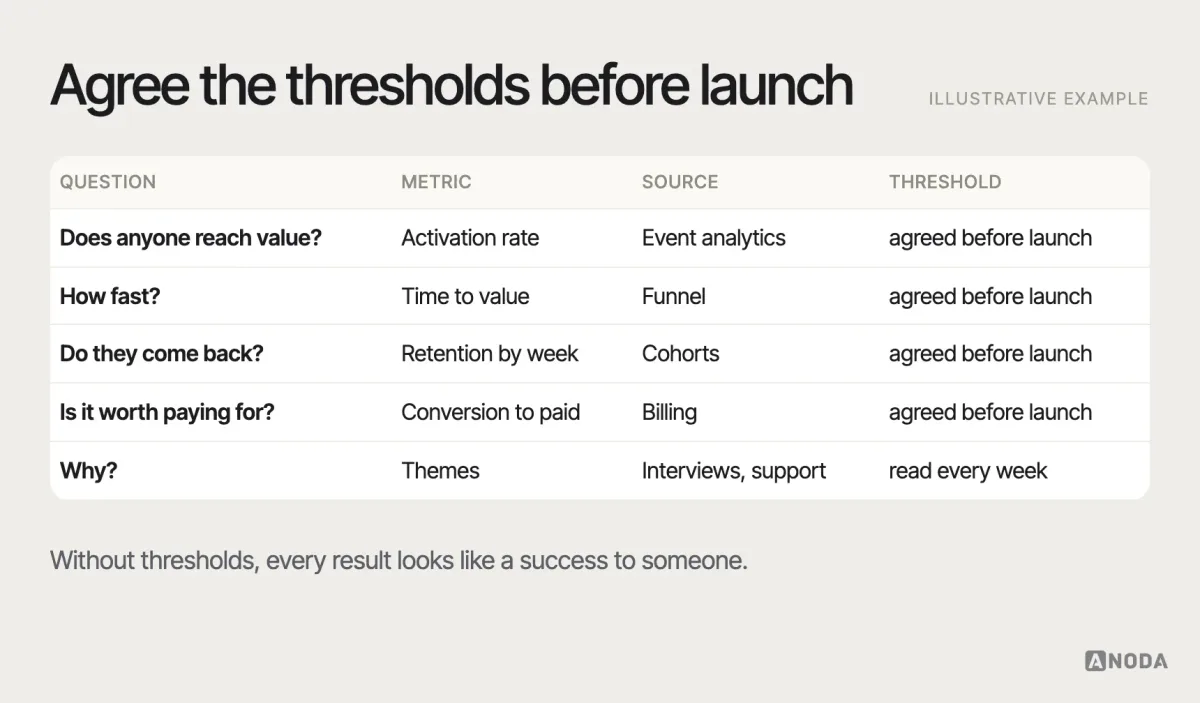
Set the thresholds before launch. What activation rate would convince you the core works? What retention would tell you it does not? Without agreed thresholds, every result looks promising to the founder and disappointing to the sceptic, and the meeting ends with “let’s add a few features and see”.
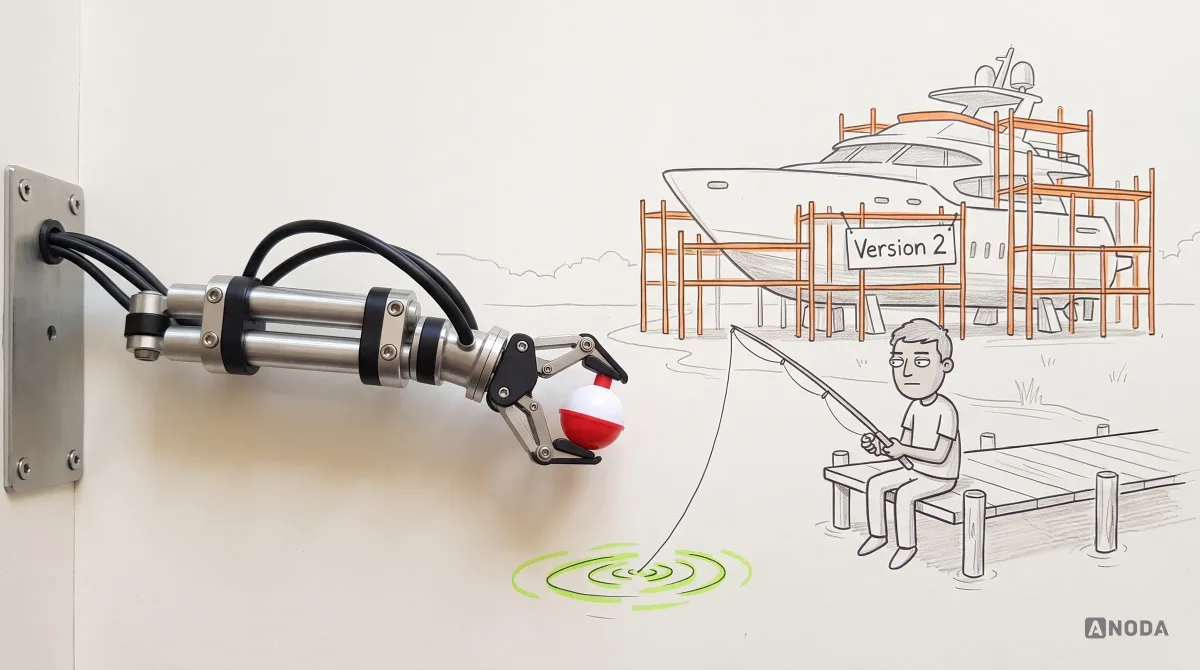
The first weeks after launch should look like fishing, not like building a yacht. Watch the float. See whether anything bites. The yacht can wait until you know there are fish in this lake.
Decide what comes next with evidence, not anxiety
After launch, the pressure to add features arrives immediately. A few users ask for something. A competitor ships something. The founder reads a thread on social media at two in the morning. None of these is evidence about your product.
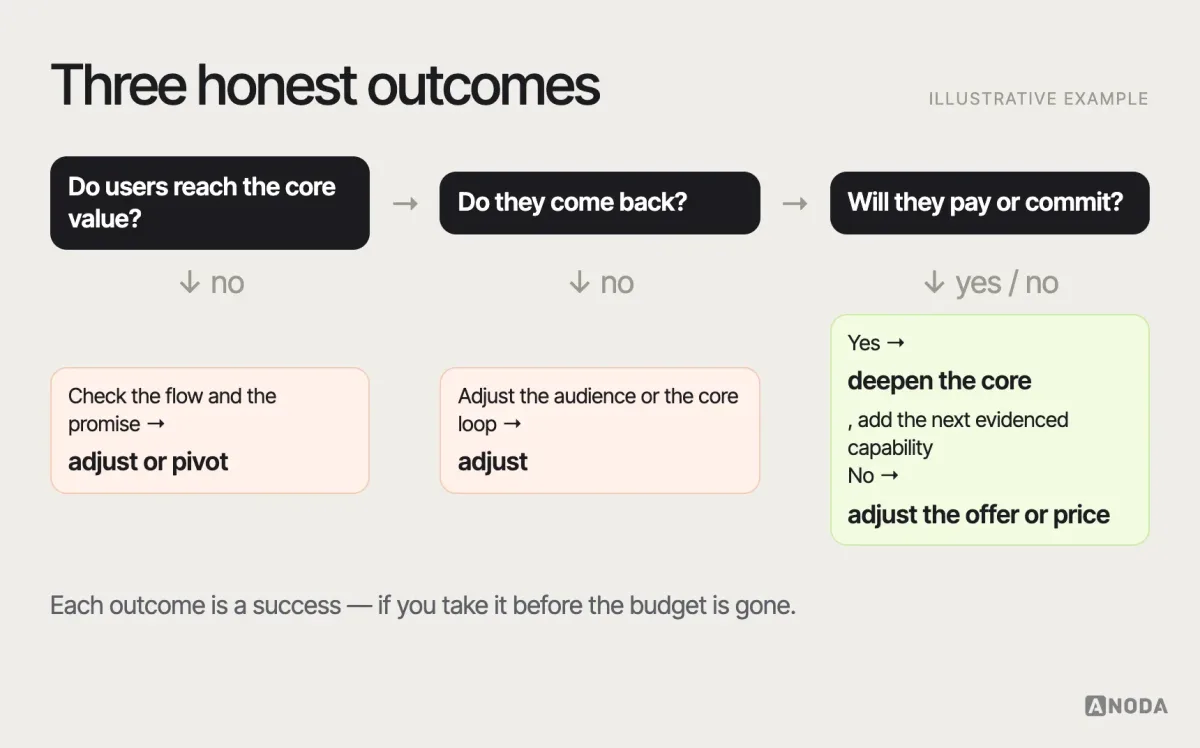
The next release should come from what the MVP measured. There are usually three honest options:
- Persevere and deepen. Users reach value and come back. Improve the core, remove friction, and add the next capability that the evidence points to.
- Adjust. Users reach value but do not stay, or stay but will not pay. Change one important thing — the audience, the core flow, the offer, the pricing — and test again.
- Pivot or stop. Users do not reach value, or reach it and do not care. The MVP did its job: it saved you from building the full product. Change direction or stop, with the budget you still have.
Competitor feature lists are the worst input to this decision. They show what someone else built, not what their users value, and certainly not what yours need. Copying them is how an MVP turns into a slightly worse version of the market leader.
Questions founders ask us about MVPs
Should the MVP be native or cross-platform? It depends on what the core value needs. Heavy use of device capabilities, performance-sensitive interactions or platform-specific conventions favour native. A content- or form-driven product that needs to reach both platforms quickly is often a good fit for a cross-platform approach. The right answer comes from the core flow, not from a technology preference.
Do we need an admin panel? You need a way to operate the product: manage users, content and support cases safely. For an MVP that can be a very simple internal tool or even a well-protected database interface, as long as nobody has to edit production data by hand in a panic. A polished admin product can wait.
Should the MVP be free? If willingness to pay is one of your riskiest assumptions, charging — or at least asking for a commitment such as a pre-order or a deposit — is the only way to test it. Free users tell you whether people like the product. Paying users tell you whether it is a business.
How many users do we need? Enough to see a pattern in the behaviour you care about, from the audience you care about. For some B2B products that is a few dozen active accounts; for a consumer app it is usually far more. What matters is not the headline number but whether you can read activation and retention with some confidence — and talk to the people behind the numbers.
What if a competitor launches first? Then you learn from their launch for free. A competitor’s feature list tells you what they guessed. Your users’ behaviour tells you what is true.
The MVP mistakes that cost the most
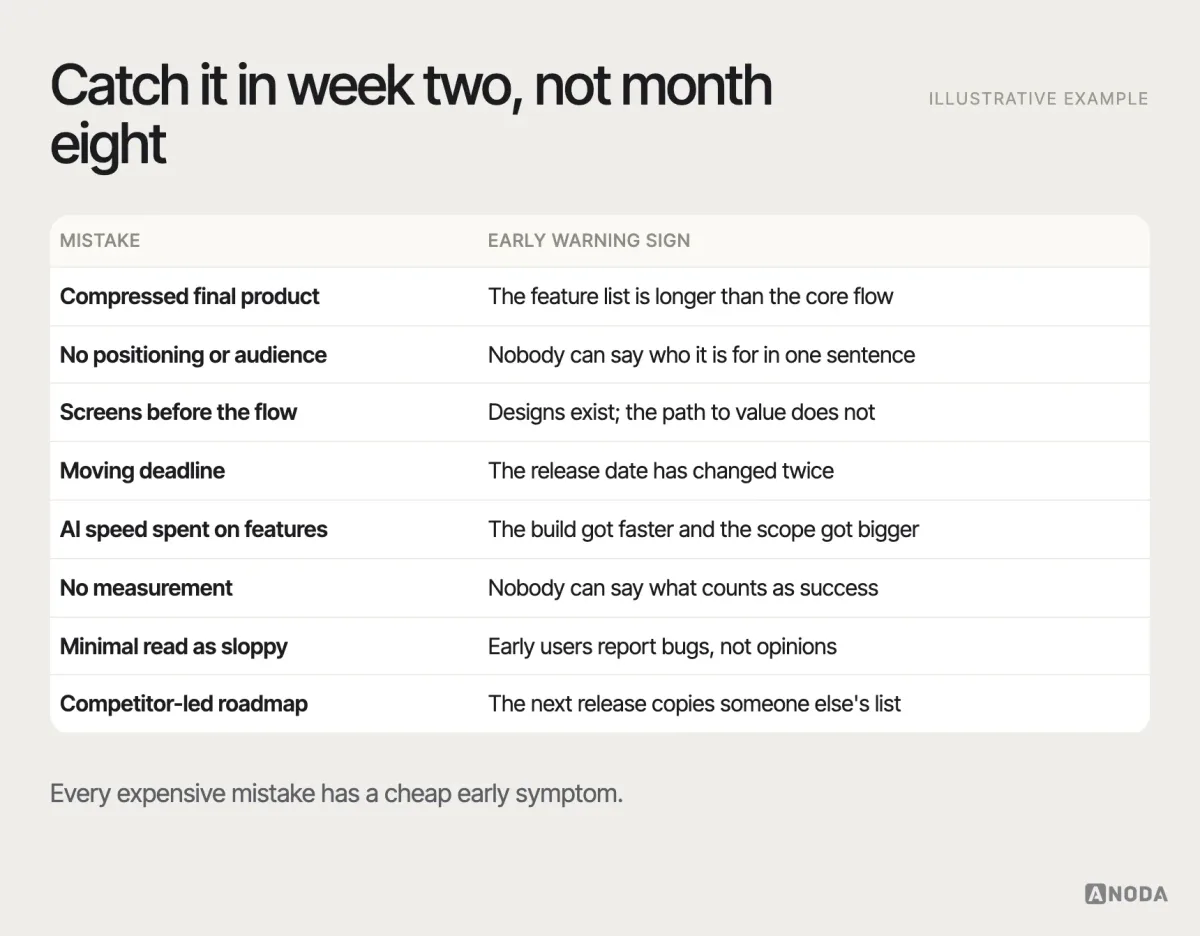
Different founders, different ideas, the same expensive mistakes. If several of these sound familiar, the MVP is already drifting.
- Treating the MVP as a compressed final product. Every feature of the vision, each a little smaller. The result is too big to ship fast and too thin to delight anyone.
- Skipping positioning and audience. Building for “everyone who might need this”, so no design decision has a clear answer and no metric can be read.
- Designing screens before the flow. Beautiful screens that do not connect into a path to value.
- Letting the deadline move. Scope grows to fill the time, then the time grows to fill the scope.
- Using AI speed to add features instead of learning. The build is faster; the product is bigger; the question is still unanswered.
- Launching without measurement. Opinions about the launch replace evidence about the product.
- Mistaking minimal for sloppy. A buggy, confusing product tests nothing except users’ patience.
- Reading competitor roadmaps instead of your own data. The next release copies someone else’s guesses.
An illustrative MVP example
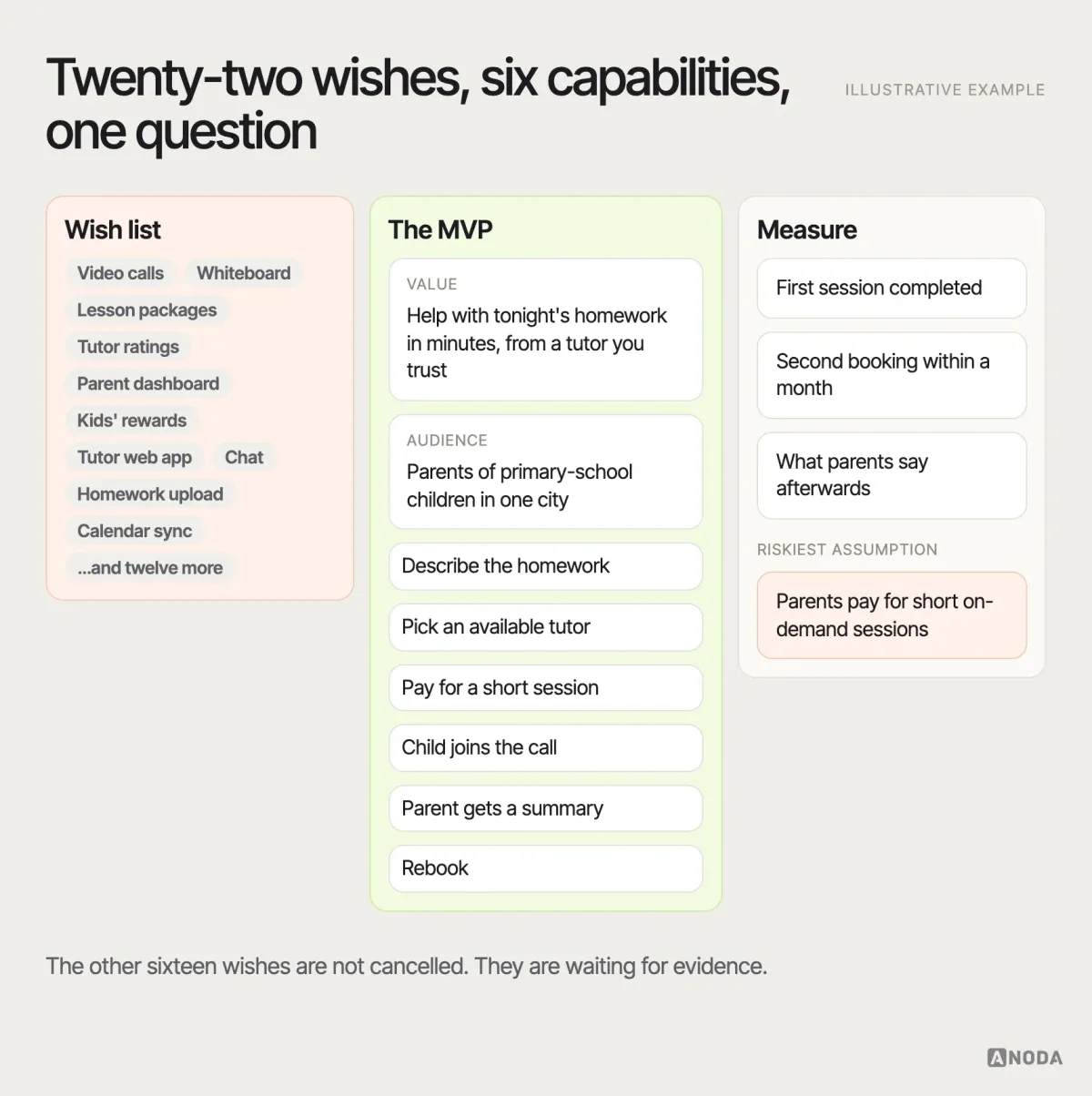
Here is what the process looks like on a typical project — an illustrative example, not a specific client. A founder wants to build an app that connects busy parents with vetted tutors for short, on-demand homework help. The original feature list has twenty-two items: video calls, a whiteboard, a marketplace for lesson packages, tutor ratings, parent dashboards, a rewards system for children, a web version for tutors and more.
Positioning narrows the value to one sentence: help with tonight’s homework in minutes, from a tutor the parent can trust. Audience narrows to parents of primary-school children in one city, where the founder already has a network of tutors. The core flow becomes: a parent describes the homework, picks an available tutor, pays for a short session, the child joins a call, and the parent gets a short summary. Six capabilities make it happen. The whiteboard, packages, rewards and the tutor web app go on the next-release list.
The riskiest assumption is value: will parents pay for short, on-demand sessions rather than booking weekly tutoring? The MVP ships on one mobile platform with a fixed date, and measures how many parents complete a first session, how many book a second within a month, and what they say afterwards.
Whatever the numbers say, the founder learns in weeks what the full product would have taught them in a year — and still has most of the budget to act on it.
Why ANODA connects scope to the whole first journey
In Payyro, a first version was released with Webflow and Wized, while the redesigned next version connected customer, donor, vendor and admin roles through detailed flows. A bill being funded, verified and paid to the vendor is a sequence of different decisions, not one button. ANODA designs those relationships before they become development surprises.
For your MVP, that means a smaller roadmap without missing the steps that make the core value work. You spend on a coherent first experience and preserve the budget to extend it when users tell you what matters.
How to build an MVP, step by step
To pull it together, here is the sequence we recommend:
- Write the positioning. One sentence of unique value and the reason someone would switch to it.
- Choose the first audience. Narrow enough that you can reach them and read their behaviour.
- Name the riskiest assumption. The one that would kill the product if it were wrong.
- Map the core flow. From trigger to value, with recovery paths for the likely failures.
- Cut the scope to five or six capabilities. Everything else goes on the next-release list.
- Fix the release date. Scope gives way; the date does not.
- Design the core experience. Excellent first run and core flow, plain everything else, measurement built in.
- Build and launch to the first audience. Real users, real conditions, agreed thresholds.
- Measure and decide. Persevere, adjust or pivot — with evidence, not anxiety.
If the first usable journey needs both mobile platforms and a shared custom interface, our Flutter development service builds the Dart app and its device integrations together. We scope the smallest complete journey, check the plugins and native requirements early, and put working iOS and Android builds in your hands before adding the next feature.
Ship a narrow, understandable product quickly, measure whether users reach value, and let evidence — not founder anxiety or a competitor’s feature list — choose the next release. That is the whole benefit of building an MVP: you learn the expensive truths while they are still cheap. For more on planning and designing products, browse the rest of the ANODA blog.

MVP development
An idea you can explain, and a budget you would rather not burn?
We turn it into a bounded MVP: positioning, the core flow, five or six capabilities, an interface people understand, a handoff your developers can build and the measurement that tells you what to do next.
Written by