In short
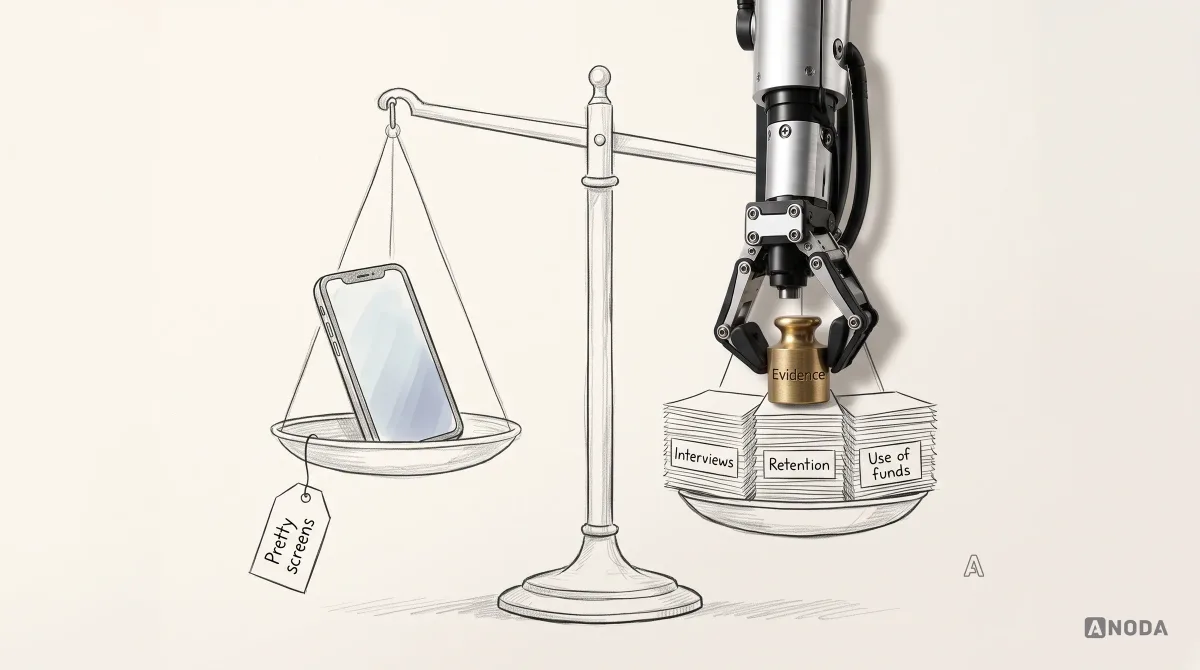
Investors fund evidence, not app ideas or attractive screens. Before outreach, show that the problem is real, that a specific buyer will pay, that people keep using the product, and exactly which milestone the money buys. Then pick investors who fund your stage and market, and run a short, organised process. Here is the whole path, from funding fit to the evidence room, the pitch, the demo, diligence and the no's.
In this article
- Decide whether external funding fits the business
- What investors actually buy
- Define the problem, the buyer and the market
- Prototype, MVP and traction are different things
- What evidence each stage needs
- App-specific evidence: activation, retention and money
- Build an evidence room
- Model assumptions, milestones and use of funds
- Choose the investor type and stage
- Build a qualified target list
- Channels: introductions, accelerators, events and outbound
- Write a concise outreach message
- Prepare the pitch deck
- Prepare the product demo
- Run meetings and follow-up as a process
- SAFEs, convertible notes and priced rounds
- Prepare for diligence before anyone asks
- Handle rejection and update the evidence
- Make the product case impossible to miss
- Common mistakes founders make
- Investor-readiness checklist
- The decision rule
Investors don’t fund app ideas. They fund evidence. To get investors for an app, you need to show that a real problem exists, that a specific buyer will pay to solve it, that your product solves it better, that you can reach those buyers, and exactly which milestone the money will buy. Build that evidence first, pick investors who fund your stage and market, and run outreach as a short, organised process, not a year of coffee meetings.
Every week, somebody somewhere opens a pitch with a gorgeous prototype and the sentence “we just need funding to build it”. The screens are lovely. The gradients are expensive. The investor nods, asks who has used it, how they found those people, what they paid and what happens after month two. The founder talks about vision. The meeting ends politely. The follow-up email never gets a reply.
We have designed products for founders for 15 years. ANODA makes the opportunity tangible: a clear customer problem, a focused product journey and a demonstration investors can understand. We connect the promise to the experience, so your product case carries the conversation.
Here is the uncomfortable part. Every month spent pitching without evidence is runway you’re burning on meetings. The time you spend on a failed round is time you didn’t spend talking to customers, which is the one thing that would have made the next round work. Raising is expensive even when nobody sends you an invoice.
This guide walks through the whole path in the order it should happen: deciding whether investors are right for your app at all, building the evidence each stage needs, turning it into a milestone plan and a use of funds, picking investors who actually fund what you’re building, writing outreach that gets read, preparing the pitch and the demo, running meetings, getting through diligence and learning from the no’s.

Decide whether external funding fits the business
Before asking how to get investors, ask whether you want them. Equity investors buy a share of your company because they expect it to become worth many times more. Most professional funds need a few companies in their portfolio to return the whole fund, so they look for businesses that could become very large. That’s their business model, not a character flaw.
Plenty of good apps will never be that kind of business, and they don’t need to be. A profitable tool for a niche of 20,000 professionals can pay its founders well for years. Selling a large part of it to people who need a hundredfold outcome is like entering a family saloon car in Formula 1. The car is fine. The race is wrong.
Ask four questions honestly.
- Is the opportunity big enough for an equity investor? Not “is the market big” in a slide, but could this company realistically grow into something many times its current value?
- Does speed matter? If a competitor with money could take the market while you grow slowly on revenue, outside capital may be worth its price. If not, slower can be smarter.
- Can revenue fund the next step? Some apps can charge early, from the first customers. Customer money is the cheapest capital there is: it costs no equity and proves demand at the same time.
- Are you ready to work for shareholders? Investors bring board seats, reporting, expectations about growth and, eventually, an exit. That is a job on top of your job.

If the answers point away from equity, there are other routes: bootstrapping from revenue, services revenue that funds the product, grants for research-heavy work, revenue-based financing once income is steady, or a small round from angels who are happy with a smaller outcome. Choosing these isn’t giving up. It’s choosing your own terms.
What investors actually buy
At every stage, an investor is buying a reduction in risk at a price. The app idea is the smallest part of that. Ideas are cheap, and investors hear the same idea several times a year. What they’re trying to judge is whether this team can turn it into a business, and how much of the risk has already been removed.
The risks are always roughly the same:
- Problem risk. Does anyone have this problem badly enough to change their behaviour?
- Product risk. Does your product actually solve it, in a way people choose over their current workaround?
- Market risk. Are there enough of these people, and will they pay?
- Distribution risk. Can you reach them at a cost that makes sense?
- Team risk. Are you the people who can build and sell this?
- Capital risk. Will this round reach a milestone that makes the next round possible, or will you run out of money halfway?
Your job before fundraising is to remove as much of that risk as you can, and to be honest about what’s left. Investors know early companies are risky. What worries them is a founder who doesn’t seem to know which risks remain.
This is also where most app founders overestimate design. A polished interface reduces one sliver of product risk: it shows you can imagine a good experience. It doesn’t show that anyone wants it, pays for it or sticks around. Selling a round on screens alone is like selling a house with a Pinterest board of the kitchen. The kitchen may be lovely. The buyer still wants to see the foundations.
Define the problem, the buyer and the market
Start with the problem, described in the customer’s words, not yours. “Private music teachers lose hours every week chasing lesson payments and rescheduling by text” is a problem. “Inefficiencies in the education scheduling ecosystem” is a sentence nobody has ever said out loud.
Then define the buyer precisely. Who has the problem, who decides to buy and who pays? In consumer apps they’re often the same person. In B2B apps they almost never are: the user suffers, the manager approves, finance pays. Your pitch has to show you know which one you’re selling to.
Then size the market from the bottom up. Top-down sizing (“the global education market is worth billions, if we get 1%…”) tells an investor you haven’t done the work. Bottom-up sizing counts the buyers you can actually reach and multiplies by what they’d realistically pay.

Show your assumptions openly. Where did the number of teachers come from? Why £12 a month and not £30? An investor will poke at every assumption anyway. It’s far better if they find you already have.
If your problem definition still feels fuzzy, don’t fix it with a nicer slide. Fix it with discovery: interviews, observing the workaround people use today, testing whether they’d pay. That’s exactly the job of product discovery, and it’s much cheaper than a round that stalls because the problem was never proven. If you’re still at the stage of deciding whether the idea deserves investment at all, our guide to evaluating your app idea for investment comes first.
Turn the idea into a clear product case
ANODA will pin down the problem, the buyer and the focused release before you spend months pitching.
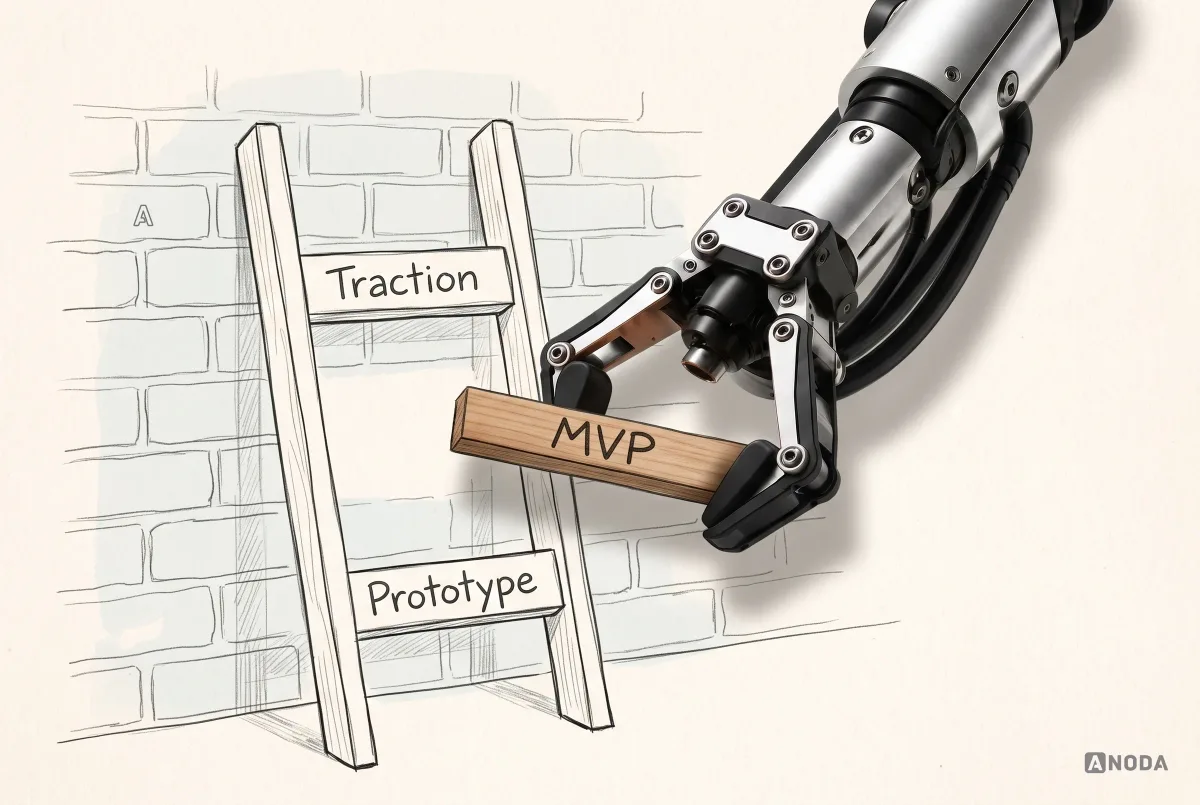
Prototype, MVP and traction are different things
Founders use these words as if they meant the same thing. Investors don’t. Each one proves something different, and each one fits a different stage.
- A prototype shows how the product would work. It can be a clickable design in Figma or a rough coded demo. It proves you’ve thought through the experience and helps you test whether people understand the value. It proves nothing about whether they’ll use it next week.
- An MVP is the smallest real product that delivers the core value to real users. People can sign up, use it and, ideally, pay. It proves you can build, and it starts producing evidence you can’t get from a prototype: activation, repeat use, payments.
- Traction is evidence that the product is working in the market over time: people come back, pay, stay and bring others. It’s not a number of downloads in a launch week. It’s a pattern.

A clickable prototype presented as a product is a film-set street: the saloon, the bank and the sheriff’s office all have beautiful front walls, and nothing behind them. It works on camera. Investors have seen enough film sets to walk round the back.
Do you need an MVP before approaching investors? Not always. Some pre-seed investors and accelerators back teams with a strong prototype and early customer evidence, especially when the team has done this before or the product needs capital to build. But the less product you have, the more of the remaining evidence has to come from somewhere else: interviews, letters of intent, a waiting list of the right buyers, pilots, pre-orders. Something has to show demand. The less you’ve built, the more that something needs to weigh.
If you need to get from an idea to a real, focused product that can start producing evidence, that’s where MVP design earns its keep: one core job, done well, for one buyer, with the analytics to prove it’s working.
What evidence each stage needs
There are no official rules for what each round requires, and anyone quoting you exact thresholds is guessing, or selling something. Expectations vary by market, sector, investor and year. What doesn’t vary is the direction: each stage should remove a different layer of risk.
- Pre-seed. The problem is real and painful; the team understands the buyer; there’s a credible product thesis, usually a prototype or an early MVP; there are early signs of demand. Investors are mostly backing the team and the insight.
- Seed. The product is live, and real people use it for the core job. There are early signs of retention and willingness to pay. The team has a view on how to reach customers, ideally with some channel already working.
- Series A and later. The engine is visible: customers are acquired, activated, retained and paid for at economics that improve as you grow. The round pours fuel on something that is already running.

Notice what’s missing: “a beautiful design” isn’t a stage. Neither is “a big vision”. Both help. Neither replaces evidence.
App-specific evidence: activation, retention and money
General startup advice often forgets that an app lives or dies on a few very specific behaviours. These are the numbers an investor who understands apps will ask about, and the ones you should be able to show, even at small scale.
Activation. What share of people who sign up reach the moment the product becomes useful? For our fictional scheduling app for music teachers, that might be “added their students and scheduled a first lesson”. If most new users never get there, more marketing money only buys more people who leave. Paying to acquire users who never activate is filling a bath with the plug out.
Retention. Of the people who activated, how many are still using the product after four weeks, eight weeks, three months? Retention curves that flatten out, instead of sliding to zero, are the most convincing evidence an early app can show. They say: for some group of people, this became part of their routine.

Willingness to pay. Free users are nice. Paying users are evidence. Even a small number of people paying a real price says more than thousands of free sign-ups.
Unit economics. At seed stage and beyond, investors want to understand what it costs to win a customer and what that customer is worth over time. Early numbers are noisy, and that’s fine. What matters is that you measure them honestly and understand what would improve them.

Be careful with vanity numbers. Downloads, page views and waiting-list sign-ups look good on a slide and prove very little. An investor who sees “10,000 downloads” will ask how many are active today. If the answer is awkward, the downloads just became a liability.
Downloads are applause. Retention is people coming back to the show.
Build an evidence room
An evidence room is a single, organised place with everything that backs up your claims. Most founders call it a data room and build it in a panic the week an investor asks for it. Build it first, before outreach. It’ll show you where your case is thin while there’s still time to fix it.
What goes in it depends on the stage, but for an early app it usually includes:
- Customer evidence: interview notes and a summary of what you learned, pilot results, letters of intent, testimonials you have permission to share.
- Product evidence: the prototype or product, key user flows, a short demo video, the roadmap for the next milestone.
- Usage data: activation, retention and payment data, with definitions of how each number is calculated.
- Market evidence: your bottom-up sizing with sources, competitor analysis, why now.
- Financial model: assumptions, monthly costs, the milestone plan and use of funds.
- Company documents: incorporation, cap table, founder agreements, IP assignments, key contracts.

Organise it by the questions investors ask, not by your file system. “Do customers want this?” is a better folder name than “Research_final_v3”. And make sure every number in the deck matches the number in the room. One inconsistency and an investor starts wondering which other figures are rounded up.
Model assumptions, milestones and use of funds
This is where many app pitches fall apart. “We’re raising £600,000 to build the product and grow” is not a plan. It’s a wish with a currency sign.
A credible raise starts from the milestone, not the amount. What must be true at the end of this round for the company to be clearly more valuable, and fundable for the next step? For the music-teacher app, that might be: 1,000 paying teachers, retention that holds after three months, and one acquisition channel that works at a known cost. Then you work backwards: what do you need to build, who do you need to hire, what will you spend on reaching customers, and how long will it take?

The amount is the cost of reaching that milestone, plus a buffer, because everything takes longer than planned. Every experienced investor knows that, and a plan with no buffer looks naive rather than lean.
Use of funds then shows how the money is split: product and engineering, go-to-market, operations, and the buffer. Tie each line to the milestone it serves. “£150,000 for marketing” says nothing. “£150,000 to test three acquisition channels and scale the one that reaches paying teachers most cheaply” says you know why you’re spending it.

Keep the financial model simple and honest. At pre-seed and seed, nobody believes a five-year forecast to the pound. What investors look at is whether the assumptions are sensible, whether you understand which ones matter most and whether the plan survives if the important ones turn out worse. Show the sensitivity: what happens if conversion is half what you hoped? If the plan still works, say so. If it doesn’t, say what you’d change.
Choose the investor type and stage
Different investors fund different things, at different stages, in different amounts. Pitching the wrong type is like applying to medical school with a portfolio of oil paintings. The paintings might be brilliant. You’re still in the wrong building.
- Friends and family. Often the first money. Fast and flexible, but only take money people can afford to lose, and put it on proper terms.
- Angel investors. Individuals investing their own money, often early, often in areas they know. A good angel with relevant experience can be worth more than the cheque.
- Accelerators. Programmes that invest a small amount for equity, provide support and end with an investor demo day. Strong programmes are selective; weaker ones mostly take equity.
- Pre-seed and seed funds. Professional funds that back early companies. Each has a focus: sector, geography, business model, stage and cheque size.
- Later-stage venture funds. For companies with a working growth engine. Almost never the right first call for an app founder.
- Strategic investors. Companies investing in startups close to their own business. Helpful access, but check what they expect in return.
- Crowdfunding. Equity crowdfunding can work for consumer apps with an engaged community. Treat it as a campaign that needs its own marketing, not free money.
- Grants and non-dilutive funding. Useful for research-heavy or public-interest products, usually with rules on how the money is spent.

Terms and rules differ between countries and change over time. A few reference points, checked on 29 September 2026: Y Combinator’s standard deal is $500,000 — $125,000 on a post-money SAFE for 7% of the company, plus $375,000 on an uncapped SAFE with a most-favoured-nation clause. In the UK, the Seed Enterprise Investment Scheme gives eligible investors 50% income tax relief, and a company can raise up to £250,000 under it, which is why many early UK angels look for SEIS and EIS eligibility first. In the US, Regulation Crowdfunding lets eligible companies raise up to $5 million in 12 months through a registered platform. Check the current rules with a qualified adviser before you promise anything to anyone. This guide is about readiness and process, not legal or tax advice.
Build a qualified target list
The worst way to find investors for an app is to download a list of 500 names and email all of them. It feels productive. It’s spam with a spreadsheet. Most of those investors don’t fund your stage, your sector or your geography, and the few who might are now looking at a generic email that tells them you didn’t do your homework.
A qualified target list is short, and every name on it is there for a reason. For each investor, check:
- Stage. Do they invest at your stage, and do they lead or only follow?
- Sector and model. Have they backed apps, and your kind of business model: subscription, marketplace, B2B, consumer?
- Geography. Do they invest where your company is based?
- Cheque size. Does their typical investment fit your round?
- Portfolio conflicts. Have they backed a direct competitor?
- Recent activity. Have they actually invested recently, or is the fund fully deployed?
- A person, not a firm. Which partner covers your area, and what have they said publicly about it?

Rank the list into tiers. Don’t start with your dream investors. Start with a few good-fit investors you’d be happy with, so you can practise the pitch, hear the objections and fix the weak spots before the meetings that matter most.
Sources for building the list include investor websites, portfolio pages, public funding announcements, databases, accelerator cohorts and founders who’ve raised recently in your space. Databases are a starting point, not a list. The qualifying is your job.
Channels: introductions, accelerators, events and outbound
How you reach an investor changes how your email is read.
Warm introductions work best, because someone the investor trusts is vouching that you’re worth a look. The best introductions come from founders the investor has backed. Make it easy for the person introducing you: send a short, forwardable email they can pass on without rewriting.
Accelerators combine money, support and access. For first-time founders without a network, a strong accelerator can compress years of relationship-building into a few months. Read the terms carefully and talk to founders who’ve been through the programme.
Events and communities are channels, not proof of readiness. A demo day, a startup meetup or an industry conference can start conversations. It can’t replace the evidence the conversation will turn to. Going to every event is not a fundraising strategy. It’s a very tiring hobby.
Focused outbound means a well-researched cold email to a specific person at a well-matched fund. It works more often than founders expect, when it’s short, specific and clearly written for that investor. It fails when it’s a copy-paste of the same message to hundreds of people.

Throwing spaghetti at the wall is not a pipeline. Pick the channels that reach your tier-one list, and run them on purpose.
Write a concise outreach message
Your first email has one job: earn a first meeting. Not explain the whole business, not attach a 40-slide deck, not ask for money. Proposing on the first date rarely goes well.
A good outreach message is short enough to read on a phone, and it answers five questions in a few lines:
- Why them: one sentence showing you know what they invest in.
- What you do: one line in plain words, for whom and what problem.
- Why it’s working: your strongest single piece of evidence.
- What you’re raising: the round and the milestone it reaches.
- The ask: a short call, with a link to a short deck or one-pager.

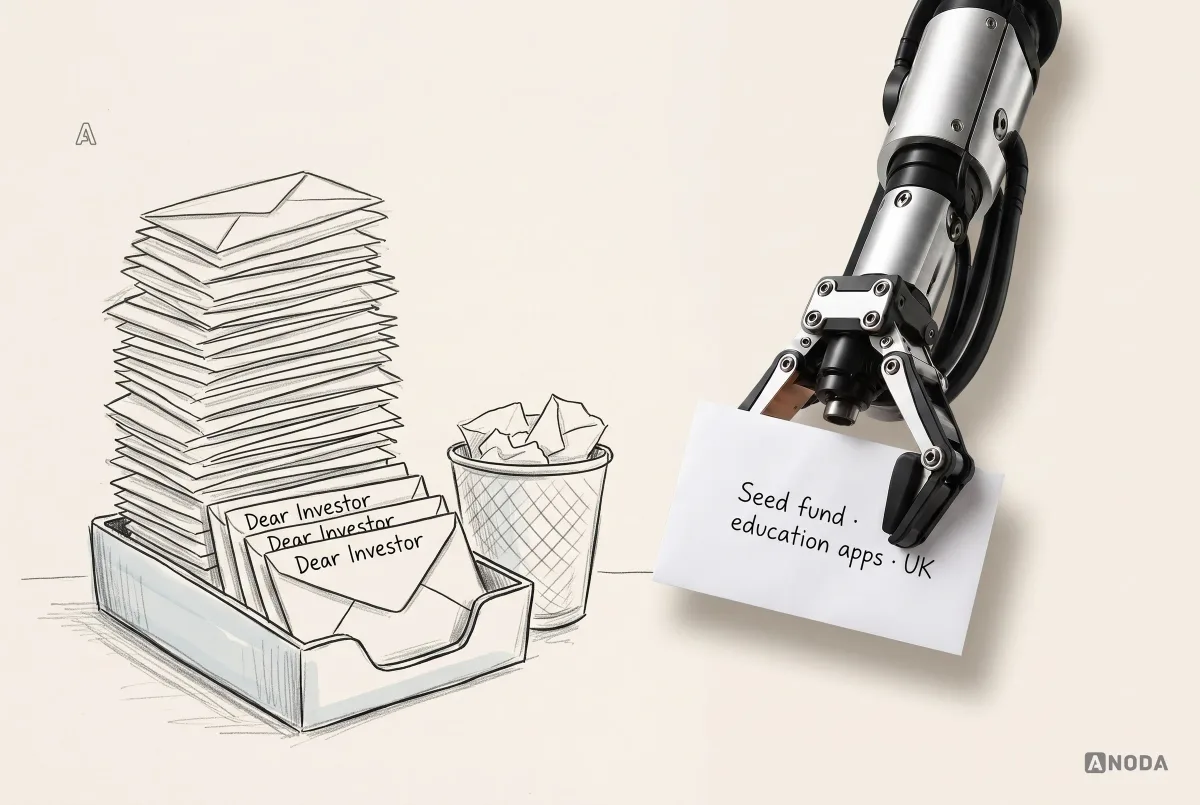
Write the subject line like a headline, not a greeting: what you are, and the one proof point. Avoid attachments that need downloading; a link to a short deck is easier. And never, ever write “we’re the Uber of X”. Investors have heard it about everything from dog walking to dentistry.
Prepare the pitch deck
The deck tells the story of the opportunity and the evidence behind it. A typical early-stage structure covers the problem, the customer, the solution, why now, the market, the business model, traction and evidence, competition, the team, the plan and the ask. The order can change; the logic can’t. Every slide should answer the question the previous slide raised.

A few things make decks work:
- One idea per slide. If a slide needs a paragraph to explain, it’s two slides or none.
- Evidence over adjectives. “Teachers love it” is an adjective. “Nine of our first 20 paying teachers invited another teacher in their first month” is evidence. (Use your real numbers, obviously. That one’s from our fictional example.)
- Show the product in context. One or two clear screens of the critical user journey help investors understand the product faster than any description.
- The ask is specific. How much, what milestone, how long, and roughly how it’s split.
We’ve written a separate guide to pitch deck design: how to structure the story, show evidence clearly and make a deck that reads well both in a meeting and on its own. There are two versions of every deck: the one you present, with less text, and the one you send, which has to make sense without you in the room.
Have the evidence, but the story is not landing?
Use our pitch-design guide to structure the opportunity, the proof, the plan and the ask.
Prepare the product demo
For an app, the demo is often the moment the pitch becomes real. It’s also where things go wrong in public. A demo that crashes, loads slowly or wanders through settings screens tells an investor more about your product than the deck does, and not in a good way.
Plan the demo like a short film:
- Start from the user’s problem. “Here’s Anna, a piano teacher with 28 students. It’s Sunday evening and she needs to reschedule three lessons.” Now the investor knows why the next screens matter.
- Show the critical journey only. The core job, start to finish, in two or three minutes. Not every feature. Nobody ever lost a round because the demo skipped the notification settings.
- Show the moment of value. Where the problem gets solved: the lesson rescheduled, the payment collected, the time saved.
- Use realistic data. Real-looking names, amounts and dates. Lorem ipsum and “Test User 1” make a product look like a school project.
- Have a backup. A recorded video of the same journey, in case the Wi-Fi, the build or the demo gods let you down.

This is where design genuinely helps fundraising. Not because investors pay for polish, but because a clear critical journey lets them understand the value in a minute instead of ten. If the product is hard to follow, the investor won’t blame the demo. They’ll assume customers will find it hard too, and they may be right. Making the core journey clear is part of the work we do in UI/UX design, and it’s worth doing for your customers long before any investor sees it.
Run meetings and follow-up as a process
Fundraising works best as a concentrated process with a start and an end, not an open-ended trickle of coffee meetings. When conversations run in parallel, investors move faster, because nobody wants to be the last to decide. When they’re spread over a year, every investor waits to see what the others do, and your runway quietly disappears.
In practice:
- Prepare everything first: deck, demo, evidence room, target list, introductions lined up.
- Start with the practice tier, then move to the investors you most want.
- Book first meetings close together, over a few weeks.
- Track every conversation in a simple pipeline: contacted, first meeting, follow-up, partner meeting, diligence, term sheet, closed or passed.
- Follow up within a day of each meeting, with answers to the questions they asked and anything you promised to send.

In meetings, listen more than you pitch. The questions an investor asks tell you what they’re worried about. Write them down. If three investors ask the same question, it’s not their problem; it’s a gap in your story or your evidence.
Send short updates to interested investors while the process runs: a new customer, a retention milestone, a key hire. Progress during the raise is powerful evidence that the business moves without the money, and will move faster with it.
SAFEs, convertible notes and priced rounds
When an investor says yes, the money arrives through an instrument, and the instrument decides what the yes costs you later. A simplified overview, not legal advice:
- SAFE (Simple Agreement for Future Equity). Created by Y Combinator and widely used in the US. The investor gets the right to shares in a future priced round, usually with a valuation cap, a discount or both. Quick to sign; the dilution only becomes clear later.
- Convertible note. The same idea structured as debt, with an interest rate and a maturity date. More common with some investors and in some markets.
- Priced round. Investors buy shares now at an agreed valuation. More legal work and cost, but clear ownership from day one. The norm from seed onwards, and in the UK schemes such as SEIS apply to shares.
Model the dilution across every round you expect to raise before you sign the first document. Several SAFEs stacked ahead of a priced round can leave founders with less than they assumed. And valuation isn’t the only term that matters: board seats, investor approval rights over future decisions, liquidation preferences and pro-rata rights all shape what the company can do next. A slightly lower valuation from an investor who knows your market and leaves you room to run the company is often worth more than the highest number on the table.
Prepare for diligence before anyone asks
Once an investor is seriously interested, diligence begins. They’ll check that what you said is true: customer references, usage data, the financial model, the team’s background, the legal set-up and the technology.
For app companies, technical and product diligence often includes:
- Who owns the code and the design. Contractors and agencies should have assigned their intellectual property to the company. Missing assignments are a common, fixable and very annoying surprise.
- The data behind the metrics. How you calculate activation, retention and revenue, and whether it matches the raw data.
- Security and privacy. How you store user data, what permissions the app asks for, and whether you comply with the privacy rules that apply to your users.
- Technical risk. Whether the product can be maintained and extended, or whether the next milestone starts with a rewrite.
If your evidence room is already organised, diligence becomes a checklist rather than a scramble. If it isn’t, this is where rounds slow down, and slow rounds are where good deals quietly fall apart.
Handle rejection and update the evidence
Most investors will say no. That’s normal, even for companies that go on to do very well. The stories of founders who raised a round with a napkin sketch are survivorship bias in a nice jacket: you only hear from the ones who made it, not from the hundreds with the same napkin who didn’t.
Treat each “no” as data. Keep a simple log of who passed and why, in their words. Most rejections fall into a few groups:
- Fit: wrong stage, sector, cheque size or geography. That’s a targeting problem; fix the list.
- Evidence: “too early”, “come back when you have more traction”. That’s a readiness problem; fix the evidence.
- Story: “I don’t understand the market” or “I don’t see why now”. That’s a narrative problem; fix the deck.
- Belief: they simply don’t believe in the market or the model. You can’t fix that, and you shouldn’t try.

Always ask whether you can keep them updated. “Too early” is often a real invitation to come back. An investor who watched you hit three milestones since your first meeting has seen the best evidence of all: you do what you say.
If most of the no’s are about evidence, stop pitching and go back to the product. Another month of meetings won’t change the facts. A month of customer work might.
Make the product case impossible to miss
Investors should understand the product before the meeting becomes a debate about your navigation. A deck refresh leaves the same expensive gap when nobody can follow the core job. ANODA connects the customer problem, the focused release and the demo into one argument: who needs this, what changes for them, and what the next investment lets you deliver.
For AispireMe, we designed the education-planning MVP across student, parent, counsellor and organisation journeys, with a clickable prototype and reusable UI kit. That is the work behind a convincing product demonstration: roles, decisions and the path to value worked out together, ready for engineering to build.
Come to ANODA with the idea and the questions investors keep asking. We turn them into a clear product scope and a demonstration people can follow, so your next meeting starts with the opportunity instead of an explanation of unfinished screens.
Common mistakes founders make
We see the same mistakes again and again, and most of them cost months.
- Pitching an idea with no evidence. The meeting becomes a conversation about what you’ll do, not what you’ve learned.
- Raising an amount instead of a milestone. “We need £600,000” invites the question “for what?”, and a vague answer ends the conversation.
- Emailing everyone. A long untargeted list burns introductions and reputation you’ll need later.
- Leading with vanity numbers. Downloads and sign-ups without activation and retention make investors suspicious, not excited.
- Hiding the risks. Investors know they’re there. Pretending they aren’t makes the rest of the case less believable.
- Over-polishing the deck and under-preparing the demo. Investors will forgive a plain slide faster than a crashing product.
- Letting the raise drag on. A process without a timeline eats runway and focus, and signals that nobody’s committing.
- Taking the wrong money. An investor with the wrong expectations can cost you more than no investor at all.
Investor-readiness checklist
Before you send the first email, you should be able to tick most of these.
The decision rule
Approach investors when you can explain, with evidence, the customer’s problem, what makes your product different, how you’ll reach buyers, what you’ve built and learned so far, and what this money will unlock. If you can’t yet, the next step isn’t a better pitch. It’s a smaller, sharper piece of work that produces the missing evidence.
Build the smallest evidence package that answers five questions: why this product, why this audience, why now, how it reaches buyers, and what the next capital milestone unlocks. Everything else in fundraising, the list, the email, the deck, the demo, is a way of delivering those answers to the right people.

Turn your app idea into a product worth backing
ANODA will define the core value, design a focused MVP and make the product case clear in the journeys, prototype and handoff. Bring us the idea and the questions that keep stopping the conversation.
Written by