In short
A free admin template can save weeks of frontend work, or cost months when its framework, licence or information architecture fights your product. We checked twelve maintained options on 29 September 2026 — AdminLTE, Tabler, CoreUI, Sneat, TailAdmin, shadcn-admin, Next Shadcn Dashboard Starter, Berry, Mantis, Materio, react-admin and Refine — for stack, licence, maintenance and product fit, and explain how to test the hardest screen before you commit.
In this article
- Why ANODA tests the workflow before the template becomes the product
- How we chose and checked these templates
- What “free” really means in 2026
- Bootstrap and HTML templates
- React and Tailwind templates
- React and Material UI templates
- Admin frameworks: react-admin and Refine
- How to choose: stack first, then everything else
- Integrating a template into your codebase
- Responsive reality and team skills
- A polished demo is not a design system
- Prototype the hardest screen before you commit
- Which template fits which product
- Questions to ask before you adopt a template
- When not to use a template at all
- The hidden costs of a free template
The best free admin dashboard templates in 2026 are the ones that match your framework, carry a licence that allows commercial use, are still actively maintained, and survive your product’s hardest screen — not the ones with the prettiest demo. On 29 September 2026 we checked twelve widely used options against those criteria: AdminLTE, Tabler, CoreUI Free, Sneat Free, TailAdmin React, shadcn-admin, Next Shadcn Dashboard Starter, Berry Free, Mantis Free, Materio Free, plus the admin frameworks react-admin and Refine.
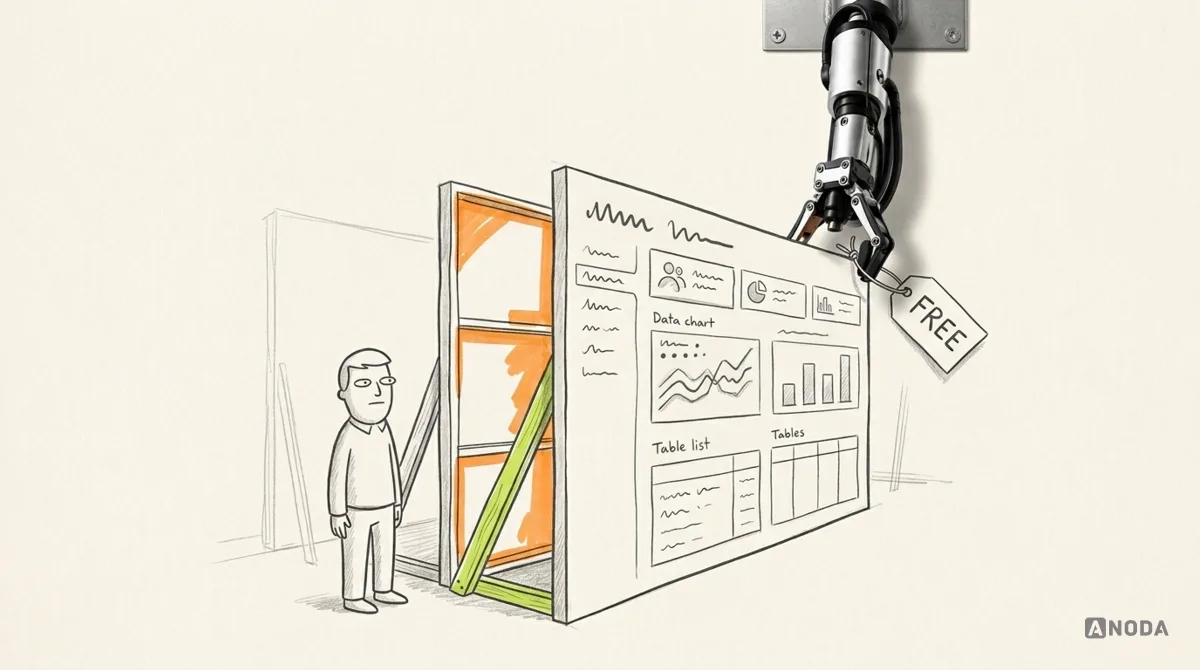
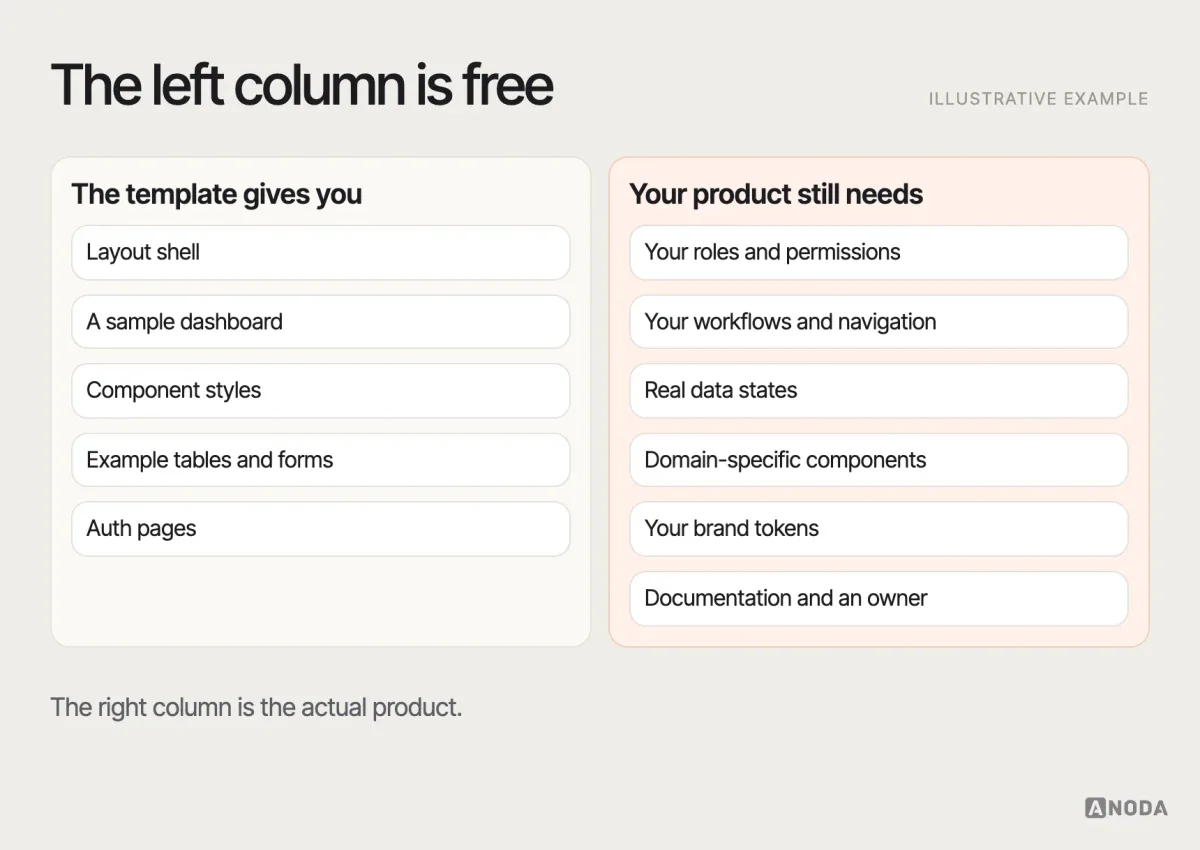
A template is a development starting point. It is not a product strategy, and it is not a finished design system. It gives you a layout shell, a set of components and a demo dashboard full of charts about someone else’s business. What it cannot give you is your roles, your workflows, your permissions, your data, and the dozens of states a real admin product goes through when data is missing, slow, wrong or forbidden.
That matters because the wrong template is expensive in quiet ways. An abandoned repository leaves you owning its outdated dependencies. A framework mismatch means rewriting half of it. An information architecture built for an e-commerce demo fights a product built around approvals or tickets. The template was free. Undoing its assumptions is not.
Why ANODA tests the workflow before the template becomes the product
A free dashboard shell becomes expensive when every approval, bulk action and permission state needs another workaround. Replacing the template after a year means paying again for layouts your operators have already learned. Choosing the most polished demo does not reveal that cost.
ANODA starts with the hardest real workflow: the roles, the table or record, the action and the states around it. We use that prototype to decide what the starting point can support, then design the missing patterns and a shared system your team can extend. You buy a useful product structure instead of a growing collection of template overrides.
In Qarma we designed the inspection report and corrective-action workflow for phone and desktop, with evidence, ownership and approval kept in context. Those are the product-specific patterns a generic admin demo cannot choose for you. See Qarma’s product design and plan your dashboard with ANODA.
How we chose and checked these templates
Roundups of admin templates tend to go stale within months: repositories are archived, “free” versions shrink to upsell funnels, framework versions move on. So here is exactly what we checked, and when.
- Date of check: 29 September 2026. Versions, licences and activity below are as of that day. Check them again before you adopt anything.
- Licence: read from the project’s repository. Every template listed uses the MIT licence for its code; we note where assets or “Pro” versions sit under different terms.
- Maintenance: the latest tagged release and the latest commit to the repository. We excluded projects with no commits in the last twelve months.
- Stack: framework and major dependency versions read from each project’s
package.json, not from the marketing page. - Coverage: what the live demo actually includes — dashboard, tables, forms, authentication pages, error pages — and what it leaves to you.
- Fit: the kind of product and team each one suits, based on its stack and structure.
We did not rank by GitHub stars. Stars measure popularity over the life of a project, not whether it is maintained today or right for your product; a template with a huge following can still sit on an old framework version, and a young starter with a fraction of the stars can be the better foundation.
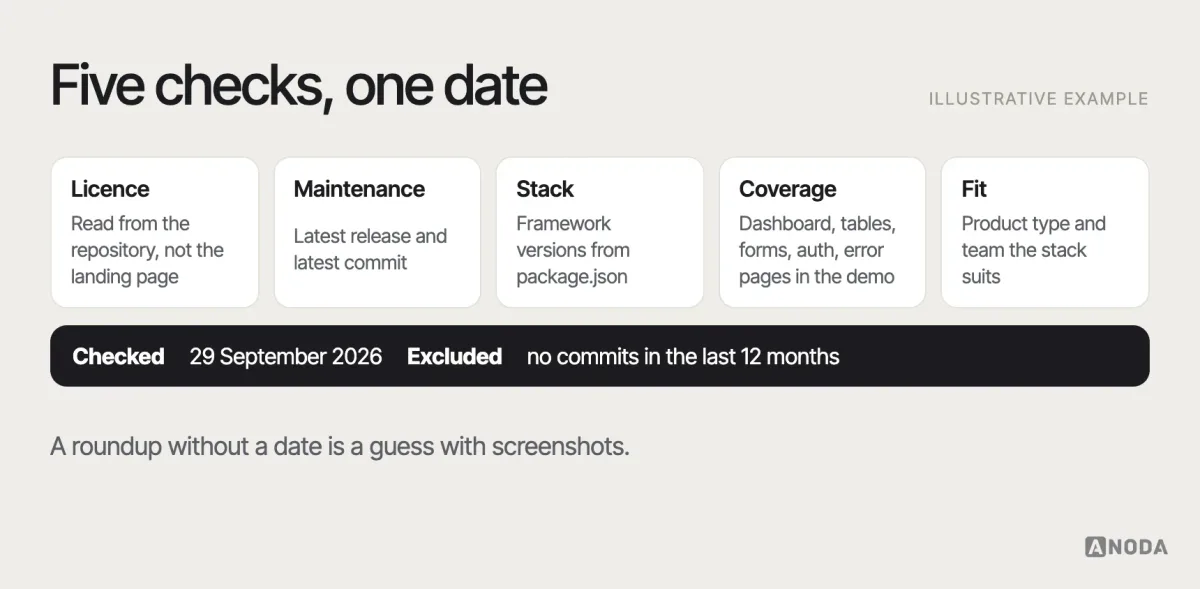
Several popular templates did not make the list because their repositories showed no commits in over a year when we checked: Volt (Bootstrap 5, last commit March 2023), Windmill Dashboard (Tailwind, February 2024), Horizon UI Chakra (January 2025) and the Flowbite admin dashboard (March 2025). They may still work as visual references, but adopting them means adopting their maintenance too.
What “free” really means in 2026
“Free admin template” covers three quite different things, and it helps to know which one you are looking at.
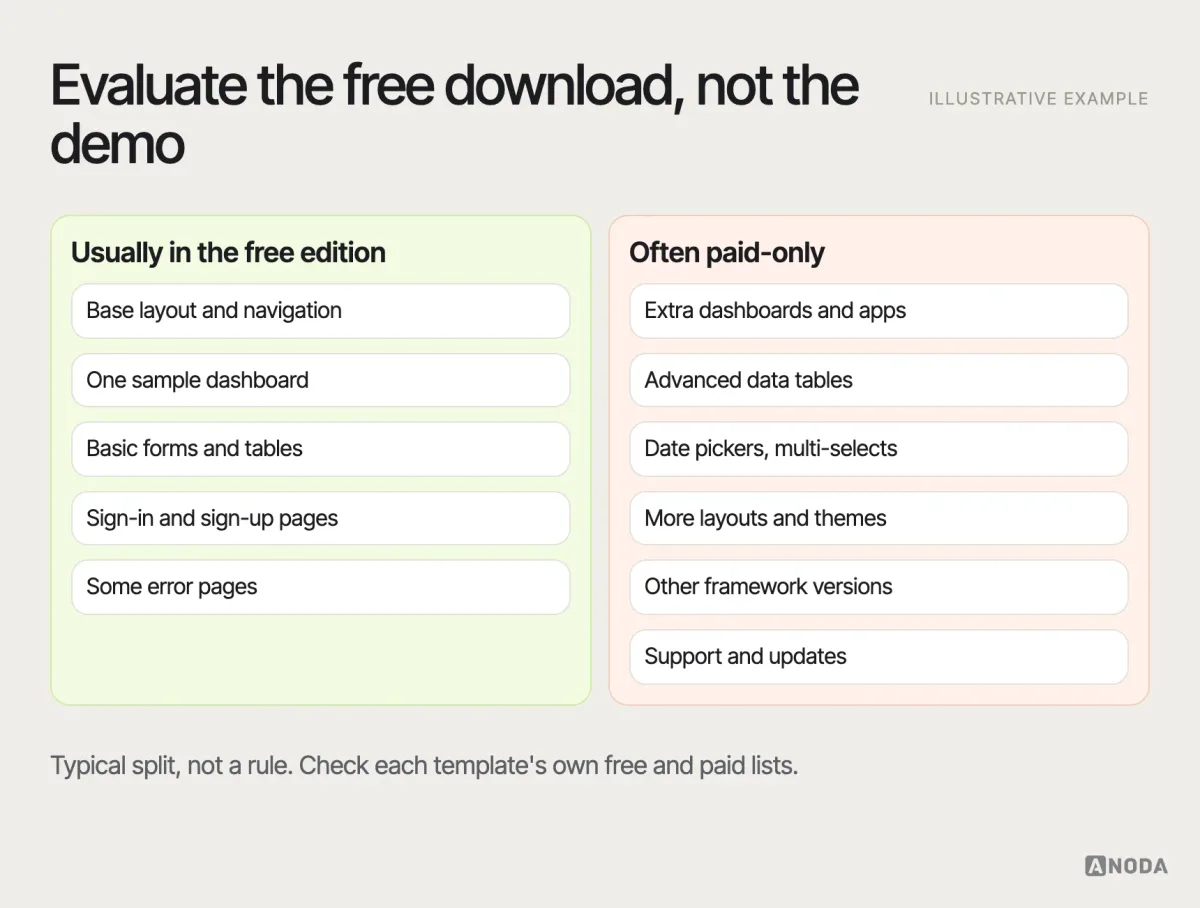
Genuinely open-source projects. Community-maintained or sponsor-funded templates with everything in the open repository. AdminLTE and shadcn-admin are closest to this model. What you see is what you get; support comes from issues and the community.
Open-core “lite” versions of paid products. A free edition of a commercial template, with more pages, components, layouts or framework versions in the paid tier. CoreUI, Sneat, Materio, Berry, Mantis, TailAdmin and Tabler all offer paid tiers alongside their free versions. This is a fair model — the free code is MIT — but it shapes the demo: menus show locked items, banners promote upgrades, and the most impressive screens may not be in the free download.
Frameworks rather than templates. react-admin and Refine give you structure for data, forms and permissions, and leave the visual design largely to you. They are “free” in the licence sense and very different in what they save.
None of these is better in general. What matters is that you evaluate the free download, not the demo site, and that you know which parts of your roadmap might push you towards the paid tier.
Bootstrap and HTML templates
Bootstrap-based templates are the safest choice when your team renders HTML on the server — Laravel, Django, Rails, .NET, plain PHP — or when you want a dashboard without a JavaScript framework. They are also the easiest to hand to a backend-heavy team.
AdminLTE 4
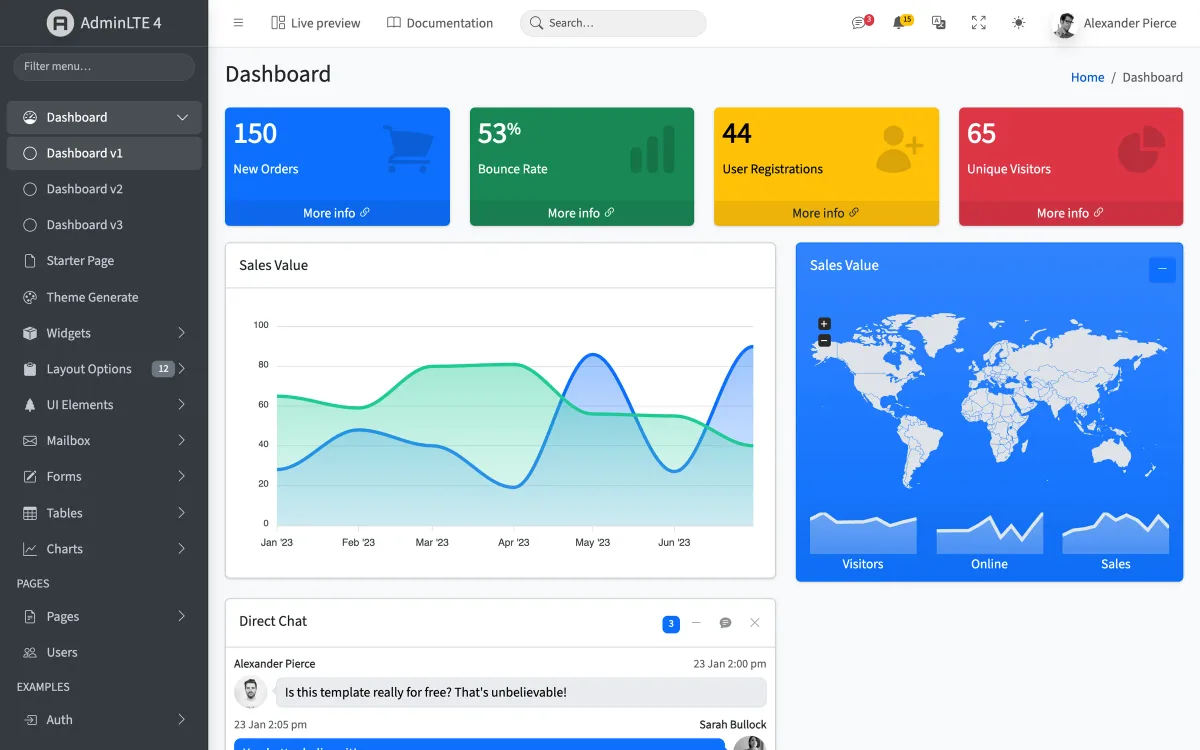
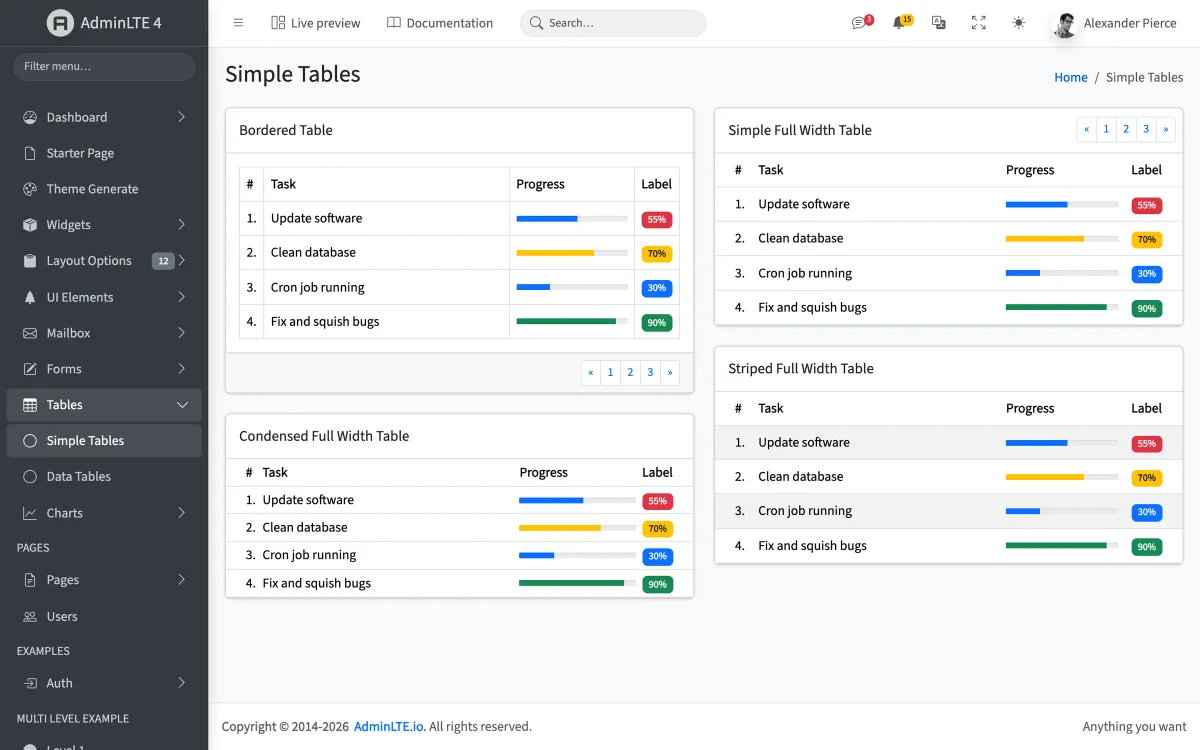
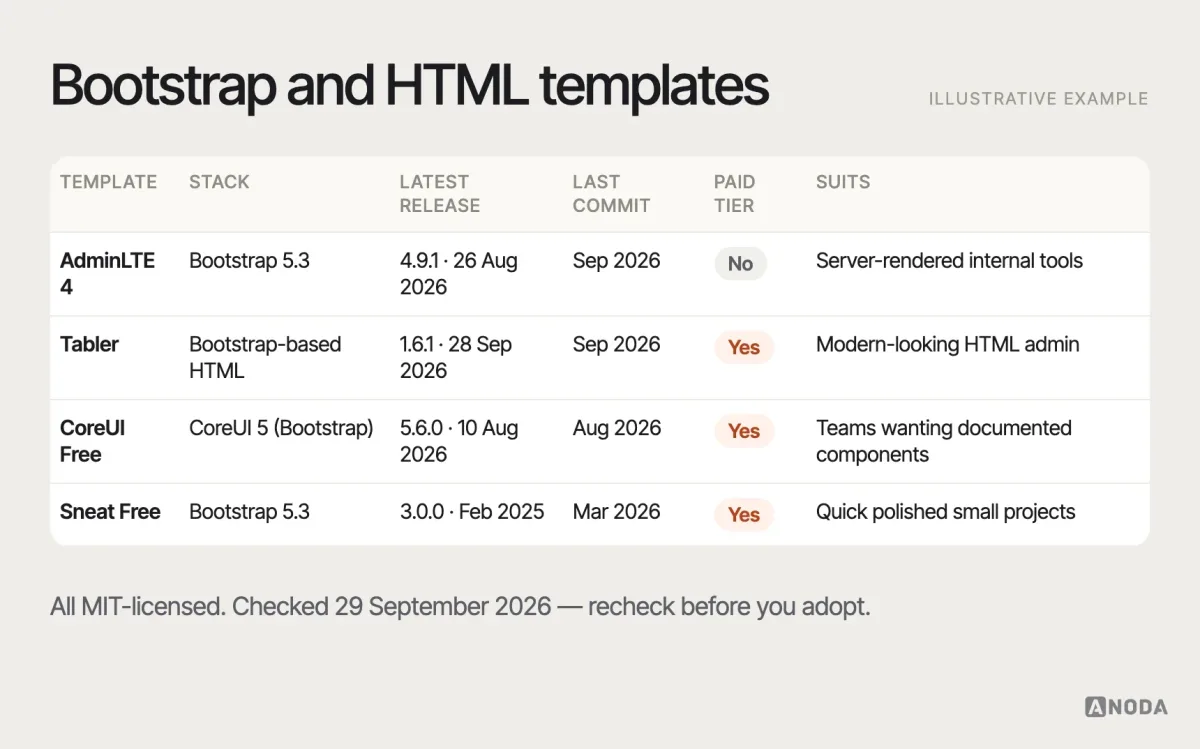
AdminLTE is the long-running default of free admin templates, rebuilt on Bootstrap 5 for version 4. On our check the latest release was 4.9.1 (26 August 2026), MIT-licensed, with Bootstrap 5.3 and a TypeScript build. It ships a large set of example pages: dashboards, widgets, forms, tables, a mailbox, authentication pages. It suits server-rendered admin panels and internal tools where the team wants a familiar Bootstrap structure and a lot of ready pages. Watch out for the sheer volume of demo pages and plugins: decide early which ones you keep, or the codebase will carry them forever.
Tabler
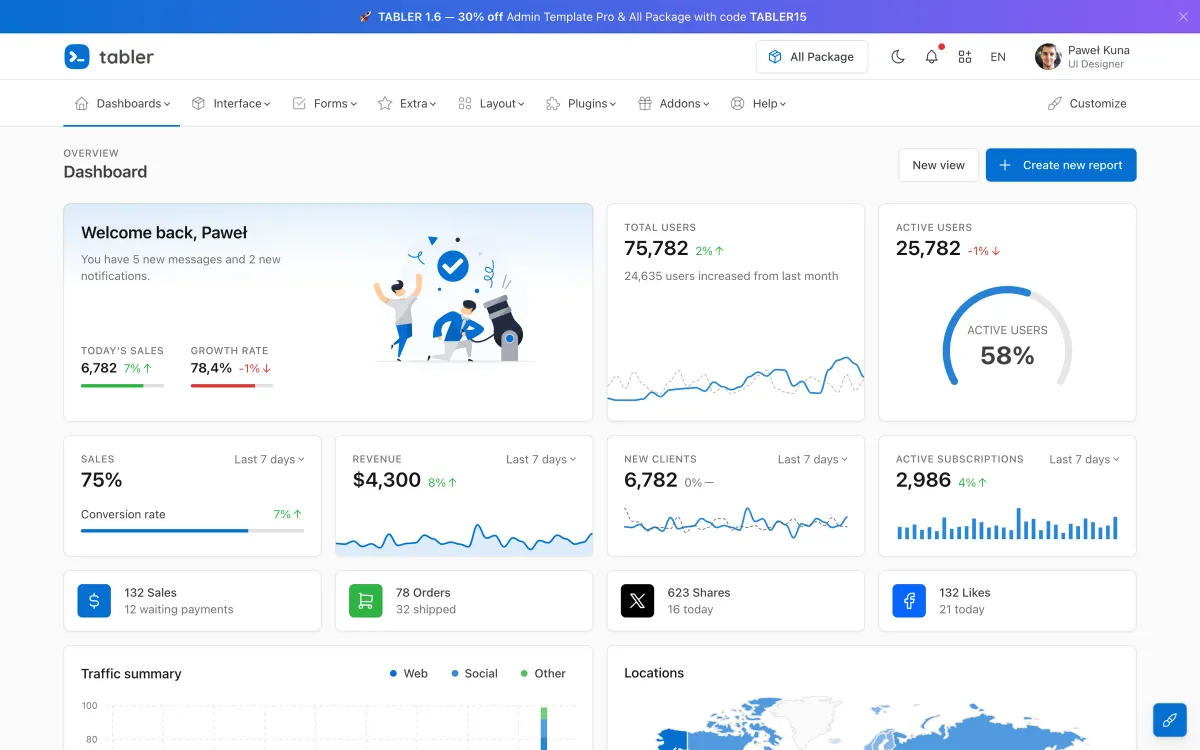
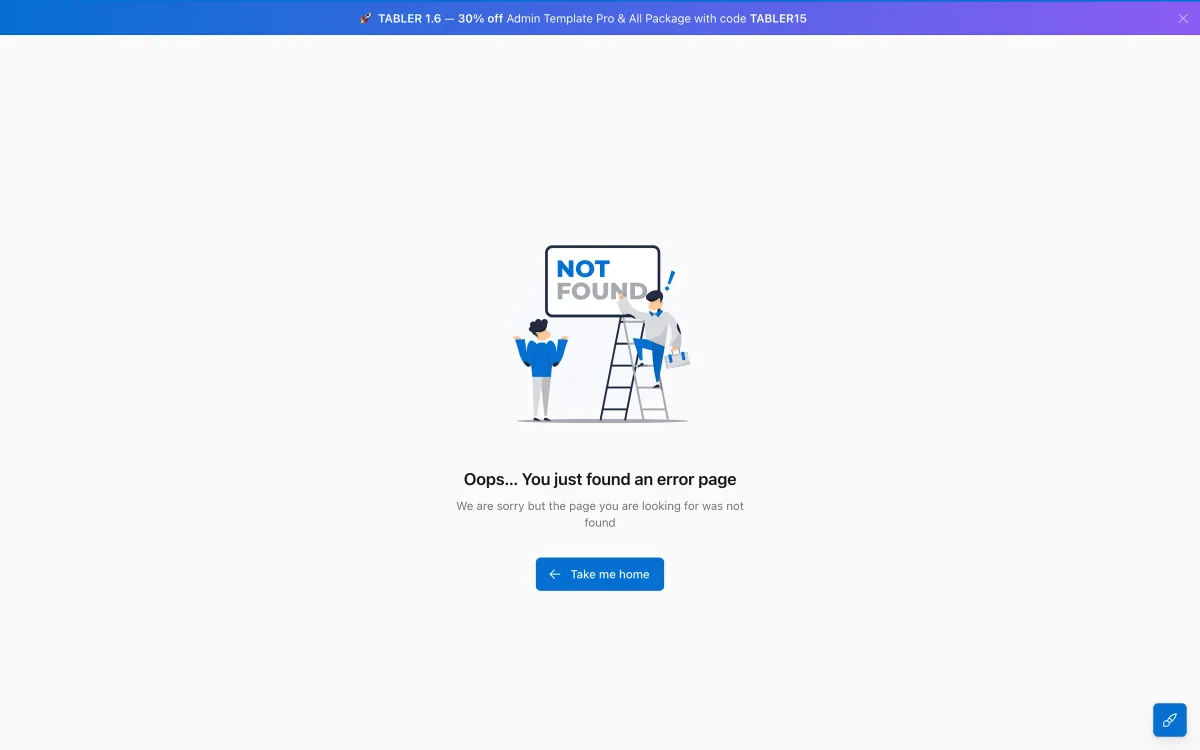
Tabler is an HTML dashboard kit built on Bootstrap with a cleaner, more modern visual style. On our check the core package was at 1.6.1, released on 28 September 2026, MIT-licensed. Its preview includes dashboards, interface components, forms, authentication and error pages. A commercial “Pro” package exists alongside the free one, and the demo advertises it. Tabler fits teams who want a Bootstrap foundation that looks less like 2015. Watch out for the line between the free core and the paid package — some of the most attractive pages in the preview may belong to the latter.
CoreUI Free
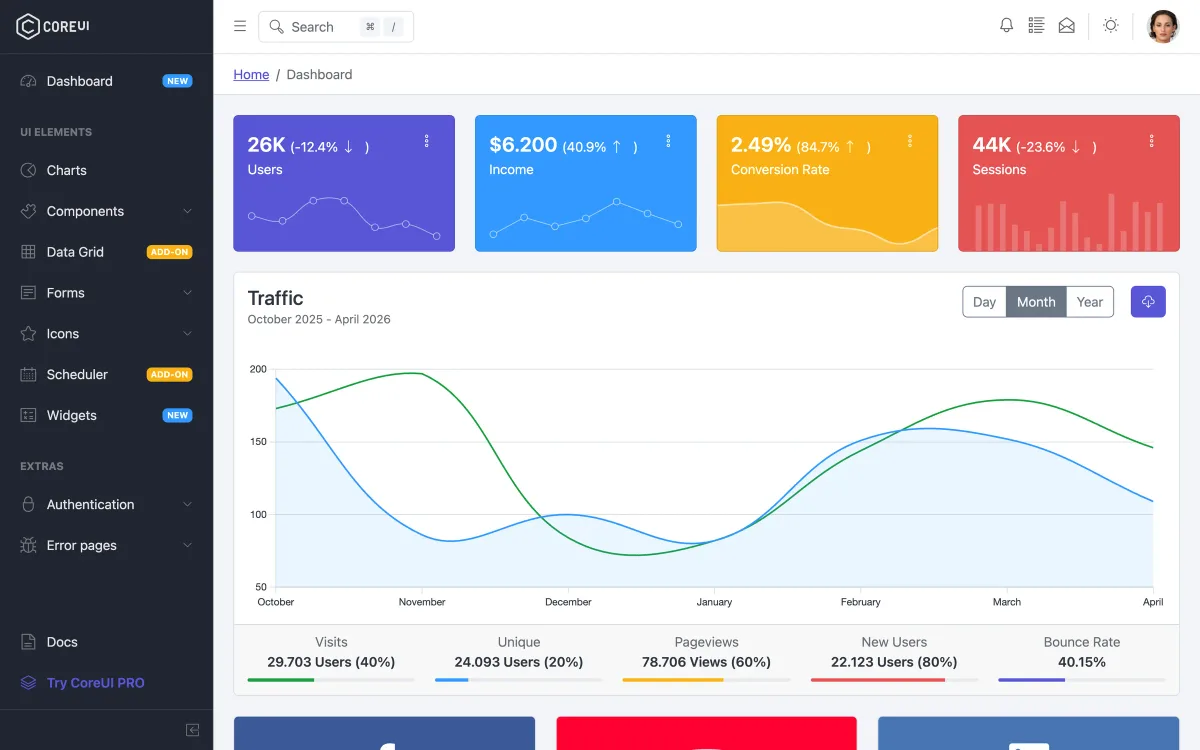
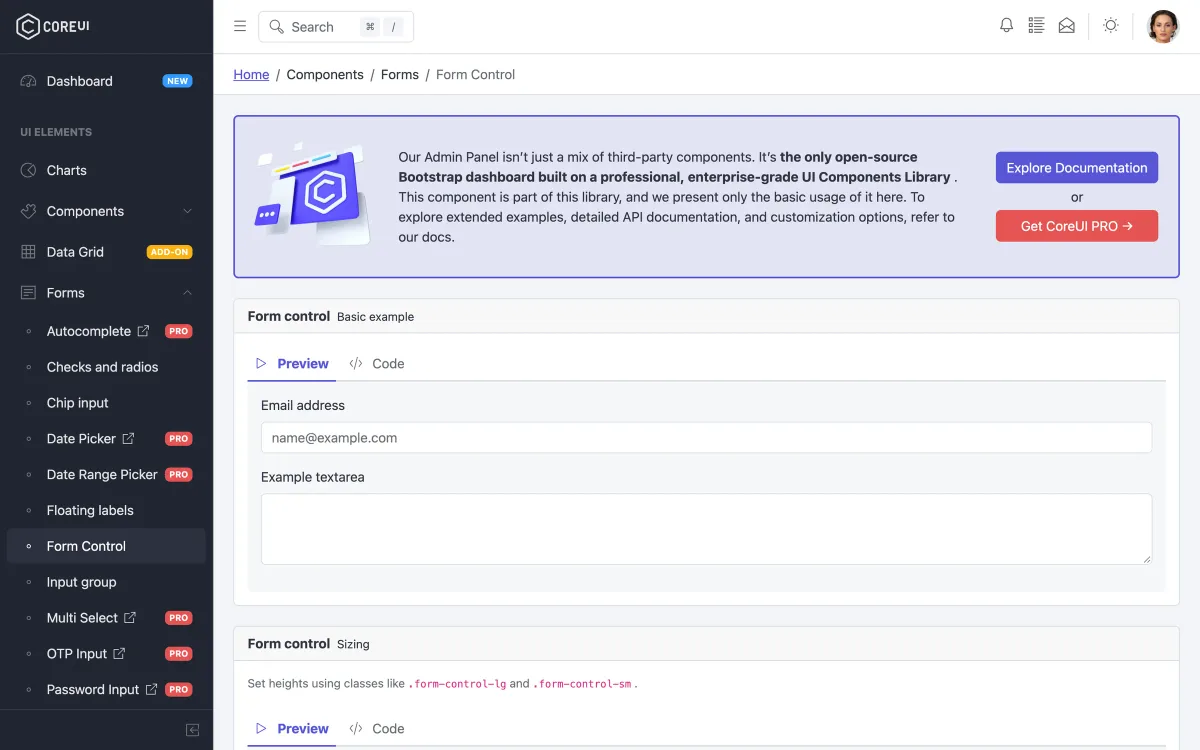
CoreUI’s free Bootstrap admin template sits on the CoreUI component library (Bootstrap-compatible). Its latest release on our check was 5.6.0 (10 August 2026), MIT-licensed, with Chart.js for charts. The free demo is clearly a funnel toward CoreUI Pro: several components in its navigation are marked “Pro” and link out. That is not a problem if you know it going in; it is a problem if the component you need turns out to be one of them. On the plus side, CoreUI documents its components thoroughly, and the same library exists for several frameworks, which helps teams that expect to change stacks later.
Sneat Free
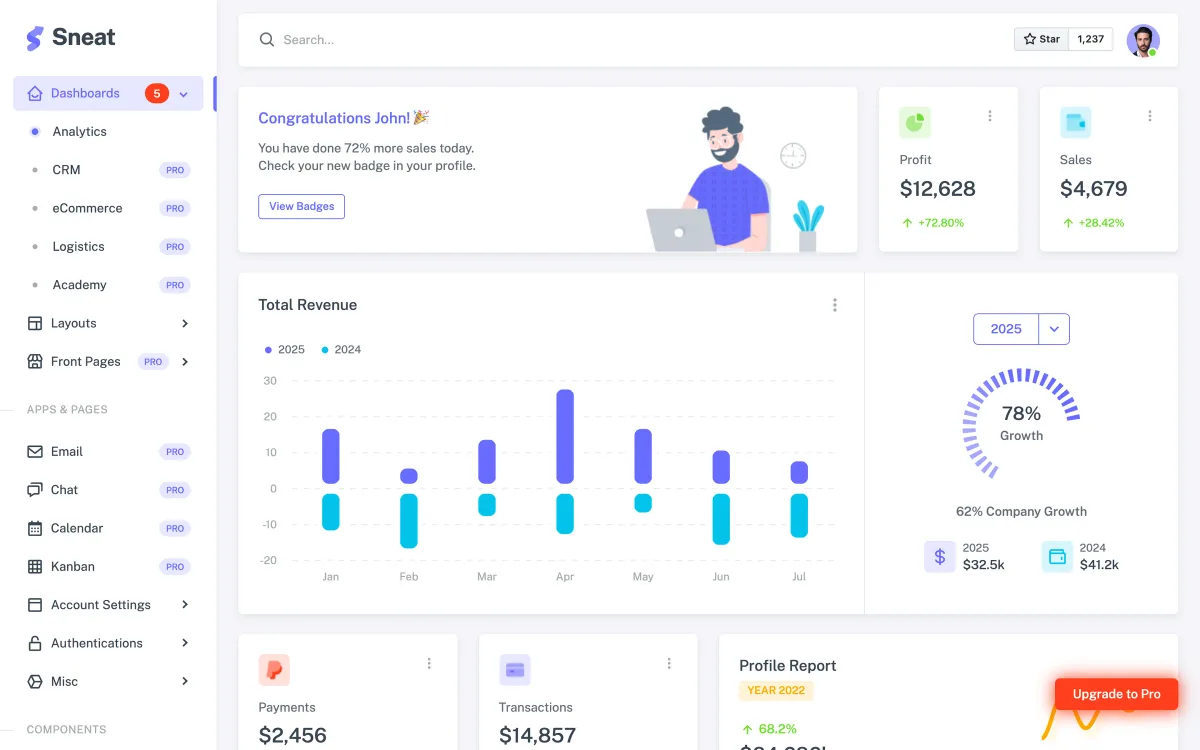
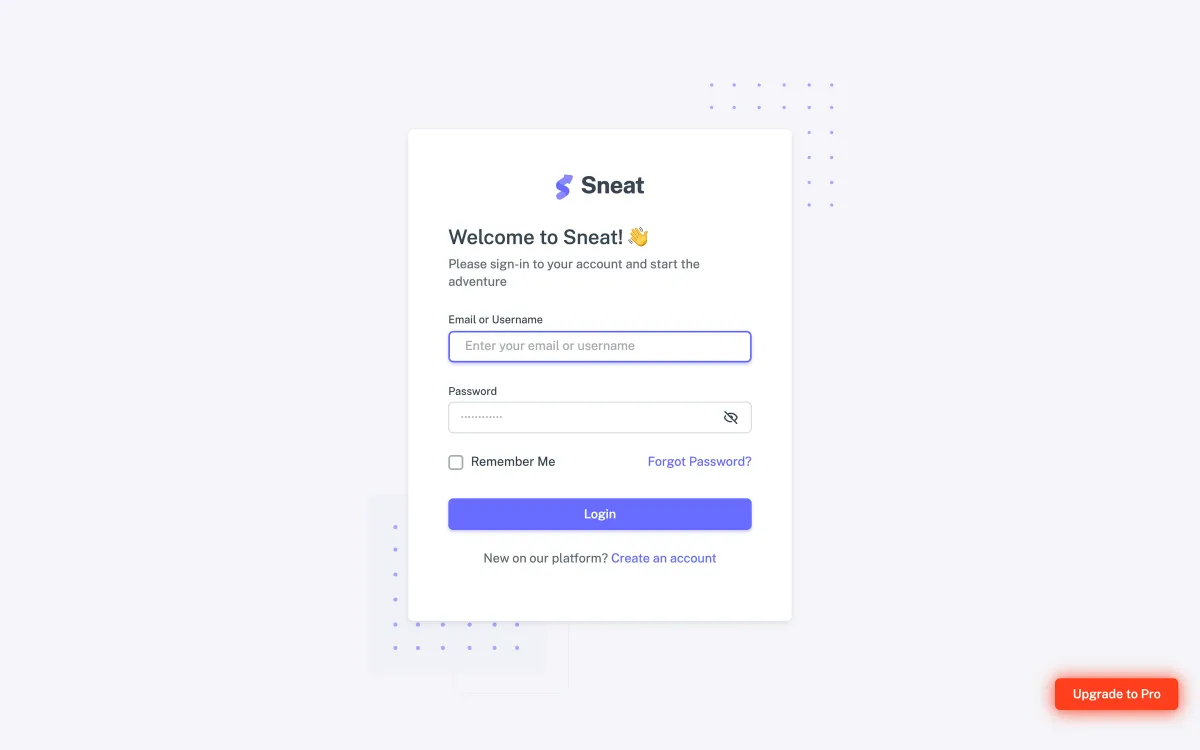
Sneat’s free Bootstrap 5 HTML template, from ThemeSelection, was at release 3.0.0 (February 2025) with repository activity in March 2026 on our check, MIT-licensed, on Bootstrap 5.3. The free version covers a dashboard, layouts, account settings and authentication pages; many menu items are marked “Pro”. It suits small projects that want a polished Bootstrap look quickly, with the upgrade path in plain sight. Watch out for the gap between the last tagged release and current Bootstrap and tooling versions; check the build before you commit to it.
React and Tailwind templates
React with Tailwind is the stack most new SaaS admin panels start from in 2026. The templates here are closer to “starter kits”: fewer example pages, more modern tooling, and code you are expected to own.
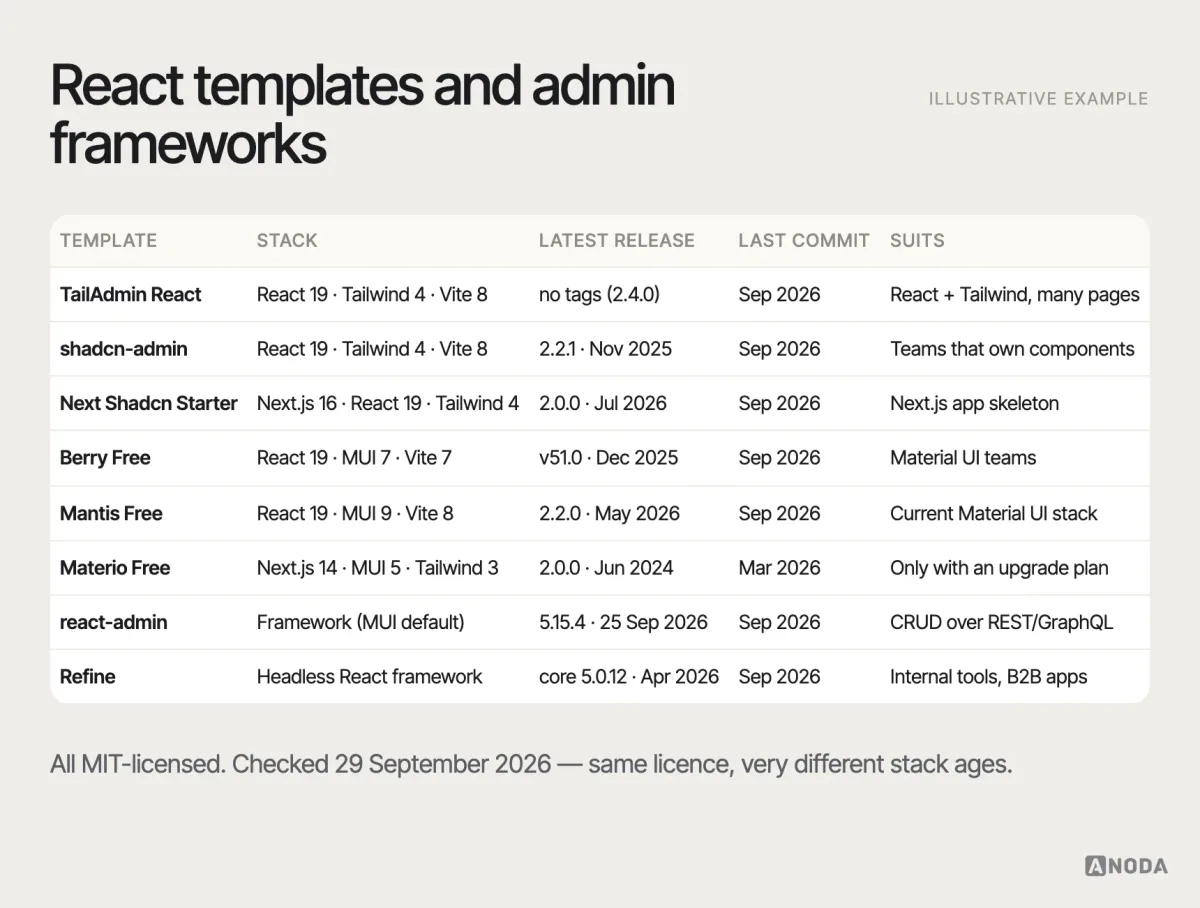
TailAdmin React (free)
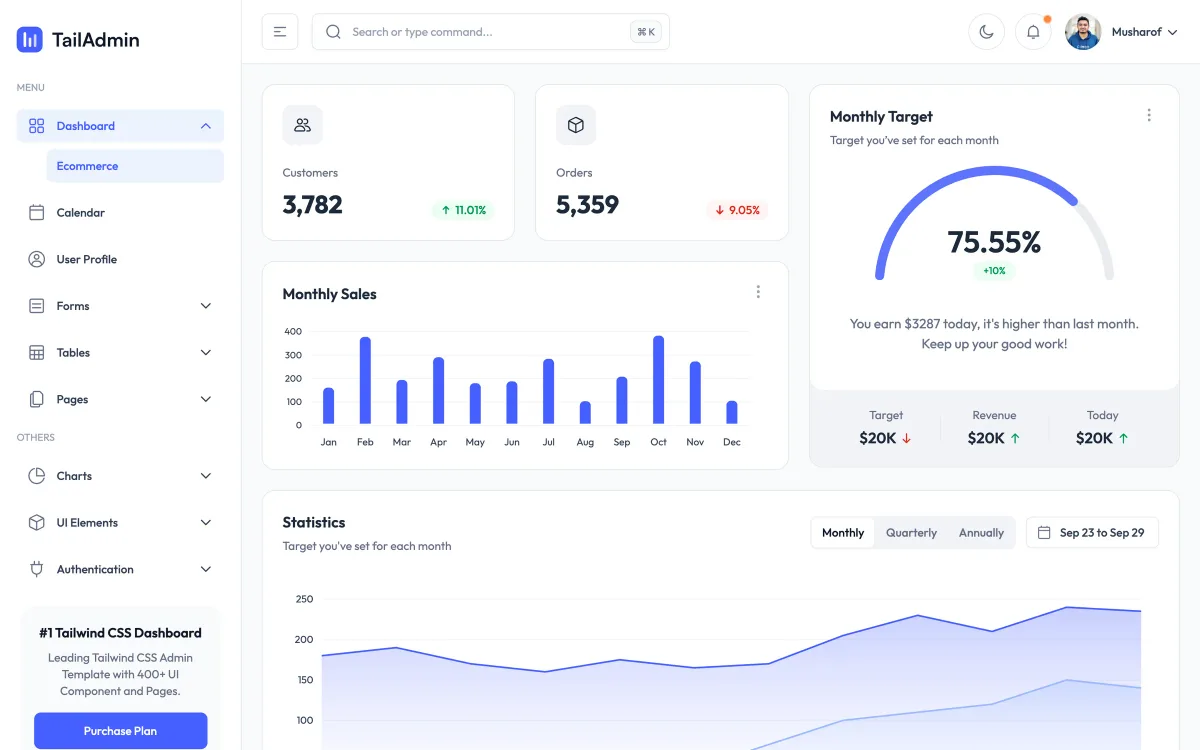
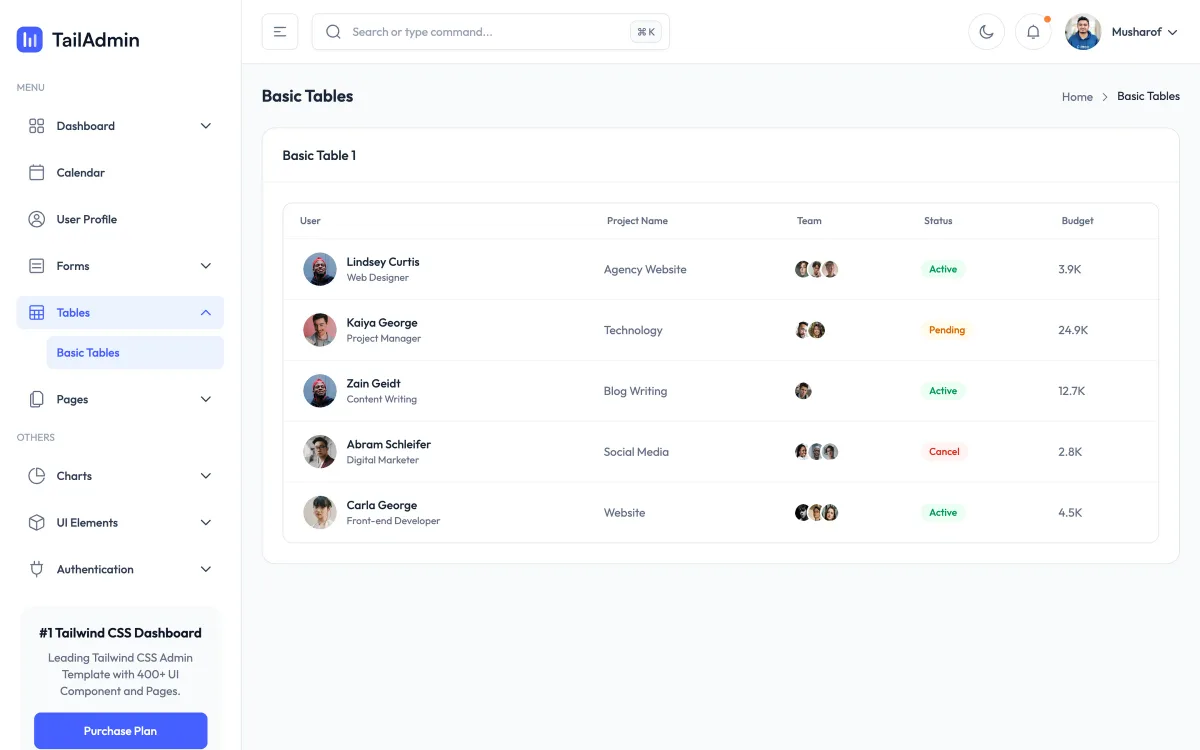
TailAdmin’s free React version was at 2.4.0 on our check, MIT-licensed, built on React 19, Tailwind CSS 4 and Vite 8, with ApexCharts for charts. The repository had commits in September 2026 but no tagged releases. The demo includes an e-commerce dashboard, calendar, profile, forms, tables and authentication; the sidebar promotes the paid plan. It suits teams who want a current React and Tailwind stack with more ready-made pages than a bare starter. Watch out for the lack of tagged releases: pin a specific commit so updates are deliberate rather than accidental.
shadcn-admin
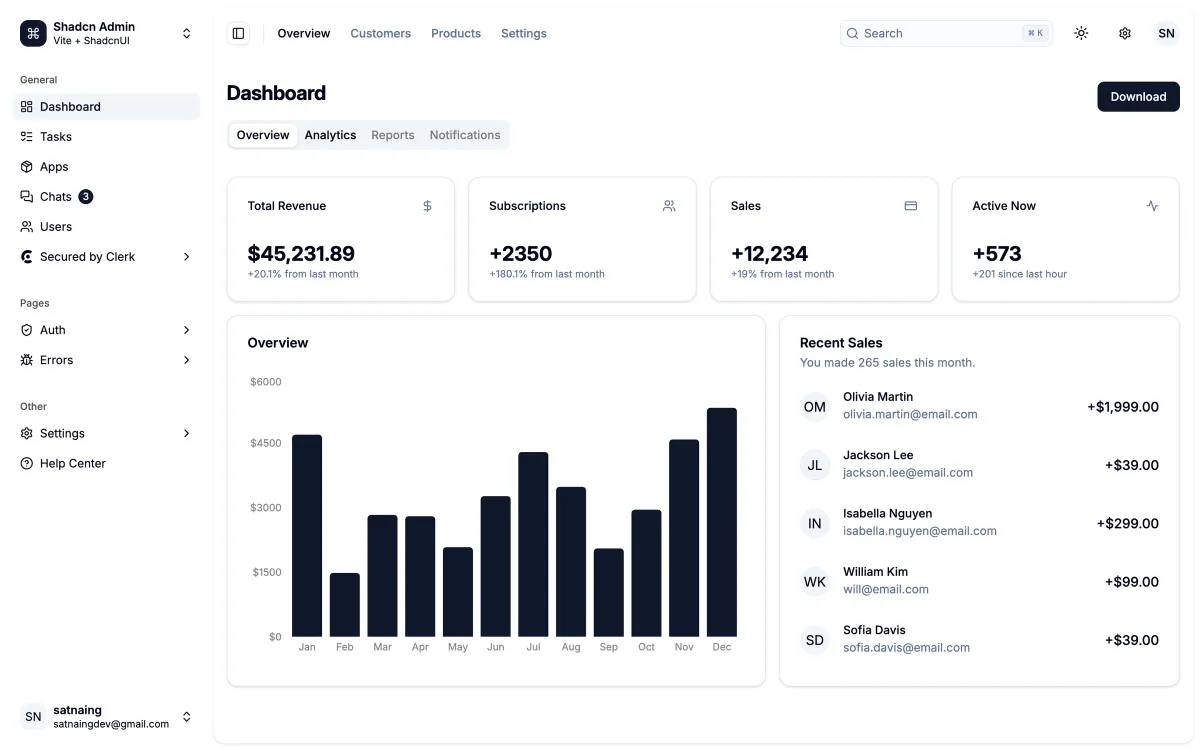
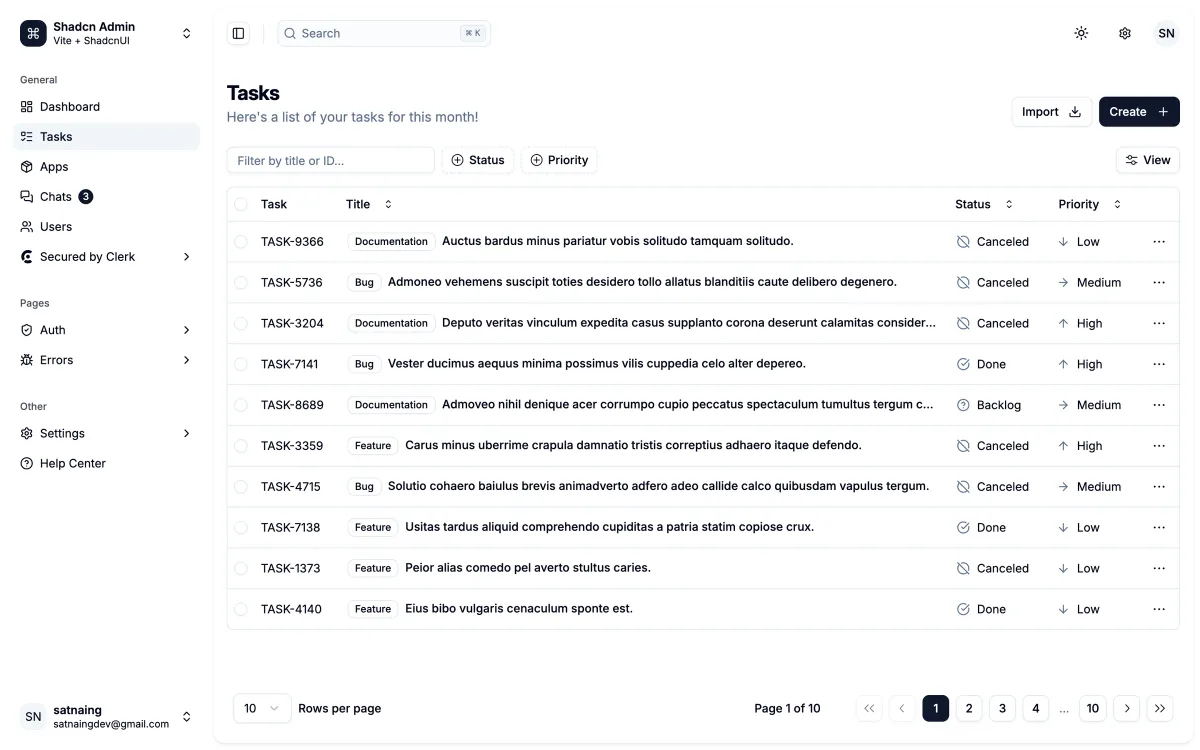
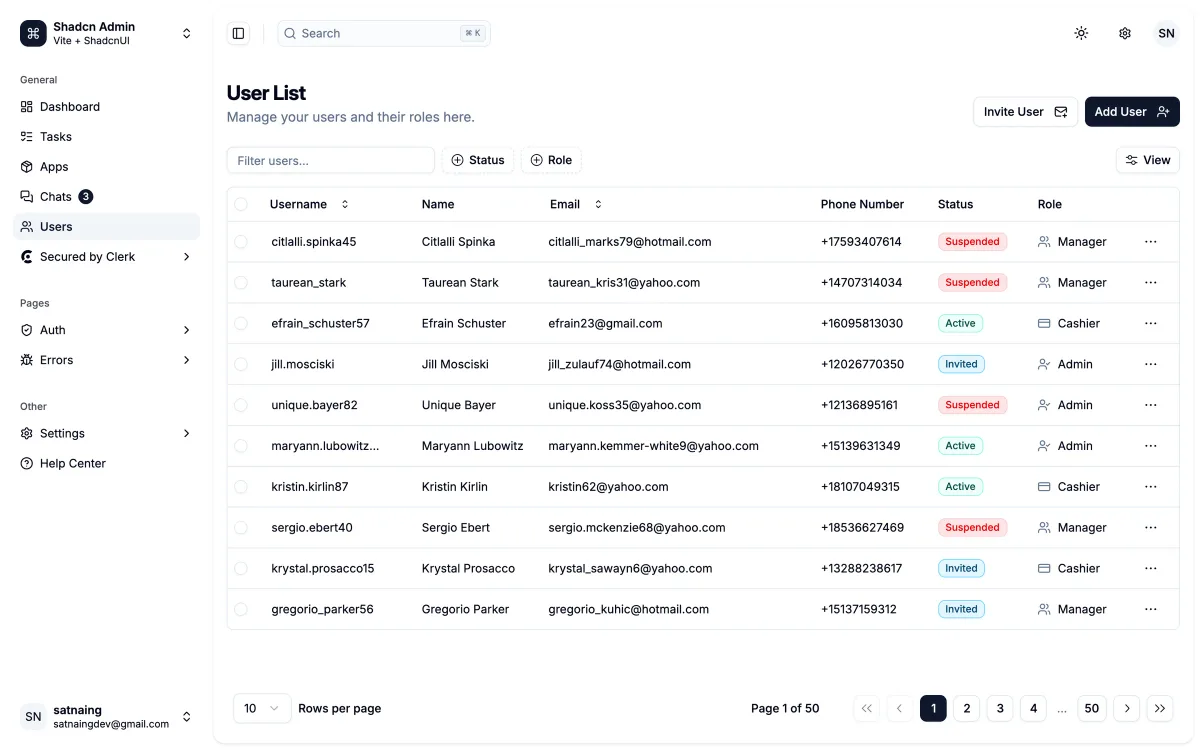
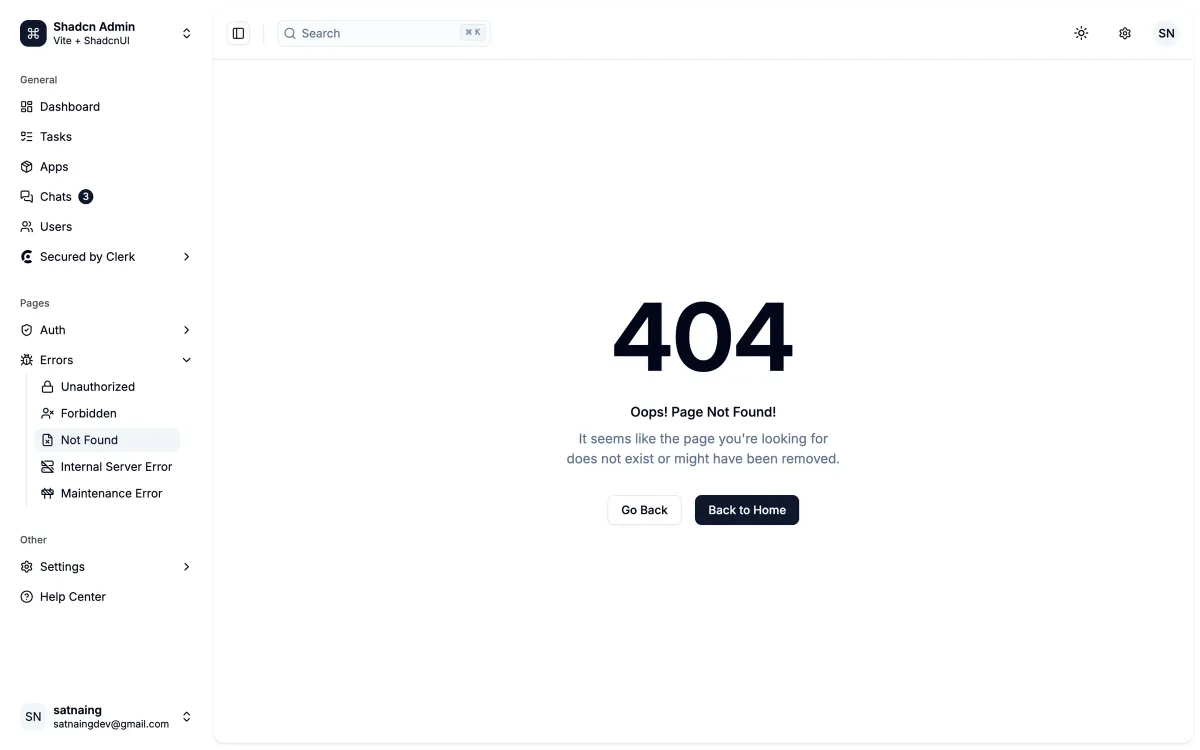
shadcn-admin is an admin dashboard built with shadcn/ui components on React 19, Vite 8 and Tailwind CSS 4, with TanStack Table for data tables. On our check its latest release was 2.2.1 (November 2025), with repository commits in September 2026, MIT-licensed. Because shadcn/ui copies components into your codebase rather than installing a library, you own and edit every component — good for product teams that want control, more work for teams that want a black box. The demo is notably strong on the unglamorous parts: tasks and users tables with filters and pagination, and a full set of error pages.
Next Shadcn Dashboard Starter
Kiranism’s Next Shadcn Dashboard Starter was at release 2.0.0 (July 2026) on our check, MIT-licensed, on Next.js 16, React 19 and Tailwind CSS 4 with TanStack Table. Its public demo requires signing in through a hosted authentication provider, which tells you something useful: it is built as an application starter with authentication wired in, not a static page collection. It suits teams already on Next.js who want an app skeleton rather than a gallery. Watch out for the choices it makes for you — authentication provider, routing, data fetching — and decide early whether they fit your architecture or need replacing.
React and Material UI templates
Material UI templates suit teams that want a comprehensive, well-documented component library and are comfortable with its visual language and theming model.
Berry Free
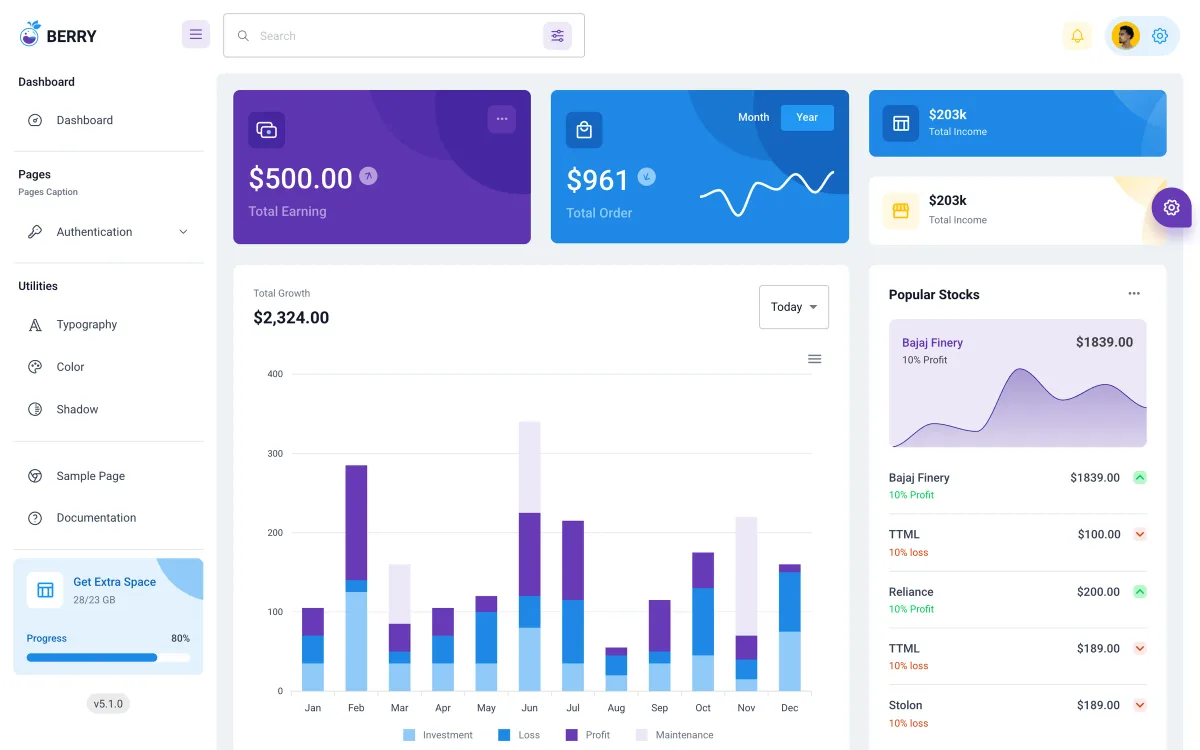
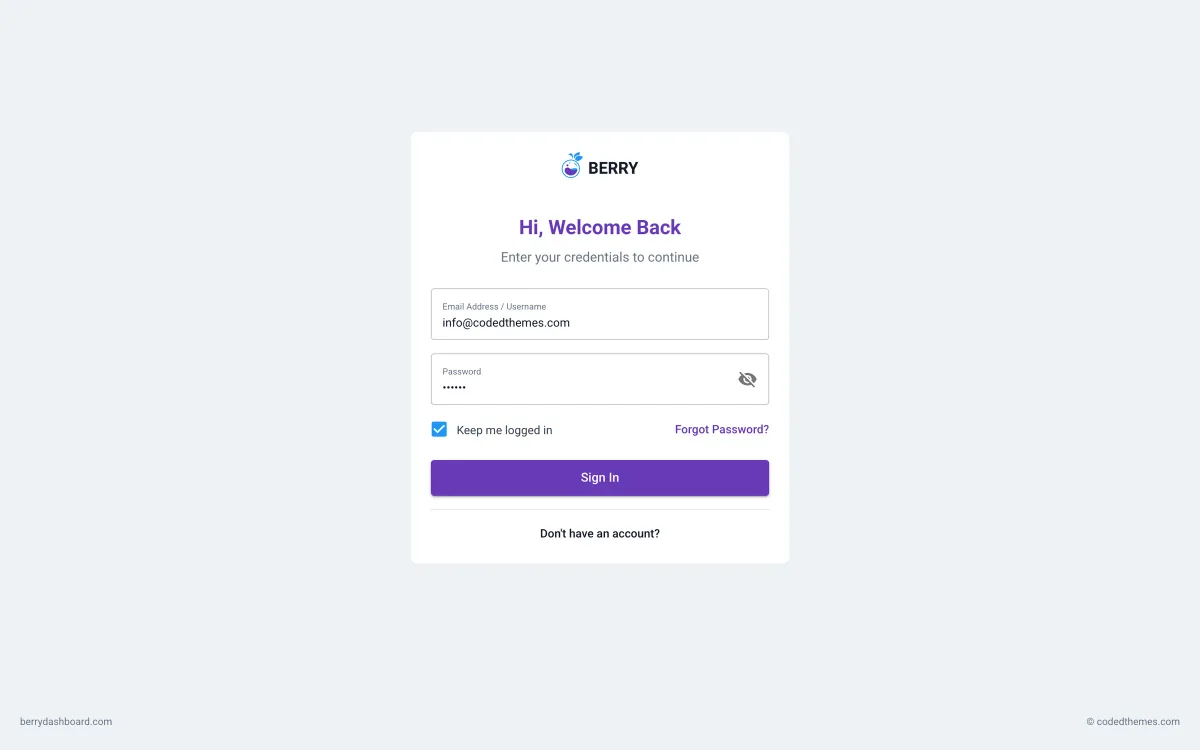
Berry’s free React template from CodedThemes had its latest release (v51.0) in December 2025 and commits in late September 2026 on our check, MIT-licensed. Its Vite version uses React 19 and MUI 7. The demo covers a dashboard, authentication pages and utility pages; more extensive pages belong to the paid version. It suits teams already invested in Material UI who want a ready shell; the distinctive purple visual style will need replacing with your own theme.
Mantis Free
Mantis, also from CodedThemes, was at 2.2.0 (May 2026) with commits on 29 September 2026 on our check, MIT-licensed, on React 19, MUI 9 and Vite 8 — the most current Material UI stack in this list. Its demo site did not finish loading during our screenshot attempts, so we have no image of it here; the repository itself was active and current. If you are starting a new Material UI project, it was the most up to date of the MUI options we checked — but do your own demo and accessibility check before relying on it.
Materio Free
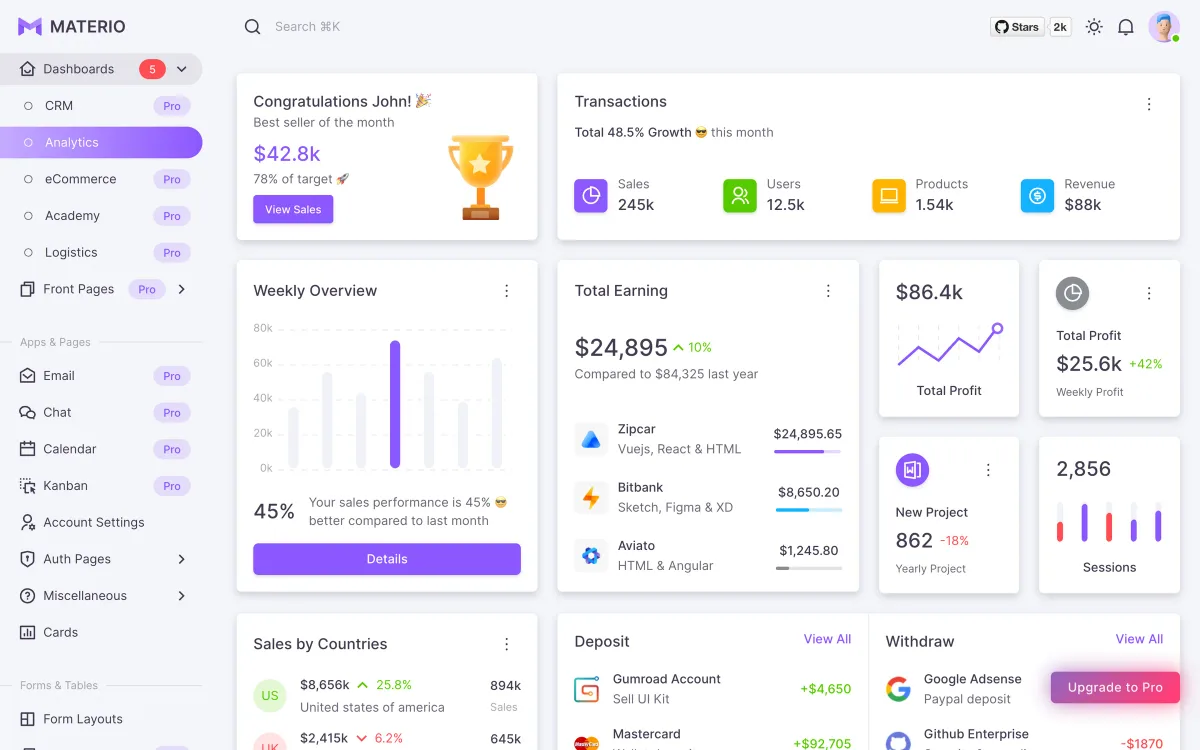
Materio’s free Next.js and MUI template from ThemeSelection had its latest release in June 2024 and commits in March 2026 on our check, MIT-licensed. Its stack is older than the others here: Next.js 14, MUI 5 and Tailwind CSS 3. It still looks polished and ships many layouts, but choosing it today means planning an early upgrade.
Admin frameworks: react-admin and Refine
Not every admin panel should start from a template. If your admin is mostly CRUD over an API — list, filter, create, edit, delete, with permissions — an admin framework can save more work than any visual template, because it handles data fetching, forms, validation and routing, not just layout.
- react-admin (Marmelab), release 5.15.4 on 25 September 2026, MIT-licensed. A mature framework for single-page admin apps on top of REST or GraphQL APIs, with Material UI components by default.
- Refine, core package 5.0.12 (April 2026) with commits in September 2026, MIT-licensed. A headless React framework for internal tools, admin panels and B2B apps that works with several UI libraries.
Both public demos sit behind demo logins or storefront examples, so we did not screenshot them. The trade-off is the reverse of a template: less visual starting point, much more data-handling structure. They also scale better when the admin grows: dozens of resources, role-based access and audit requirements are closer to what these frameworks were built for than to what a dashboard demo shows. The cost is a learning curve and a set of conventions your team has to accept.
How to choose: stack first, then everything else
The fastest way to narrow the list is to start from what your team already runs.
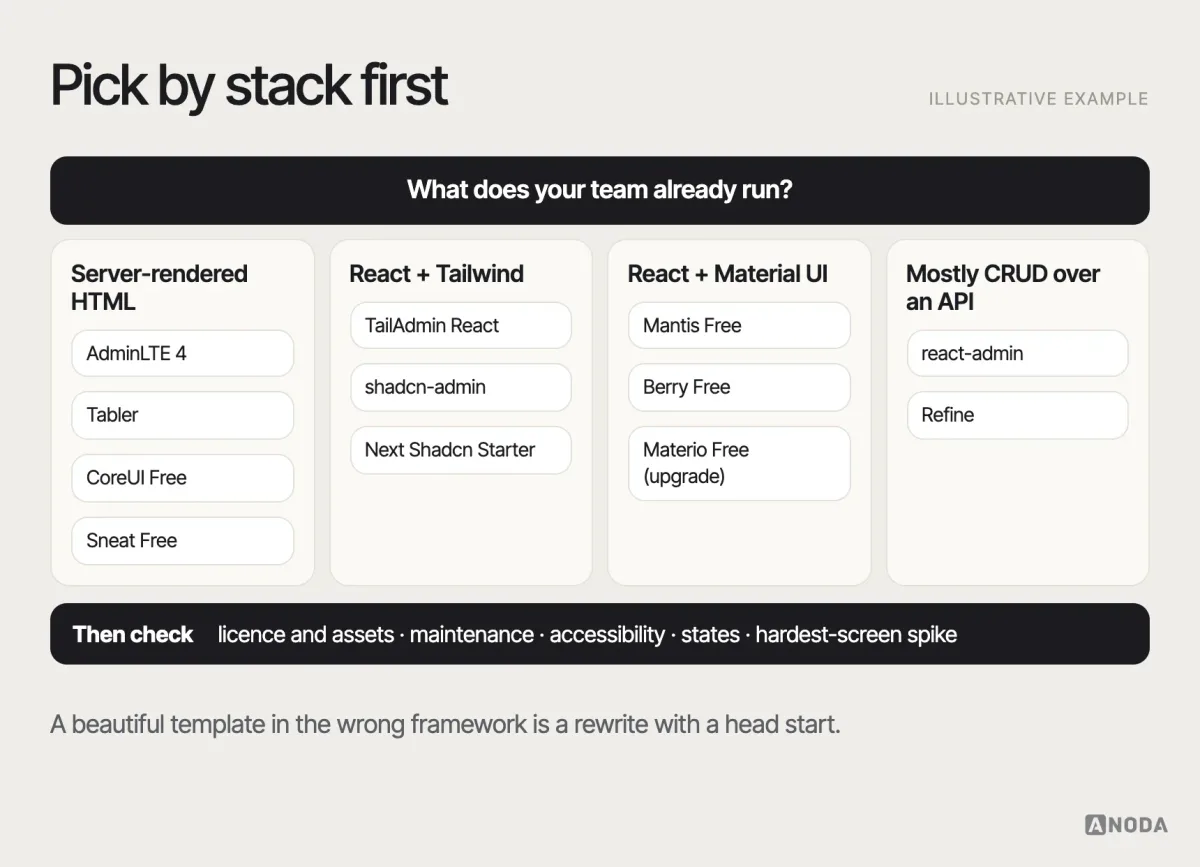
Then check four things for each candidate:
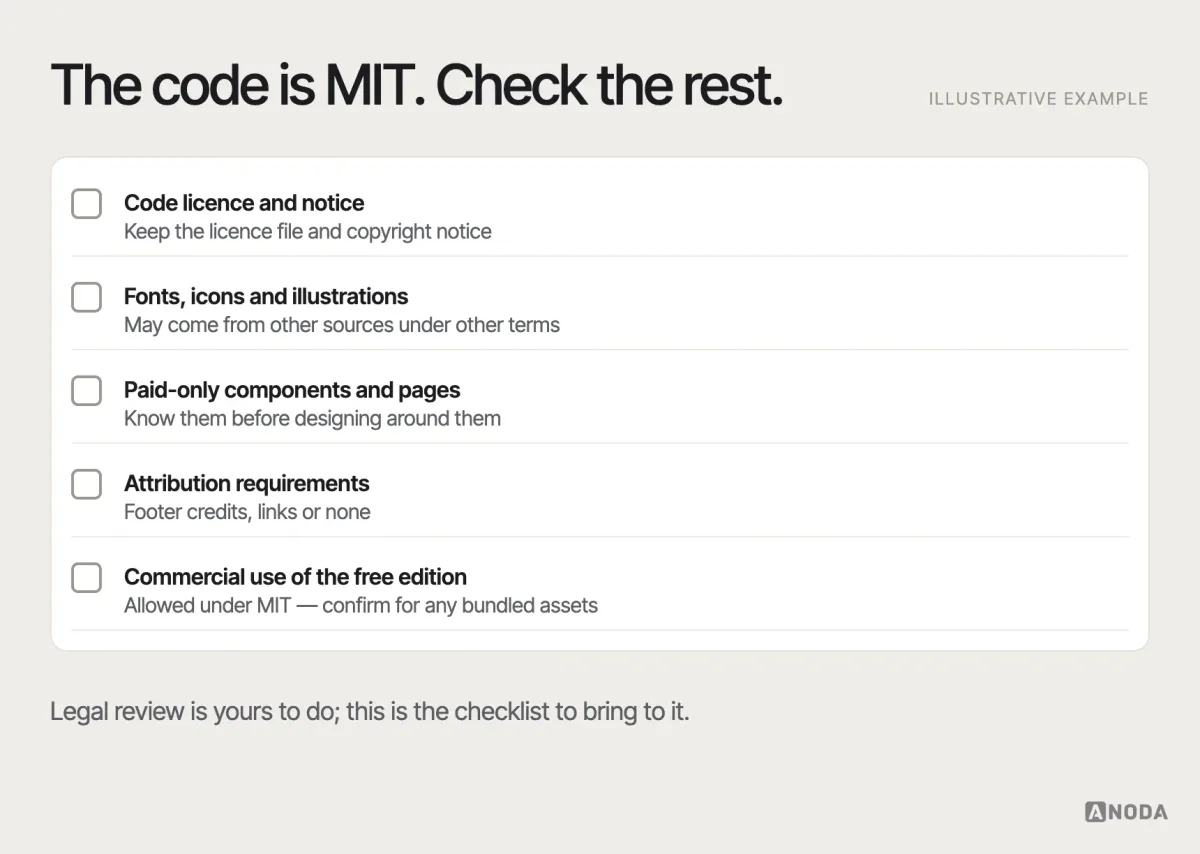
Licence. MIT covers the code in every option above, which allows commercial use with the licence notice kept. But check the assets separately: illustrations, icons, fonts and images in a template can come from other sources under other terms. And be clear about what is free and what is “Pro” before you design around a component.
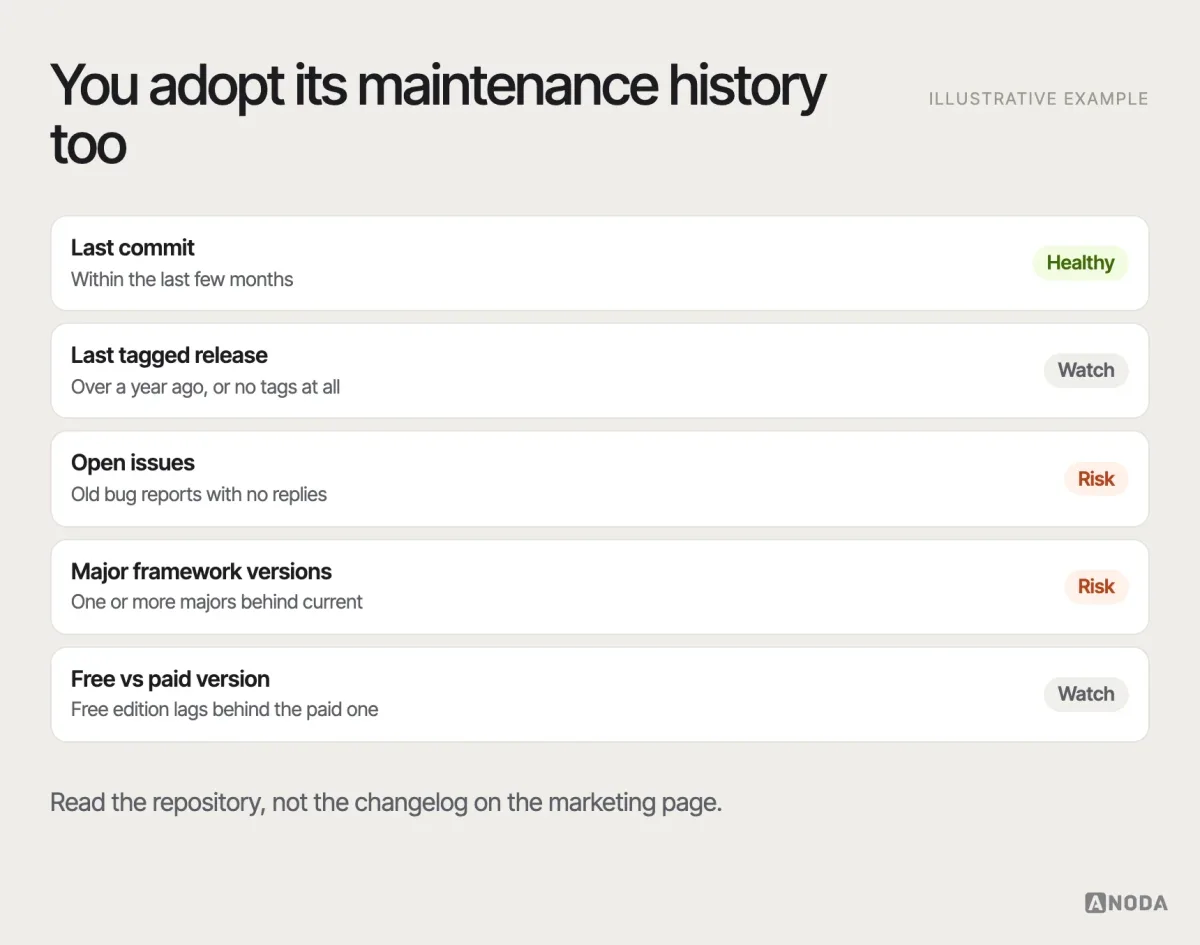
Maintenance. Look at the latest release, the latest commit, how issues are handled and how old the major dependencies are. A template on an old framework version is a migration you have scheduled without knowing it.
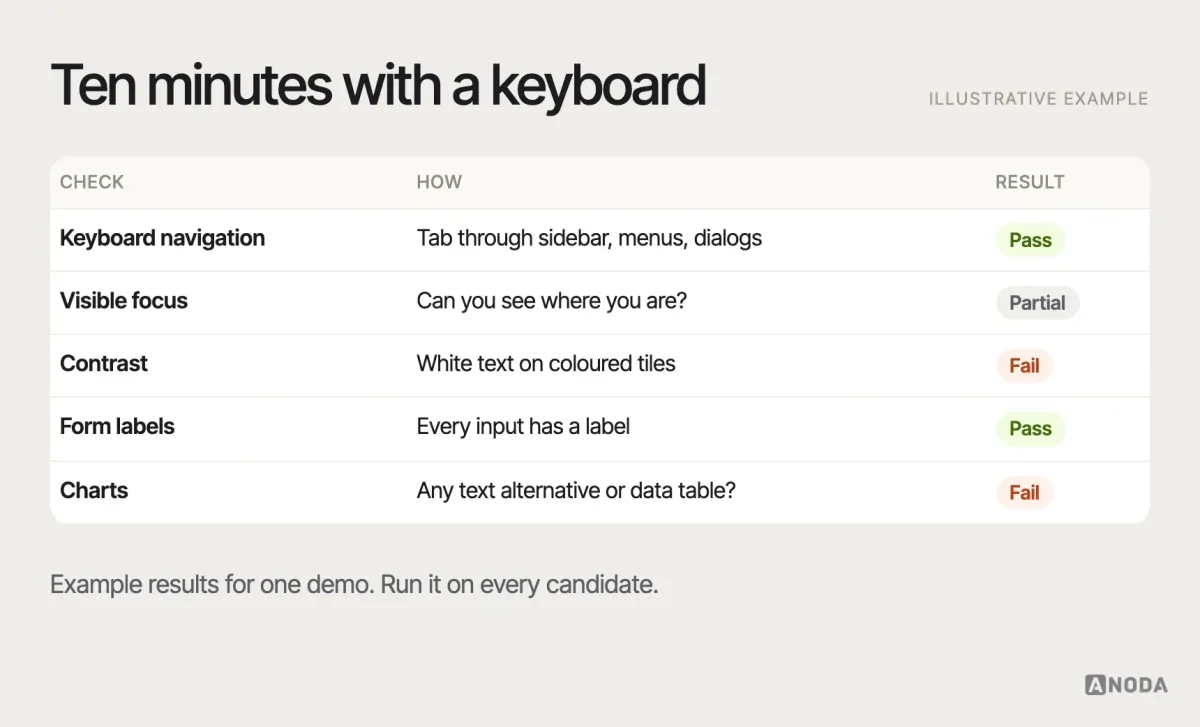
Accessibility basics. Demos rarely advertise accessibility, and many fall short. Check keyboard navigation through the sidebar, menus and modals; visible focus states; colour contrast of text on coloured cards; labels on form fields; and whether charts have any text alternative. Fixing these later across every screen is far more expensive than choosing a better base.
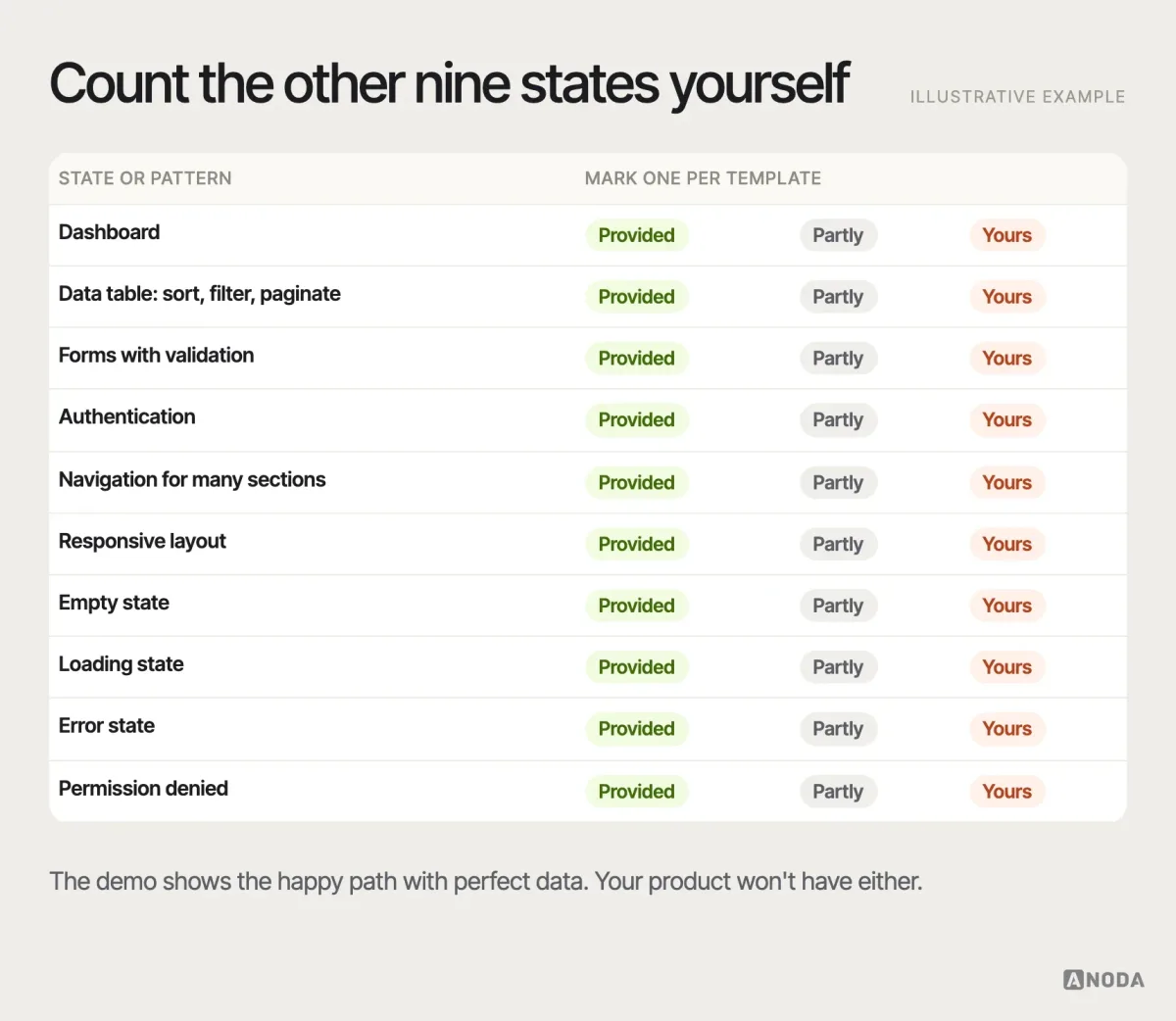
Coverage of the states your product needs. Demos show the happy path with perfect data. Your admin will need loading states, empty states, errors, permission-denied views, long values that break layouts, and tables with thousands of rows. Count what the template gives you and what you will design yourself.
Integrating a template into your codebase
How you bring a template into your project decides how painful it will be to live with.
Most admin templates are meant to be copied and owned: you clone the repository, delete what you don’t need and treat the rest as your code. That gives you full control and full responsibility — upstream fixes will not reach you automatically. A few pieces, such as component libraries underneath (Bootstrap, CoreUI, MUI, shadcn/ui primitives), stay as dependencies you update through your package manager.
Decide the boundary on day one. Keep the underlying libraries as dependencies you upgrade on a schedule. Treat the template’s layouts and pages as your own code from the first commit, rename them to your domain, and delete demo pages aggressively. Record which version of the template you started from, so you can compare against upstream later if you want to cherry-pick a fix. What you should avoid is the half-way state where the demo pages stay around “for reference”, slowly get copied into real features, and nobody knows which code is product and which is sample.
Theming and dark mode. Replace the demo theme with your own tokens — colour, typography, spacing, radius — before building features, not after. Most templates here support a dark theme in some form; check whether it is driven by tokens you can control or by hard-coded colours scattered through components, because that difference decides how painful your brand work will be.
Performance. Admin panels are often treated as internal and slow is tolerated. Your users still pay for it every day. Check the bundle size of the starting point, remove chart and plugin libraries you don’t use, and test the hardest screen with realistic data volumes. A template that feels instant with twenty demo rows can crawl with twenty thousand real ones.
Responsive reality and team skills
Every template here claims to be responsive, and every demo collapses its sidebar nicely on a phone. That is the easy part. The hard part is what happens to your densest tables, multi-column forms and side-by-side panels on a tablet or a small laptop — the screens many operators actually use. Test your hardest screen at those sizes, and decide deliberately which workflows need to work on mobile and which only need to be readable.
Match the template to the team as well as to the stack. A backend-heavy team will move fastest with a Bootstrap template and server-rendered pages. A frontend team fluent in React and Tailwind will be more productive owning shadcn-style components than fighting a theme it did not write. A team already fluent in Material UI will get more from its theming system than from a new visual language. The best template is often the one your developers can confidently change on a Friday afternoon.
A polished demo is not a design system
Every template demo looks finished, because demos are designed to look finished. It is worth being clear about what that polish is, and what it is not.
A demo is a set of example pages with sample data. A design system is a set of decisions: which components exist, how they behave in every state, how they combine into patterns for your workflows, which tokens define your brand, and how all of it is documented and maintained. A template gives you components and a visual style. It does not give you your patterns, your states or your rules — and its visual style belongs to someone else. That last point is easy to underestimate. Your customers see the same dashboard shell in dozens of other products; if your admin is customer-facing, looking like a free template is a small but real signal about how much care went into the rest.
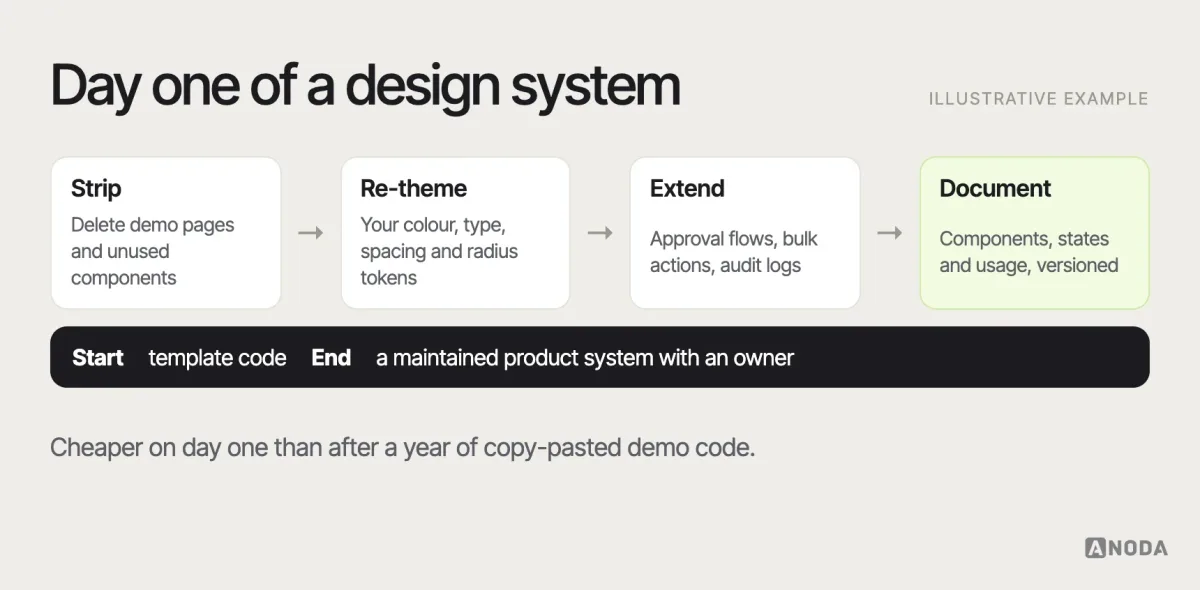
If the template is going to become the base of a long-lived product, plan the path from template to system early: replace the demo theme with your tokens, remove what you will not use, document the components you keep, and add the product-specific patterns the template never had. That is the work of a design system, and it is much cheaper to start on day one than to retrofit after a year of copy-pasted demo code.
Design systems
Chosen a template, and it is already turning into a patchwork?
We turn a generic starting point into a maintainable system for your real workflows: tokens, components, states and patterns your team can extend.
Prototype the hardest screen before you commit
The single most useful test of an admin template takes a day or two: build your hardest screen with it. Not the dashboard — the screen your users will spend most of their time on, with the most data, the most states and the most actions. A dense table with filters, bulk actions and inline editing. A multi-step approval. A record page with tabs, history and permissions.
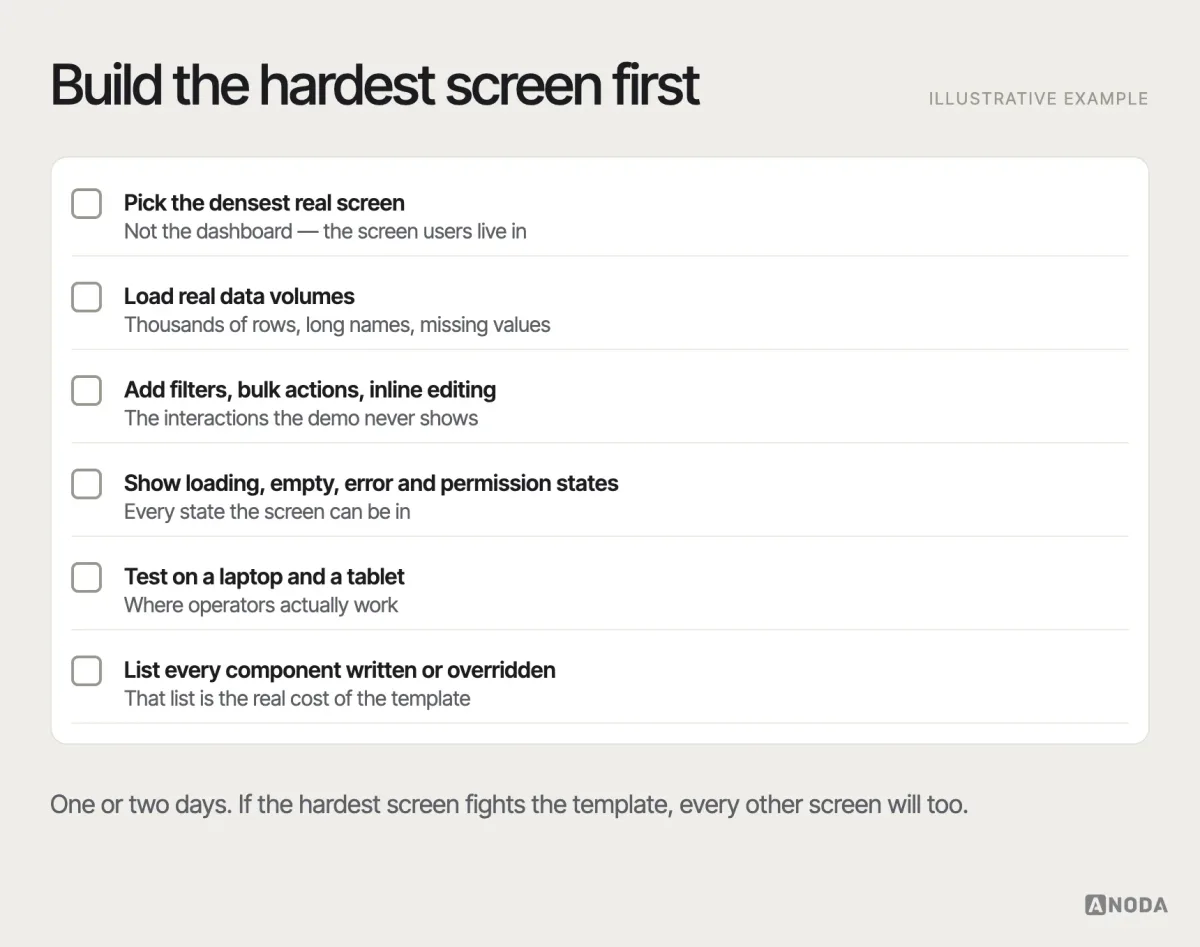
Count how many components you had to write from scratch, how many you had to override, and how much of the template’s layout you had to work around. If the answer is “most of it”, the template is not saving you time; it is lending you a structure you will pay to remove.
Run the spike on two candidates, not one, if the choice is close. The comparison is usually decisive within a day: one template bends to your screen, the other breaks. Keep the spike code — not as the start of the product, but as evidence for the decision and a list of the components you will need to build either way.
This is also where the template’s information architecture shows its limits. Most demos are organised around a generic dashboard, an e-commerce store or an analytics product. If your admin is built around approvals, tickets, bookings or compliance reviews, you will be redesigning the navigation and the page hierarchy anyway — and our guides to dashboard UI design and web dashboard design cover how to structure those decisions.
Which template fits which product
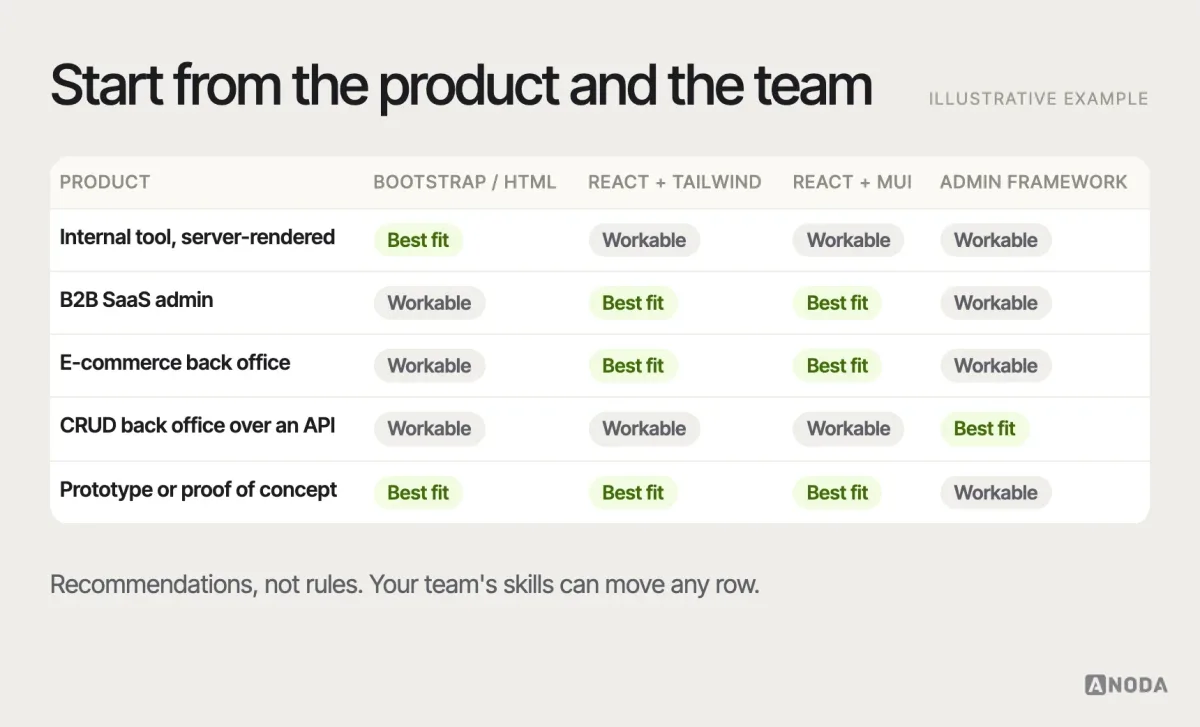
These are recommendations, not rules — the right answer always depends on your team and your product.
- Internal tools on a server-rendered stack: AdminLTE or Tabler. Lots of ready pages, easy for backend teams, stable Bootstrap foundation.
- A new B2B SaaS admin on React: shadcn-admin or the Next Shadcn Dashboard Starter if your team wants to own the components; TailAdmin if you want more ready pages.
- Teams standardised on Material UI: Mantis or Berry for current stacks; Materio only if you are ready to upgrade it.
- CRUD-heavy back offices over an existing API: react-admin or Refine, with your own visual layer.
- A quick prototype or proof of concept: almost any of them — just do not let the prototype’s template silently become the product’s architecture.
Questions to ask before you adopt a template
Before anyone runs git clone, answer these as a team:
- Who are the users of this admin, and what is the one task they do most? If nobody can answer, no template will help.
- Which framework and rendering model does our product already use? Pick templates on that stack only.
- Which screens will carry most of the work? Tables, records, approvals, bulk actions — list them before looking at dashboards.
- Which states and roles do those screens need? Empty, loading, error, partial data, permission denied; admins, operators, read-only users.
- What is free, what is paid, and which paid pieces are we likely to need? Price the upgrade before it becomes an emergency.
- Who will own the template code after the first week? A template without an owner becomes legacy code within a quarter.
- How will it become our design system? Tokens, components to keep, patterns to add, documentation.
If the answers are clear, a template is likely to save real time. If they are not, the problem is not which template to pick — it is that the admin’s workflows have not been designed yet.
When not to use a template at all
Sometimes the honest answer is none of the above. If the admin panel is central to your product’s value — the place where your customers’ operators spend their day — its information architecture and interaction patterns are part of what you sell. Starting from a generic dashboard shell pulls that product towards everyone else’s defaults.
The same applies when your domain is unusual: complex approval chains, dense operational data, regulated audit trails, real-time monitoring. Templates rarely have the patterns, and the effort of bending one to fit can exceed the effort of building a small, well-designed component set on top of a solid library.
And a note on security: authentication pages in a template are screens, not security. Login, password reset and two-factor flows still need proper implementation, session handling and review. Treat the template’s dependencies like any other — audit them, update them and remove what you don’t use.
The hidden costs of a free template
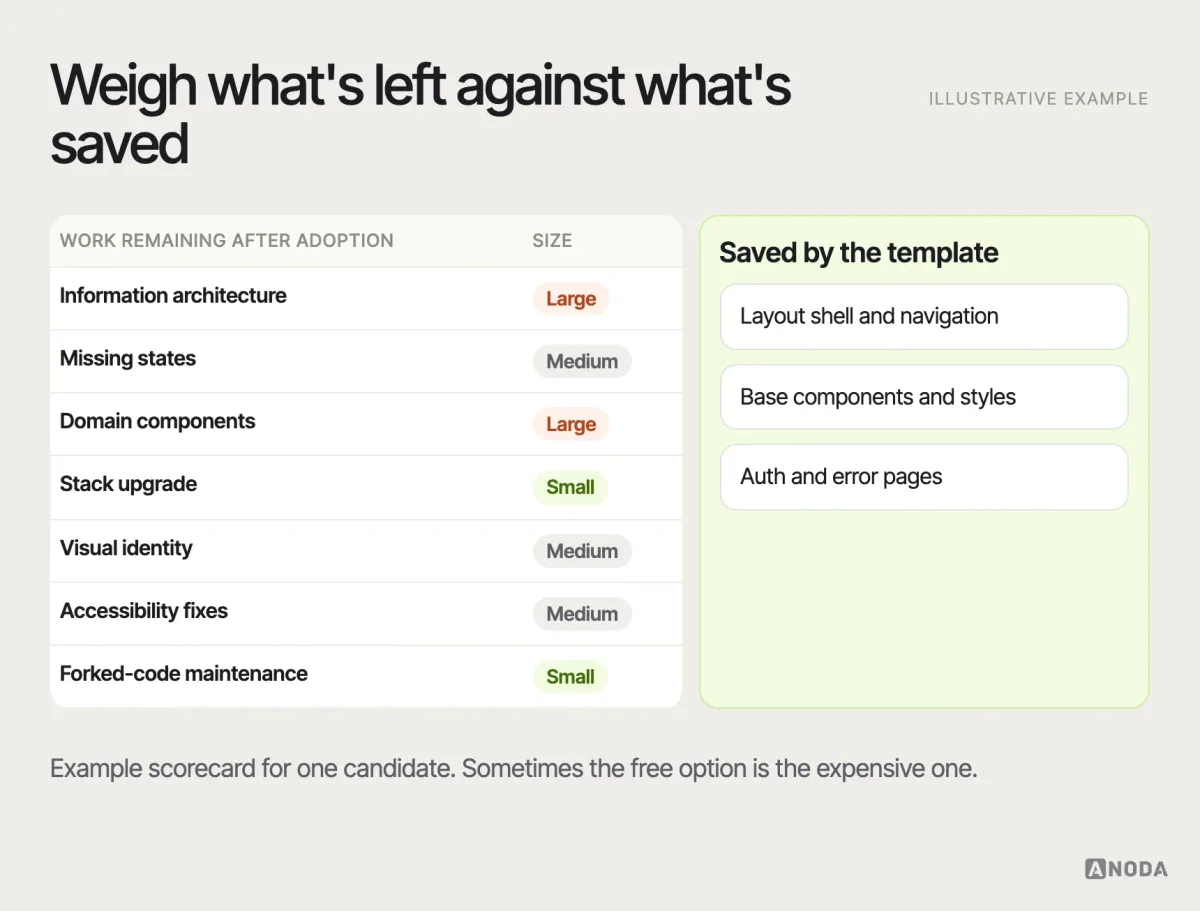
The template is free. These are not:
- Replacing the demo’s information architecture with one built around your users’ workflows.
- Designing the missing states: empty, loading, error, partial data, permission denied, long values.
- Building domain components the template never had: approval flows, audit logs, complex filters, bulk editing.
- Upgrading an old stack or unwinding abandoned dependencies.
- Replacing the visual identity so your product does not look like a thousand other dashboards.
- Accessibility fixes across every screen built on an inaccessible base.
- Maintaining forked code when the upstream template changes.
None of this means templates are a bad idea. For many teams they are exactly the right start. It means the decision deserves an hour of checks and a day of prototyping, not five minutes in a screenshot gallery. When the template stops being the question and the product’s roles, workflows and decisions become the real problem, that is a UI/UX design job — and for SaaS admin and operations products specifically, SaaS product design — rather than another round of template shopping. If the problem is getting the chosen foundation integrated, extended and hardened in code, that is frontend development.
Compare current, verified options on explicit criteria, prototype the hardest screen, and make sure your team can maintain and customise the foundation you choose. The best free admin template is the one you will still be glad you chose a year from now.

Dashboard UX
The template is not the hard part. Your workflows are.
We check whether a template fits your product, then design the roles, states and screens it cannot give you — and adapt the foundation into a system your team can keep building on.
Written by